
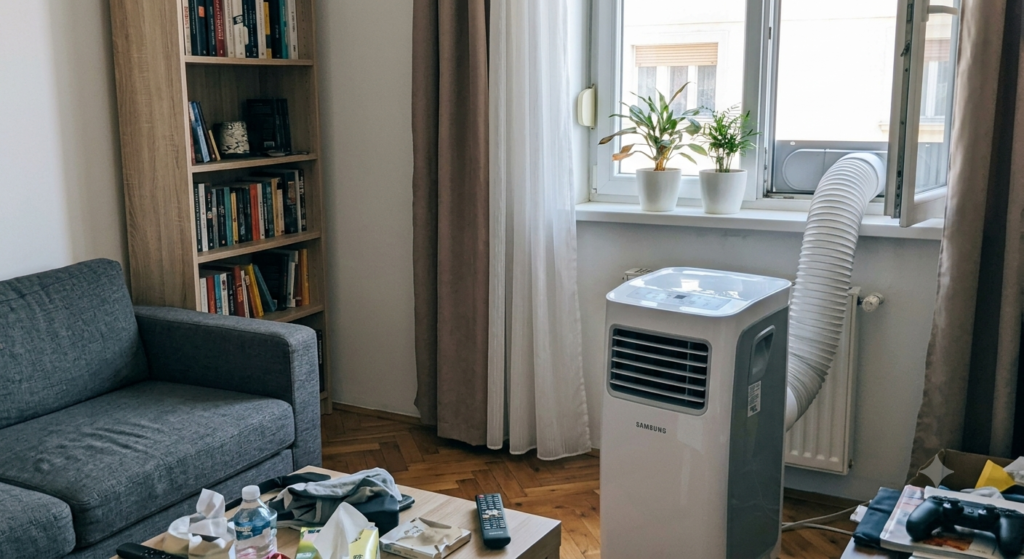
Here’s a confession: I bought a 14,000 BTU portable AC once and it barely touched a 300 square foot room.
That’s not a defect story. That’s a labeling story. Every portable AC sold today carries two different BTU numbers, and the big one on the box — the one that makes the unit look powerful — is the one you should mostly ignore.
Disclosure: This post contains affiliate links. If you buy through them, I earn a small commission at no extra cost to you. I only recommend products I’d use myself.
The Two Numbers in This Portable AC Buying Guide
ASHRAE BTU is the old rating. It’s measured in a lab at 80°F, ideal conditions, no exhaust hose losing cool air, no warm air sneaking back through door gaps. It’s the number manufacturers put in the product title because it’s the bigger one.
SACC — Seasonally Adjusted Cooling Capacity — is the newer DOE-mandated rating. It accounts for what happens in your room: the hose radiating heat, negative pressure pulling warm air in through cracks, real humidity instead of a lab’s 51%. SACC is almost always 25-35% lower than the ASHRAE number on the same unit. A “14,000 BTU” unit might carry a SACC of 9,000-10,000. Same machine. Different math.
Manufacturers aren’t hiding this — it’s required disclosure — but they’re not making it easy to find either. The big number stays on the box. The honest number is in the spec sheet, sometimes in parentheses, sometimes on a separate line you have to scroll to find.
Why This Actually Matters When You’re Shopping
If you compare two units by their ASHRAE number, you might pick the one that’s actually weaker in your room. A dual-hose unit with a lower ASHRAE rating can out-cool a single-hose unit with a bigger number, because single-hose units create negative pressure that pulls warm air back in through every gap in your window and door frame. Dual-hose doesn’t have that problem — it draws intake air from outside instead of your already-cooled room.
So the rule I’d give a friend: compare by SACC, not by the number in the product title. If a listing only shows ASHRAE, that’s often a sign the SACC number would embarrass them.
Single-Hose vs. Dual-Hose — The Decision That Matters More Than BTUs
Single-hose units are cheaper and fine for small rooms or occasional use — a home office, a bedroom you’re only cooling at night. They exhaust air out the window, and the room “inhales” replacement air from wherever it can find it, which is usually warm.
Dual-hose units cost more but close that loop. One hose pulls in outside air for the compressor, the other exhausts it, so your room air stays yours. For anyone in a hot climate running the unit most of the day, the price difference pays for itself in performance you can actually feel.
Three Units, Three Budgets
👉 SereneLife 8,000 BTU Portable AC — $220
Single-hose, 3-in-1 cooling/fan/dehumidifier — right for a bedroom you only run at night, not fighting negative pressure for 12 hours straight.
Check Price on Amazon →
👉 Midea Duo 12,000 BTU Dual-Hose Inverter — $549
The one I’d point most people to — dual-hose, inverter compressor, honestly disclosed 10,000 SACC rating, covers up to 450 sq ft.
Check Price on Amazon →
👉 BLACK+DECKER Smart 14,000 BTU — $500
10,200 SACC that holds up well against its ASHRAE number — a sign of genuinely efficient design, covers up to 700 sq ft.
Check Price on Amazon →
Sizing Without Getting Fooled
Forget “one BTU per square foot” internet math — it ignores ceiling height, sun exposure, and how many people are in the room. Rough starting point using SACC, not ASHRAE:
- Small room, 150-250 sq ft: 6,000-8,000 SACC
- Medium room, 250-400 sq ft: 8,000-10,000 SACC
- Larger room, 400-550 sq ft: 10,000-12,000 SACC
Kitchen, direct sun, or multiple people in the room regularly — size up one tier. A unit that’s slightly oversized cycles more efficiently than one that’s undersized and runs constantly without ever catching up.
What Else Actually Moves the Needle
Drainage. Some units are “drainage-free,” using the compressor heat to evaporate condensate through the exhaust hose. In humid climates, that’s marketing more than reality — you’ll still empty a tank. Look for how often, not whether.
Noise. Compressor-driven units run 50-55 dB at typical settings. If the room is a bedroom or home office, that number matters more than most spec sheets suggest — look for it explicitly listed, not just “quiet” in the title.
Smart controls. App and voice control are now standard, not premium — worth having, not worth paying much extra for.
Where This Lands
Ignore the number in the product title. Find the SACC. Compare units by that number, favor dual-hose if you’re running it daily, and size one tier up if the room gets direct sun. That’s the whole decision — everything else on the spec sheet is secondary. If you’re also outfitting the rest of the kitchen this season, my appliance buying guides cover the same no-nonsense approach for other categories — including my French door refrigerator buying guide.
THE BOTTOM LINE
Ignore the ASHRAE number on the box — it’s a lab rating, not a room rating. Find the SACC number, compare units by that, favor dual-hose if you run it daily, and size one tier up if the room gets direct sun.
Cheers,
Kazaan
Pingback: Dehumidifier Buying Guide: The Pint Capacity Myth
Pingback: Space Heater Buying Guide: Safety Before Price