
- Tip-Over and Overheat Protection Are Non-Negotiable
- Ceramic vs Radiant vs Oil-Filled: Match the Tech to the Room
- Wattage and Room Size, Without the Guesswork
- The Cost Math People Skip
- Where the Efficiency Claims Fall Apart
- Space Heater Buying Guide: My Take
- Placement Mistakes That Cause the Most Problems
- Ceramic Isn’t Inherently Safer: Here’s What Actually Is
- The Extension Cord Rule Nobody Follows
- A Decision Rule You Can Use Without a Link
- What I Would Not Buy
Space heaters cause thousands of house fires every year in the US, and almost every one of those cases traces back to the same handful of preventable mistakes. Before we talk efficiency, we’re talking safety, because that part isn’t optional. This space heater buying guide leads with safety on purpose, because the stakes here are genuinely higher than most kitchen appliances.
This post contains affiliate links. If you click and buy, I may earn a small commission, at no extra cost to you.
Tip-Over and Overheat Protection Are Non-Negotiable
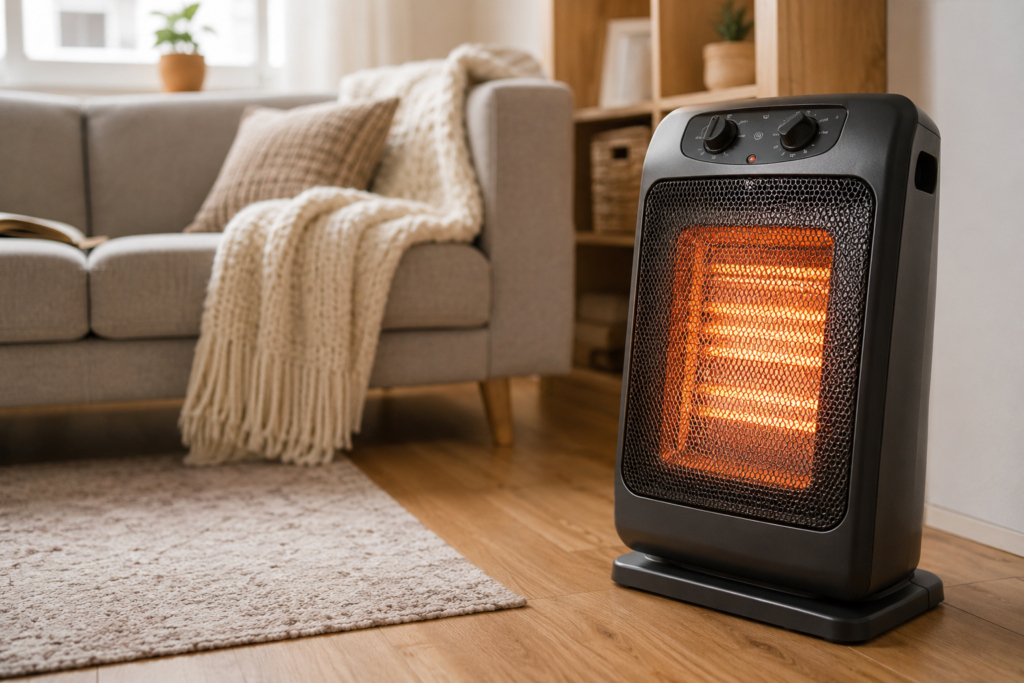
Any space heater you buy in 2026 should have automatic shutoff if it tips over, plus an overheat sensor that cuts power if internal temperature climbs too high. If a listing doesn’t explicitly mention both features, skip it. This isn’t a nice-to-have, it’s the baseline that separates a safe appliance from a liability.
👉 DREO Quiet Space Heater, 1500W, with Remote, $59.45
Tip-over protection isn’t a nice-to-have here, it’s the feature that actually prevents this thing from becoming a fire hazard.
Check Price on Amazon →
Ceramic vs Radiant vs Oil-Filled: Match the Tech to the Room
Ceramic heaters warm the air quickly and work best in smaller, occupied rooms where you want fast heat. Radiant (infrared) heaters warm objects and people directly rather than the air, which makes them efficient in drafty or larger spaces since they don’t lose effectiveness to air movement. Oil-filled radiators heat slowly but hold warmth long after they’re switched off, which makes them a strong overnight option in bedrooms if you want low ongoing noise and stable heat.
👉 JIBUFI Ceramic Fan Heater, Portable, Remote Control, $39.98
Small footprint, fast heat-up, the pick for a single room where you don’t need to heat more than what’s right in front of it.
Check Price on Amazon →
Wattage and Room Size, Without the Guesswork
A rough rule: 10 watts per square foot for a room with average insulation. A 150 sq ft bedroom needs roughly 1,500 watts, which happens to be the max most units are legally capped at on a standard household circuit. If your space is bigger than that, you’re better off with two smaller units in different outlets than one heater straining at its limit.
👉 Amazon Basics Portable Oil Radiator Heater, 3 Heat Settings, $71.99
Oil-filled radiators heat slower but hold that heat longer and run quieter, the better call for a room you’re in for hours.
Check Price on Amazon →
The Cost Math People Skip
A 1,500W heater running 8 hours a day adds up fast on your electric bill. This is a supplemental heat source for one room, not a central heating replacement. If you’re trying to heat a whole floor, you’re better off addressing insulation or your actual HVAC system. Space heaters win when the problem is one cold room, not a cold house.
Where the Efficiency Claims Fall Apart
Every electric resistance heater turns essentially all the electricity it draws into heat. A 1,500 watt ceramic, oil-filled and infrared heater all deliver about 5,100 BTU per hour. The difference between them is how and where that heat reaches you, not how much of it exists. So a box that advertises energy saving is describing the thermostat and the placement, not the physics. A heater that cycles off at a set temperature will use less than one that runs all day, but that comes from the thermostat, not the heating element.
Now put a price on it. Run a 1,500 watt heater for eight hours and it uses 12 kWh. At about 17 cents per kWh that is roughly $2 a day, or $60 over a 30-day month. Heat only the room you are sitting in and let the thermostat do its job, and the real number drops. Try to heat a whole floor with it and you will see the difference on the bill.
Space Heater Buying Guide: My Take
Small room, want it warm fast → ceramic with tip-over and overheat protection, no exceptions. Drafty or larger space → infrared/radiant. Bedroom, overnight use, care about quiet → oil-filled radiator. Always plug directly into a wall outlet, never an extension cord. That single habit prevents most of the fire risk this category carries.
Placement Mistakes That Cause the Most Problems
Even a well-built unit becomes a hazard in the wrong spot. This space heater buying guide would be incomplete without covering placement: keep at least 3 feet of clearance from curtains, bedding, furniture, and anything flammable, on all sides, not just the front. Never place one on a rug or carpet unless the manufacturer specifically rates it for that use, and never leave one running unattended in a room with pets or small children who could knock it over despite tip-over sensors.
Placement also affects performance, not just safety, a heater tucked behind furniture or in a corner has to work harder to heat the same space, which means higher energy use for a worse result.
Ceramic Isn’t Inherently Safer: Here’s What Actually Is
Ceramic heaters aren’t inherently safer than infrared or oil-filled types, real safety comes from the tip-over shutoff and overheat protection features, not the underlying heating technology. This space heater buying guide treats those two features as non-negotiable across every type for exactly that reason: they’re the actual variable that determines whether a unit is safe, not the marketing language around “ceramic technology” or similar. Look for UL or ETL certification on the box too, it’s a genuine third-party safety testing standard, not just a logo.
Cool-touch exteriors are worth checking if you have kids or pets in the house, some models keep the outer housing genuinely cool to the touch even during operation, while others get hot enough to burn on contact within seconds.
The Extension Cord Rule Nobody Follows
Never run a space heater on an extension cord, always plug directly into a wall outlet. Extension cords are one of the most common causes of space heater-related house fires, because most household extension cords aren’t rated for the sustained high current a space heater draws, and the connection point heats up over time, sometimes without any visible warning before it fails. If the outlet you need is genuinely too far from where the heater needs to sit, that’s a sign you need an electrician to add an outlet, not a workaround with a cord rated for a lamp.
Balancing heating and cooling needs in the same home? Our portable AC buying guide covers the other half of that equation. For safety standards behind these ratings, Wikipedia’s space heater overview is a helpful reference.
A Decision Rule You Can Use Without a Link
If one occupied room is cold and you want heat fast, buy a ceramic fan heater sized at about 10 watts per square foot. If you want quiet, steady warmth through the night, buy an oil-filled radiator. If you sit at a desk and want warm legs right now, buy a radiant heater and point it at yourself. If more than one room is cold, the problem is the house, not the heater.
What I Would Not Buy
I would not buy a heater with no safety certification mark such as UL or ETL on the product page. I would be suspicious of any plug-in heater that claims more than 1,500 watts. A standard 15-amp household circuit tops out at 1,800 watts, and the plug and cord are built around that limit. I would also not buy a tiny personal heater and expect it to warm a bedroom. Low wattage means low heat output, and no marketing line changes that. And I would never trust a heater that I need to plug into an extension cord to make it reach.
THE BOTTOM LINE
Tip-over and overheat protection are non-negotiable no matter your budget. Beyond that: ceramic fan heaters warm a small room fast, oil-filled radiators hold heat longer and quieter for overnight use.
Cheers, Kazaan.