
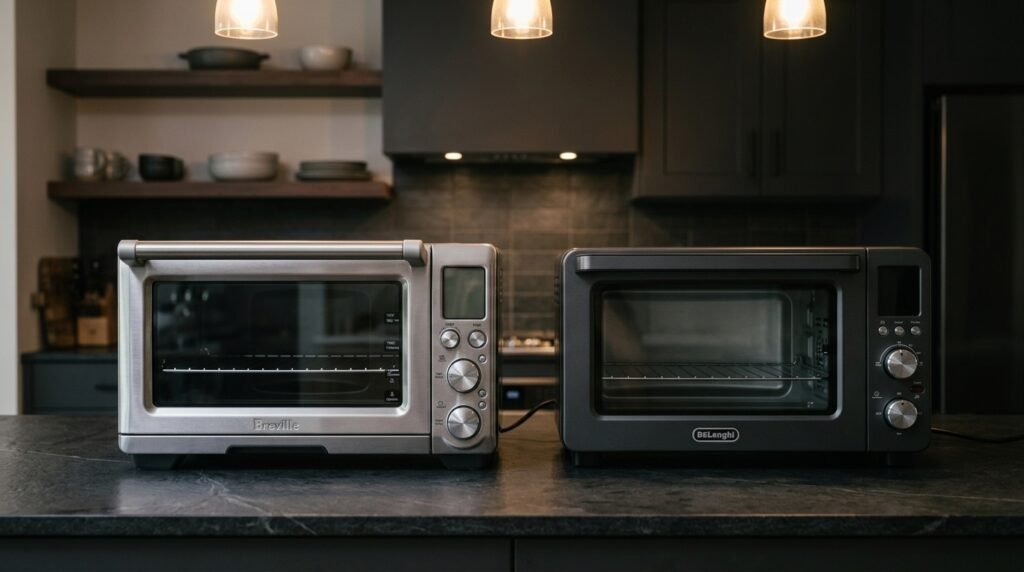
Breville and De’Longhi compete head-to-head across nearly every espresso price point — and in many of their mid-range machines, they’re both quietly using the same Italian-made pump component to do it.
This post contains affiliate links. If you click and buy, I may earn a small commission — at no extra cost to you.
Two Different Companies Solving the Same Problem Differently
Breville is an Australian company that entered the espresso market targeting the mid-to-high end — machines that look and feel premium, priced to match. De’Longhi is an Italian manufacturing giant with a much broader footprint, selling everything from budget-friendly basics to some of the most expensive automatic machines on the market. That difference in company positioning shows up in the product range: Breville’s lineup runs roughly $300 to $2,800, with the bulk of its machines clustered in the $600–$800 range. De’Longhi’s range is wider and more evenly spread — $300–$400 for the entry-level Dedica line, $750–$1,300 for the La Specialista range, and $1,700–$2,500 for the PrimaDonna and Eletta automatic lines, which actually run higher than almost anything Breville sells.
The Part Both Brands Actually Share
Here’s the detail that undercuts a lot of brand-loyalty arguments before they even start: in many of their mid-range machines, both Breville and De’Longhi use the same 15-bar Ulka vibration pump, manufactured in Italy. Ulka is a specialized pump manufacturer that supplies much of the espresso machine industry — it’s not a Breville part or a De’Longhi part, it’s an industry-standard component that both companies buy from the same source and build their own machines around.
That matters because it means the actual pressure-generating heart of a mid-range machine from either brand is frequently the same physical component. The differentiation between the two brands isn’t happening at that level — it’s happening in what each company builds around that shared core.
Where Breville’s Money Goes
Breville differentiates primarily through electronics and heating system engineering: more precise digital temperature control, PID systems on higher-tier models, and interface refinement — LCD or touchscreen displays, programmable presets, and details like drip tray fill indicators and magnetic tamper storage that read as thoughtful rather than decorative. The build quality across the range leans heavily stainless steel, which is part of why Breville rarely goes much below roughly $300 even at the entry tier — the material and the electronics both cost more than a comparable plastic-bodied entry machine.
👉 Breville Barista Express — ~$600–$700
the clearest expression of what Breville’s premium actually buys — a built-in grinder paired with precise digital temperature control and manual tamping, in the price zone where Breville is most competitive.
Where De’Longhi’s Money Goes
De’Longhi’s differentiation runs the opposite direction: proven mechanical simplicity over electronic sophistication, particularly at the lower and middle tiers. Entry-level De’Longhi models use more plastic in their construction specifically to hit a lower price floor, while the brand’s premium tiers — La Specialista and above — match Breville’s build quality with metal construction and comparable attention to detail. The consistent thread across De’Longhi’s range, low price to high, is a design philosophy that favors fewer things that can go wrong internally over maximum feature density.
👉 De'Longhi La Specialista Arte — ~$750–$800
De’Longhi’s direct answer to the Barista Express at the same price zone — Smart Tamping and dual heating systems built around the same mechanical-simplicity philosophy that runs through the rest of the De’Longhi lineup.
Repairability: The Trade-Off Underneath the Price
This is the part that doesn’t show up in a spec sheet comparison. Breville’s advanced electronic controls and heating systems are genuinely capable, but they add complexity that makes DIY repair less accessible when something eventually fails — you’re more likely to need authorized service. De’Longhi’s mechanical-first approach, especially on its simpler manual and semi-automatic lines, tends to be more straightforward to service and repair, which matters over the 5–10+ year ownership window most people expect from a machine at this price.
Neither approach is objectively wrong. It’s the same trade-off you see across a lot of consumer electronics: more sophisticated control systems generally mean more capability up front and more dependency on the manufacturer’s service network later.
👉 De'Longhi Dedica Arte — ~$300–$400
represents De’Longhi’s actual price floor — a genuinely lower entry point than anything comparable from Breville, at the cost of a simpler build and fewer electronic features.
Decision Framework
Choose Breville if precise digital temperature control and a more premium stainless-steel build matter to you, and you’re comfortable with a narrower but more electronically sophisticated price band clustered around $600–$800.
Choose De’Longhi if you want the widest possible range of entry points under one trusted brand — from a genuinely sub-$400 option up through a $2,500 automatic — or if straightforward mechanical repairability matters more to you than advanced digital controls.
What I Wouldn’t Buy
I wouldn’t assume a higher Breville price tag automatically means a better-made machine than a comparable De’Longhi — in the shared mid-range price zone, both brands are frequently building around the exact same core pump component, so you’re paying for the surrounding engineering philosophy, not a fundamentally different foundation.
I also wouldn’t buy De’Longhi’s cheapest Dedica-tier machine expecting Barista Express-level temperature precision — that’s exactly the gap the lower price reflects, and it’s a reasonable trade-off only if simplicity and price matter more to you than control.
THE BOTTOM LINE
Breville and De’Longhi frequently build around the same core Italian-made pump, so the real difference between them isn’t some hidden quality gap — it’s engineering philosophy. Breville spends its money on electronic precision and premium build, concentrated in the $600–$800 zone. De’Longhi spans a much wider price range with a mechanical-simplicity philosophy that tends to be easier and cheaper to repair over time. Pick based on which trade-off — electronic sophistication versus mechanical simplicity — actually matters for how long you plan to own the machine.
Before comparing these two brands specifically, our drip vs espresso vs pod breakdown is worth a read, and if the $800 semi-automatic tier interests you, semi-automatic vs super-automatic espresso goes deeper on exactly that stack.
Cheers, Kazaan.