
This is for anyone switching to induction, or seriously considering it. Good. Induction cooking is having its moment — energy efficiency, speed, safety — and the case for switching from gas or electric looks strong on paper.
But researching this takes 10 minutes. Fixing the wrong purchase takes months. Wrong cooktop for your cookware. Wrong size for your household. Wrong installation for your kitchen. This guide exists to prevent that.
Disclosure: This post contains affiliate links. If you buy through them, I earn a small commission at no extra cost to you. I only recommend products I’d use myself.
How It Actually Works
Induction doesn’t heat the cooktop surface. It heats the pan directly. Electromagnetic coils under the glass generate a magnetic field that creates heat inside compatible cookware — only where the pan sits, only while the pan is on it.
This is why induction is faster (energy goes directly into the food, not lost to the air), more efficient (up to 3x the energy efficiency of gas), and safer (the surface itself stays cool — you can touch it right after cooking without burning yourself).
The catch: it only works with magnetic cookware. Cast iron, stainless steel with a magnetic base, and most carbon steel pans work perfectly. Aluminum, copper, and glass cookware do not — unless they have a magnetic induction layer added to the bottom.
One thing is non-negotiable: test your existing pans with a magnet. If a magnet sticks firmly to the bottom, the pan works. If it doesn’t stick — or sticks weakly — you’ll need new cookware. Factor that cost into your budget.
Portable vs Built-In
Induction cooktops come in two main formats. The choice here determines your budget range, installation complexity, and how permanent this decision is.
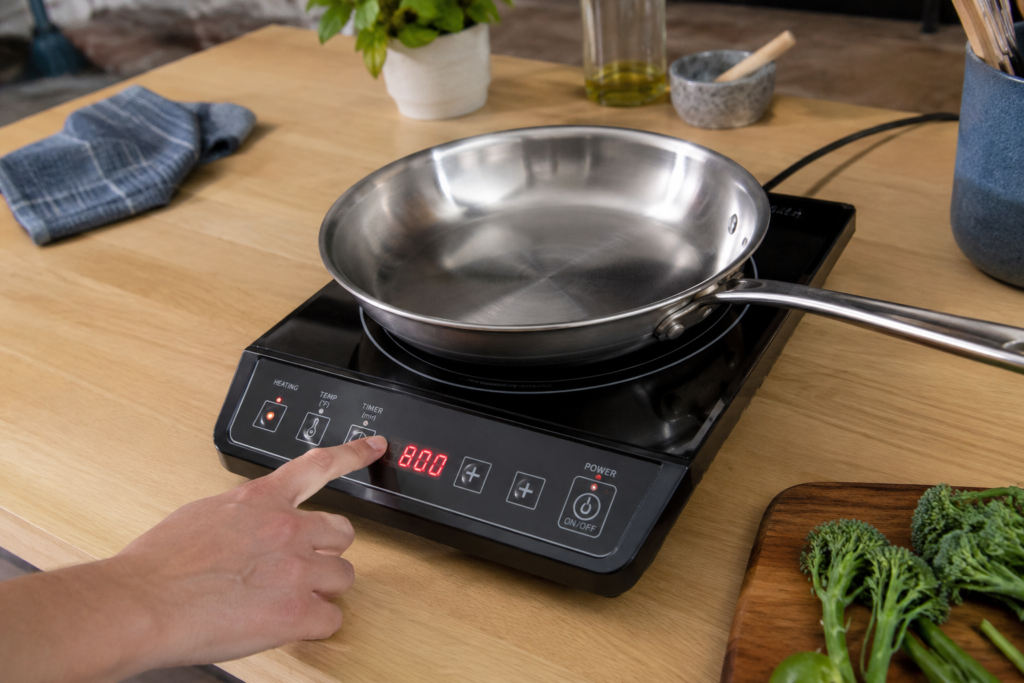
Portable/countertop induction cooktops are standalone single or double-burner units you plug into a standard outlet. They range from $30 to $200. No installation required. Great for testing induction before a full commitment, adding a second cooking zone during large meals, or use in small apartments with limited cooking space.
Built-in induction cooktops replace your existing cooktop, require professional installation and a 240V outlet, and typically run $500–$2,500+. They’re a permanent fixture with 2–6 burners, flexible zone configurations, and bridge functions that let two zones work as one large burner for griddles or fish pans.
My recommendation: if you’re renting or just testing, start portable. If you own your home and cook seriously, built-in is the long-term solution.
6 Things That Actually Matter
1. Wattage Per Burner
This directly determines how fast and how hot each burner can get. For serious cooking — searing steaks, boiling large pots of water quickly — you want at least 1800W per burner. The best built-in models offer 3000–3700W on their power burner zones.
Budget portable units often cap out at 1300W. That’s enough for everyday cooking but noticeably slower for high-heat tasks. If boil times matter to you (and they should — a 3700W burner boils water significantly faster than a 1300W one), don’t buy the cheapest portable.
2. Number of Burners and Zone Configuration
Standard built-in 30-inch models have 4 burners — the same as most gas or electric ranges. But induction gives you more flexibility. Flex-zone configurations allow burners to extend and combine, useful for large pans or griddles. Some European models like Miele and Bosch offer full-surface induction where any pan placed anywhere on the surface is detected and heated.
For a household that regularly cooks 3–4 dishes simultaneously, a 4-burner model is the minimum. If you frequently use large roasting pans or griddles, look for a model with a bridge function or a wider 36-inch format.
3. Temperature Precision and Control
This is where induction genuinely beats gas and electric. The response time from high to low (or vice versa) is near-instant. You can melt chocolate at 115°F without burning it, then switch to a rolling boil two minutes later on the same burner.
Better models offer 20+ temperature settings across the range. Budget models often have 9–10 settings, which is functional but limits precision. If you cook anything that requires temperature control — candy making, tempering chocolate, low-and-slow reduction — prioritize models with more granular control.
4. Pan Detection and Safety Features
All induction cooktops include auto shutoff when no pan is detected. Good models add pan size detection (automatically matching the heating zone to your pan’s diameter), overflow protection, and child lock.
One thing to check: minimum pan size detection. Some budget models won’t activate unless the pan covers a minimum diameter. If you use small sauce pans or espresso pots, verify the cooktop supports them before buying.
5. Noise
Induction cooktops can produce a faint hum or buzz from the electromagnetic coils, particularly at high power settings. This varies significantly between brands and models. Budget portable units tend to be noisier. Premium brands like Miele and Bosch are designed for quiet operation — nearly silent at most settings.
If you have an open-plan kitchen where cooking noise carries into living or dining areas, this matters more than the spec sheet suggests. Check owner reviews specifically mentioning noise before finalizing your choice.
6. Installation Requirements
Built-in induction cooktops require a 240V dedicated circuit, professional installation, and proper ventilation — my range hood buying guide covers CFM sizing if you’re pairing this with new ventilation. If your current setup runs on gas, you’ll need an electrician to upgrade the outlet — budget $150–$400 for that alone.
Also check cutout dimensions carefully. Standard 30-inch cooktop cutouts are similar across brands, but exact dimensions vary by model. Measure your existing cutout before ordering.
Gas vs Electric vs Induction
Gas still has advocates for good reasons. Visual flame feedback, works during power outages, compatible with any cookware, and many chefs prefer the control it gives for wok cooking and high-heat charring. Downside: lower energy efficiency (~40%), indoor air quality concerns from combustion byproducts, and harder to keep clean.
Electric (coil or ceramic) is the budget default. Slower to heat up, slower to cool down, less precise than induction. The main advantage: compatible with all cookware and the cheapest to install if you already have a 240V outlet.
Induction wins on speed (boils water faster than gas), energy efficiency (85–90% vs gas’s ~40%), safety (cool-to-touch surface), and precision. The compromises: requires compatible cookware, requires electricity (no cooking during power outages), and premium models are expensive.
My bottom line: if you’re building or renovating a kitchen and you have the budget for induction, it’s the right long-term choice for most households. If you’re replacing a broken cooktop on a tight timeline, electric radiant is the pragmatic short-term solution.
Induction Cooktop Buying Guide: My Picks by Budget
Best Portable (Under $80): NUWAVE PIC Gold (~$108)
👉 1500 watts, temperature range from 100°F to 575°F in 10-degree increments, and a 6-hour programmable timer. More precise temperature control than most portable competitors — great for testing induction or adding an extra burner.
Check Price on Amazon →
Best Mid-Range Built-In: Bosch 800 Series NIT8068SUC (~$1,299)
👉 SpeedBoost technology (3,700W on the power zone), FlexInduction that combines two burners for large pans, 17 power settings per zone, and pan size detection that actually works. Professional installation and a 240V circuit required.
Check Price on Amazon →
Best Premium Built-In: Miele KM 7574 FL (~$1,925+)
👉 Full-surface induction with TempControl — a sensor in the base monitors actual cooking temperature and adjusts power automatically. Virtually silent. The benchmark if you’re doing a full kitchen renovation.
Check Price on Amazon →
Cookware You’ll Need
This is the hidden cost most buyers miss. If you’re switching from gas or standard electric and your current cookware is aluminum or copper, you’ll need to replace it.
What works: cast iron (excellent heat retention, ideal for induction), stainless steel with magnetic base (most quality brands like All-Clad, Cuisinart, and Made In work), carbon steel (great for high-heat cooking and searing), and most modern non-stick with induction-compatible bases.
Quick test: hold a magnet to the bottom of your existing pans. Strong magnetic attraction = compatible. Weak or no attraction = won’t work.
You don’t need to replace everything at once. Start with the pans you use most, and replace the others over time.
Common Mistakes
Not checking cookware compatibility before ordering. Test your pans first. Budget for new cookware if needed — a cheap induction cooktop plus $200 in new pans is still often better than continuing with a failing gas cooktop.
Underestimating installation costs. If you’re switching from gas to induction, factor in electrician costs for the 240V upgrade. Get a quote before you finalize your cooktop budget.
Buying a portable unit as a long-term solution. Portables are great for testing the technology or supplementing a main cooktop. But if you cook daily and seriously, the limited wattage and single-burner format will frustrate you within 6 months. Invest in built-in if your kitchen and budget support it.
Prioritizing looks over specs. Induction cooktops look nearly identical on the surface — they’re all flat black glass. The differences are in wattage per zone, temperature precision, bridge functionality, and noise levels. Don’t let aesthetics drive a $1,500 decision.
FAQs
Does induction work during a power outage? No. Induction is fully dependent on electricity. If power outages are frequent in your area and cooking continuity matters, a gas backup or a single propane burner is worth having.
Is induction cooking safe around children? Very. The cooking surface stays cool — the heat is generated inside the pan, not on the glass. The risk of accidental burns from a hot stovetop is dramatically lower than gas or electric.
Does induction affect pacemakers? The electromagnetic field from induction cooktops is localized to the cooking zone and generally considered safe for pacemaker users at normal operating distances. However, if this is a concern, consult your cardiologist before purchasing.
Can I use a cast iron pan on induction? Yes — cast iron works beautifully on induction. It heats evenly, retains heat well, and the induction burner responds to it efficiently. One caution: cast iron can scratch glass cooktop surfaces if dragged. Always lift, don’t slide.
The Real Decision
Induction is the best cooking technology available for most home kitchens in 2026. If you’re also wondering about countertop appliances, check out my stand mixer buying guide or the food processor vs stand mixer comparison. Faster, more efficient, safer, and more precise than gas or traditional electric. The trade-offs are real — cookware compatibility, power dependency, upfront cost — but they’re manageable for most buyers.
If you’re testing the water, start portable. If you’re ready to commit, the Bosch 800 series hits the sweet spot between performance and price for a built-in. If budget isn’t a constraint, Miele is the benchmark.
Buy the right cooktop for how you actually cook. Not for the feature list.
Cheers,
Kazaan