
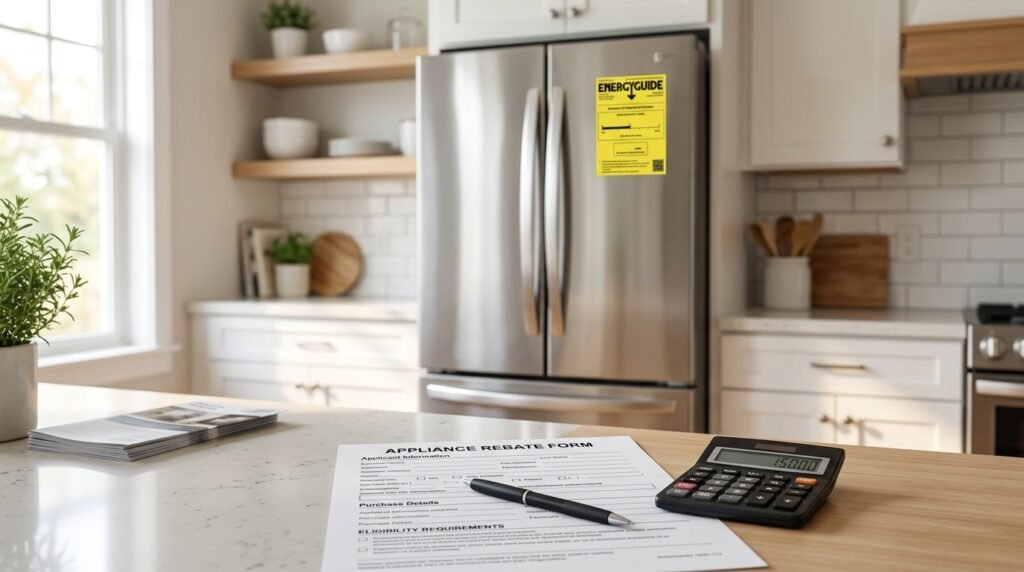
If you’re shopping for an appliance expecting a federal tax credit for buying the Energy Star Most Efficient version, that program ended on December 31, 2025 — and a lot of what’s written online hasn’t caught up to that yet.
This post contains affiliate links. If you click and buy, I may earn a small commission — at no extra cost to you.
The Label Most People Get Wrong
“Energy Star certified” and “Energy Star Most Efficient” get used almost interchangeably in casual conversation, and they’re not the same thing. Standard Energy Star certification is a baseline efficiency threshold that most major appliance brands can hit without much difficulty — it’s a floor, not a distinction. Energy Star Most Efficient is a narrower, harder-to-hit subset above that floor. For ducted heat pumps, for example, Most Efficient requires an HSPF2 rating of 8.1 or higher and a SEER2 rating of 15.2 or higher — figures that sit meaningfully above the standard certification bar. For heat pump water heaters, the Most Efficient threshold is a Uniform Energy Factor of 2.0 or higher.
This distinction matters because rebate programs don’t all require the same tier. Some programs only ask for standard Energy Star certification. Others specifically require Most Efficient. Buying the pricier Most Efficient model without checking which one your specific rebate program actually requires is how people overspend for a badge they didn’t need.
What Actually Expired at the End of 2025
Here’s the change that most older articles haven’t updated to reflect: the federal Section 25C tax credit — the one that let households claim back a percentage of qualifying Energy Star purchases, up to $2,000 a year for certain heat pump equipment — expired December 31, 2025, under the One Big Beautiful Bill Act, signed into law in mid-2025. If you bought and installed qualifying equipment before that date, you can still file for the credit on your 2025 tax return. If you’re buying in 2026, that specific credit no longer applies to your purchase, full stop.
This is worth spelling out clearly because so much content still in circulation — buying guides, appliance reviews, even some retailer marketing — was written before this expired and simply hasn’t been corrected. If an article promises you a flat federal tax credit for buying an efficient appliance this year without mentioning income limits or a state program, it’s describing a rule that’s no longer in effect.
What’s Actually Available in 2026
HEAR / HEEHRA — The Income-Gated Rebate
What replaced the blanket tax credit isn’t really a replacement at all — it’s a structurally different program that predates 25C’s expiration and continues independently: the HEAR program, also called HEEHRA (High-Efficiency Electric Home Rebate Act), funded through the Inflation Reduction Act with $4.3 to $8.8 billion nationally. Unlike a tax credit, it’s a point-of-sale rebate — the discount happens at the time of purchase through a registered contractor, not as a line item on your tax return next spring.
It’s also income-gated. Households under 80% of area median income can receive up to 100% of the rebate cap for qualifying equipment. Households between 80% and 150% of AMI get roughly 50% of that cap. Above 150% AMI, you’re not eligible for HEEHRA at all. And critically, it’s administered state by state — as of early 2026, roughly 23 states have live programs running, while others are still in setup or haven’t launched. This isn’t a program you can assume applies to you just because you read about it online; it depends entirely on your state and your income bracket.
HOMES — The Whole-Home Performance Rebate
A second, less appliance-specific program, HOMES, pays based on measured or modeled whole-home energy savings rather than which specific piece of equipment you bought. It requires a certified energy audit before and after the work, which makes it more involved to access but not tied to any single appliance’s label — broader in scope, but a bigger lift to actually claim.
How to Check If Your State’s Program Still Has Money
Do not rely on a general buying guide, including this one, for your state’s current funding status — it changes throughout the year as states burn through their federal allocation. California’s HEEHRA program, for example, was already fully reserved for single-family projects with a waitlist by February 24, 2026, less than two months into the year. Go directly to your state energy office’s website, or search “[your state] HEEHRA rebate status,” before you factor any rebate amount into your purchase decision. If a contractor tells you a rebate is available, confirm they’re specifically registered for your state’s program — working with a non-registered contractor typically disqualifies the rebate entirely, even if the equipment qualifies.
The Real Math: Is Chasing “Most Efficient” Worth It For You?
With the blanket federal tax credit gone, the math changed from “everyone gets a credit” to “check three things before assuming anything.” First, does your state have a funded, active HEAR or HOMES program right now. Second, does your household fall under the income threshold to qualify. Third, does the specific rebate you’re eligible for require the stricter Most Efficient tier, or does standard Energy Star certification already qualify.
If all three line up, chasing the Most Efficient label can still be genuinely worth the price premium — the combination of the rebate and the ongoing energy savings can meaningfully shorten your payback period. If none of them line up — your state program is out of funding, your household is above the income cap, or your rebate only needed standard certification anyway — you’re paying a premium for a badge that isn’t buying you anything beyond the appliance’s own energy savings over time, which is a real but much slower payback on its own.
What I Wouldn’t Do
I wouldn’t buy the priciest Most Efficient-tagged model assuming a rebate is coming without checking your specific state program’s live funding status first — that assumption is exactly what’s outdated in most articles still circulating.
I also wouldn’t assume standard Energy Star certification is “good enough” across the board, or that Most Efficient is “always required” — both assumptions are wrong often enough that checking your specific program’s actual requirement, not a general rule of thumb, is the only way to avoid overpaying or underqualifying.
THE BOTTOM LINE
The federal Section 25C tax credit that used to make “buy Energy Star, get money back” a simple universal rule expired at the end of 2025. What’s left in 2026 is the state-administered, income-gated HEAR/HEEHRA rebate and the audit-based HOMES program — both real, both worth pursuing if you qualify, but neither automatic. Check your state’s specific program status and your household’s income bracket before you let a rebate assumption drive which model you buy.
This rebate math connects directly to the heat pump dryer rebate breakdown, and it’s worth understanding why appliance prices moved this year before you factor any rebate into your budget at all.
Cheers, Kazaan.