
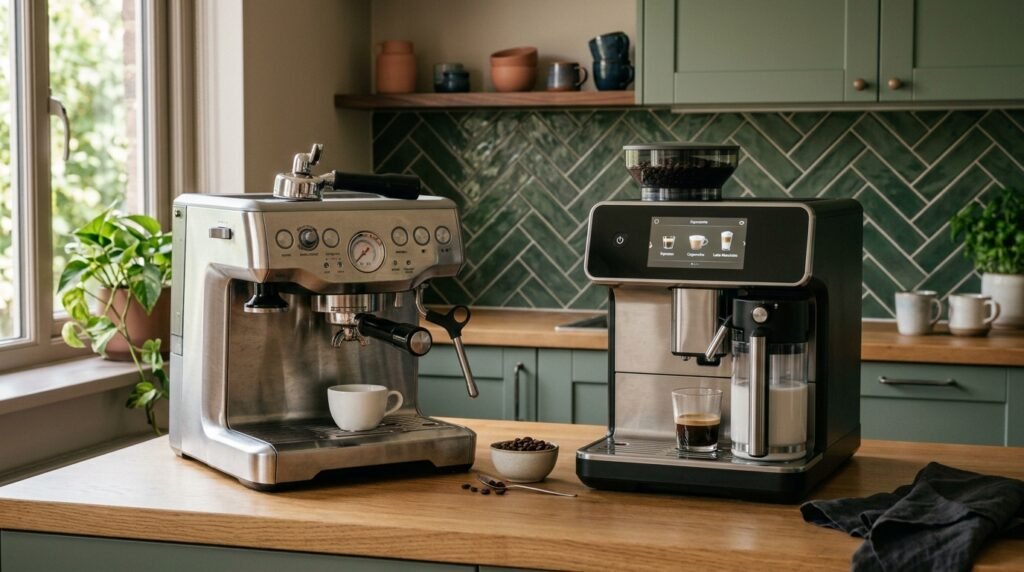
Spend $800 on a semi-automatic espresso setup and roughly $500 of it goes into the machine, $200 into a separate grinder, and the rest into accessories — spend the same $800 on a super-automatic and every dollar goes into one sealed box that does all three jobs internally. Same budget, completely different bet.
This post contains affiliate links. If you click and buy, I may earn a small commission — at no extra cost to you.
Same Shot, Two Completely Different Machines
Both machine types pull real espresso at the same roughly 9 bars of pressure, and both can produce genuinely good coffee. The difference isn’t really about shot quality at the top end — it’s about where the engineering and the money go, and how much of the process you’re doing yourself versus how much the machine is doing for you.
A semi-automatic puts you in the loop: you grind the beans separately, dose and tamp the portafilter, and manually start and stop the extraction. A super-automatic collapses all of that into the machine itself — whole beans go in one end, espresso comes out the other, one button in between.
The Mechanism: What You’re Actually Buying at Each Price
Semi-Automatic — $800 Buys Two Separate Instruments
A capable semi-automatic setup at this price point looks like two purchases, not one. A machine like the Breville Bambino Plus runs around $500 on its own — it handles heating, pressure, and steam, but nothing more. Espresso quality is unforgiving of a bad grind, so the other roughly $200–$300 of that budget has to go toward a real burr grinder, like a Baratza Encore ESP — not a $30 blade grinder, which will bottleneck the quality of everything downstream of it regardless of how good the machine is. What you end up with is two separate, independently serviceable, independently upgradable instruments working together.
Super-Automatic — $800 Buys One Integrated System
At the same budget, a super-automatic — something in the Philips 3200 series price range — puts the grinder, the brew group, the dosing mechanism, and often a milk system all inside one sealed housing. Every dollar goes toward integration and automation rather than toward two separately optimized components. The engineering goal is different: instead of “make the best possible shot with the most control,” it’s “make a consistently good shot with zero manual steps.”
What Breaks, and What It Costs When It Does
This is the part that gets skipped in most comparisons, and it’s actually the more important long-term number.
On a semi-automatic, maintenance is manual but cheap and simple: regular backflushing with a blind basket and cleaning tablets, wiping and purging the steam wand after each use, and periodic gasket replacement — maybe once a year for a heavy user. Total ongoing supply cost typically runs $25 to $50 a year. When something does fail, it’s usually a single, well-documented, inexpensive part — a home barista community exists specifically because these machines are simple enough to self-repair with widely available guides.
On a super-automatic, day-to-day maintenance is more automated — built-in cleaning cycles for the brew group and milk system, automatic descaling programs. But when something internal actually breaks — a blocked integrated grinder, a failing brew unit, a worn pump — the repair costs more, because the components are bundled together inside one complex housing rather than sitting as separate, swappable parts. Scale buildup from hard water is the single most common cause of failure in both machine types, which is why descaling on schedule, roughly every three months, matters regardless of which one you own.
👉 Breville Bambino Plus — ~$500
the machine half of the semi-automatic stack — handles heating and pressure precisely, but its value only shows up once it’s paired with a real grinder, not used alone.
The Ongoing Cost Nobody Compares Correctly
Most comparisons stop at the sticker price, which misses the actual multi-year cost picture. A semi-automatic’s separate components mean you can upgrade one piece — say, replace a $200 entry grinder with a $400 one — without replacing the whole system, spreading the investment out over years. A super-automatic’s integrated design means the grinder you get on day one is the grinder you have for the machine’s entire life; there’s no incremental upgrade path, only a full replacement when you eventually want better performance.
👉 Baratza Encore ESP Grinder — ~$200
the component that actually determines shot quality in a semi-automatic setup — pairing a good machine with a cheap grinder is the single most common mistake in this price range.
Decision Framework
Choose semi-automatic if you find the process of dialing in a shot genuinely enjoyable rather than a chore, if you want the option to upgrade individual components over years instead of replacing the whole system, and if you’re comfortable with 5–10 minutes of active hands-on time per drink.
Choose super-automatic if your mornings are rushed and one-button consistency matters more than control, if you don’t want to learn tamping and dialing in as a skill, and if you’re fine accepting that the grinder and brew system you buy on day one is what you’ll have for the machine’s whole lifespan.
👉 Philips 3200 Series Super-Automatic Espresso Machine — ~$700–$800
a representative mid-range super-automatic at the same total budget as the semi-automatic stack above — genuinely one-touch operation, with a long-life AquaClean filter that can push descaling intervals out significantly for typical households.
What I Wouldn’t Buy
I wouldn’t buy a semi-automatic machine without budgeting separately, and seriously, for a real grinder. Pairing a $700 machine with a $30 blade grinder wastes most of what you paid for the machine — grind consistency matters more to shot quality than almost anything else in the chain.
I also wouldn’t buy the cheapest super-automatic on the market assuming all bean-to-cup machines perform similarly. The internal grinder and brew unit quality vary a lot between a $300 entry unit and a $700+ mid-range one, and since you can’t upgrade that grinder later, it’s worth spending toward the higher end of your budget on this category specifically.
THE BOTTOM LINE
At the same roughly $800 budget, semi-automatic buys you two separate, independently upgradable instruments and cheap, simple ongoing maintenance, in exchange for doing the grinding, dosing, and tamping yourself. Super-automatic buys you one integrated system that does it all with one button, in exchange for a fixed, non-upgradable grinder and pricier repairs if something internal fails. Neither is the objectively better machine — they’re solving for different mornings.
If you’re still deciding whether espresso is the right category at all, our drip vs espresso vs pod comparison is worth reading first, and for day-to-day upkeep specifically, the easiest coffee makers to keep clean.
Cheers, Kazaan.