
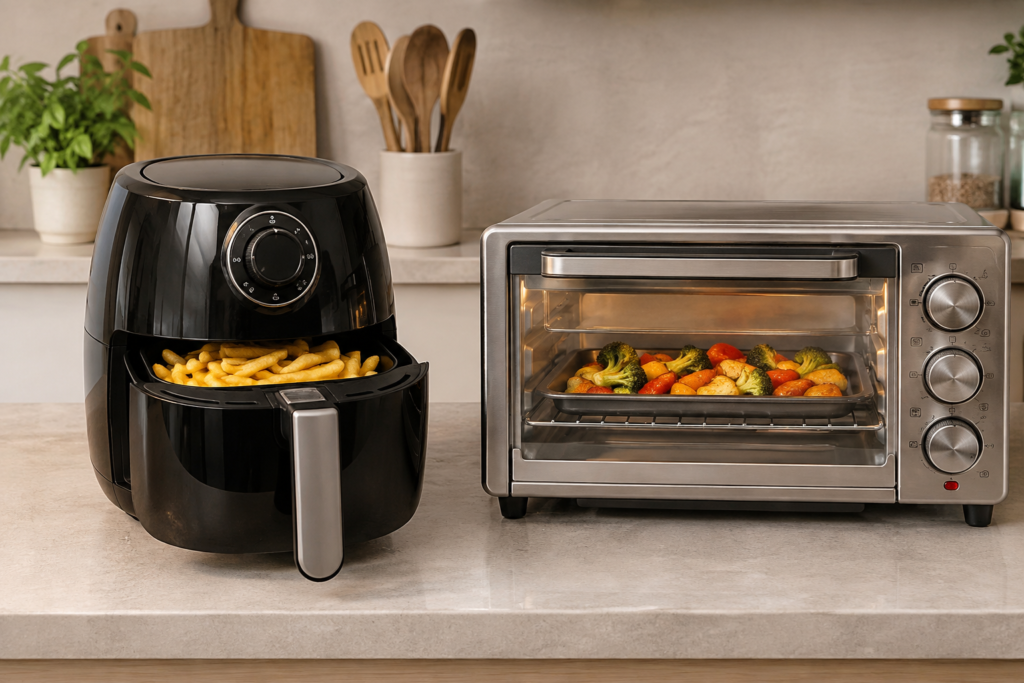
- What Each One Is Actually Built For
- The Capacity Trap Nobody Warns You About
- The Question That Actually Predicts Which One You’ll Use
- Combo Units: Worth It or Marketing Gimmick?
- Air Fryer vs Toaster Oven: My Actual Recommendation
- Leftovers Are Where the Real Difference Shows Up
- The Cleanup Difference Nobody Mentions Until You Own One
- Air Fryer vs Toaster Oven: A Few Things People Ask Me
Your kitchen doesn’t have room for both. Neither does your budget. So here’s the real answer, from someone who’s spent years inside the categories these two products compete in.
This post contains affiliate links. If you click and buy, I may earn a small commission — at no extra cost to you.
Most articles comparing these two treat them like rivals with different specs. That’s the wrong frame. They’re not rivals — they’re built for different jobs, and the mistake people make is buying based on marketing buzzwords instead of how they actually cook.
What Each One Is Actually Built For
An air fryer is a compact convection oven optimized for one thing: rapid, high-velocity hot air circulation in a small chamber. That tight space is the whole trick — it’s why a basket of frozen fries crisps up in 12 minutes instead of 25.
A toaster oven is a small conventional oven. More volume, more even heat, more flexibility — but slower, because it’s not compressing the airflow the way an air fryer does.
👉 Cuisinart Air Fryer, Glass Basket & ClearView Window, 4Qt — $139.95
The glass basket is the detail that matters here — you can actually watch food cook instead of pulling the basket every few minutes to check.
Check Price on Amazon →
If your cooking is mostly “reheat, crisp, small batch” — think frozen snacks, chicken wings, roasted vegetables for two — the air fryer wins on speed every time. If you’re baking, broiling, toasting bread, or cooking for more than 2-3 people regularly, the toaster oven’s larger cavity and even heat distribution matter more than raw speed.
The Capacity Trap Nobody Warns You About
Here’s something I learned the hard way managing this category: air fryer capacity numbers on the box are almost always optimistic. A “6-quart” basket rarely fits 6 quarts of food you’d actually want to eat, because food needs space around it for the hot air to circulate. Overload the basket and you’re steaming, not frying.
Toaster ovens don’t have this problem in the same way — a rack is a rack, and you can stack more freely. If you’re cooking for a family of 4+, that capacity gap is the deciding factor, not the appliance category itself.
👉 Toshiba 10-in-1 Convection Toaster Oven, 6-Slice, 1500W — $119.99
This is the size where a toaster oven stops being a toaster with extra steps and starts replacing your actual oven for weeknight meals.
Check Price on Amazon →
The Question That Actually Predicts Which One You’ll Use
Ask yourself this: do you cook the same 5-6 things on repeat, or do you want one appliance that does everything from toast to roast chicken?
Repeat cooking, small portions → air fryer. It’s a specialist, and specialists are fast at their one job. Broad use, bigger portions, actual baking → toaster oven. It’s a generalist, and generalists earn their counter space by replacing three other appliances.
Combo Units: Worth It or Marketing Gimmick?
There’s a growing category of air fryer/toaster oven combos. My honest take: they’re a reasonable middle ground if counter space is your real constraint, but you’re trading some performance in both directions. The air frying function in a combo unit is rarely as tight and fast as a dedicated basket-style unit, because the chamber is bigger.
👉 Toshiba ChefFry Air Fryer Toaster Oven Combo, 34QT — $219.99
If counter space is the real constraint, this is the one-appliance answer — you’re trading a bit of peak performance for not needing two units.
Check Price on Amazon →
Air Fryer vs Toaster Oven: My Actual Recommendation
Small household, snack-heavy, speed matters most → air fryer, basket-style, 4-6 quart. Family, varied cooking, baking included → toaster oven with convection setting. Tight kitchen, need both functions, willing to compromise → combo unit. Don’t buy based on what’s trending this month. Buy based on what you actually cooked last week.
Leftovers Are Where the Real Difference Shows Up
Nobody talks about this in the air fryer vs toaster oven debate, but reheating is where most people actually use these appliances day to day — not the recipe-blog stuff. Reheat a slice of pizza in an air fryer basket and the crust crisps back up in 3-4 minutes because the tight airflow hits it from every angle. Do the same in a toaster oven and you get decent results too, but it takes closer to 8-10 minutes since the heat has more space to fill. If your actual daily use is “leftover Tuesday night dinner,” the air fryer wins on pure convenience.
Where the toaster oven pulls ahead is mixed-size leftovers — a plate with chicken, rice, and vegetables reheats more evenly in a toaster oven because nothing is jammed against a basket wall losing airflow. Try that same plate in an air fryer basket and you’ll often get one component perfectly reheated and another still cold in the center.
The Cleanup Difference Nobody Mentions Until You Own One
Air fryer baskets trap grease and crumbs in the mesh bottom, which means a real scrub session every few uses if you’re cooking anything with fat content — wings, bacon, anything breaded. Most baskets are dishwasher-safe, but the nonstick coating degrades faster with dishwasher heat than hand-washing. Toaster ovens have an open rack and a removable crumb tray, which is honestly easier to keep clean long-term, even though food splatters more inside the cavity itself.
If you’re someone who lets dishes pile up, factor this in. An air fryer basket left dirty for a few days gets genuinely unpleasant. A toaster oven’s crumb tray is more forgiving.
Air Fryer vs Toaster Oven: A Few Things People Ask Me
The reheating question comes up constantly, and I covered that above — but people also ask whether one machine can just fully replace the other. Not really. That’s the core tension in this air fryer vs toaster oven decision: each is built around a different airflow design, and forcing one to do the other’s job usually means worse results on both ends. A toaster oven set to max heat with the door cracked won’t replicate true air-fry crisping, and an air fryer basket can’t hold a full-size casserole dish the way a toaster oven rack can.
If wattage and cook times are still confusing you, our air fryer wattage breakdown goes deeper into that specific question. And if you want the engineering behind why convection heats food the way it does, Wikipedia’s convection oven overview is a solid technical primer.
THE BOTTOM LINE
Cooking for one or two and want speed → air fryer wins. Cooking bigger batches, baking, or reheating leftovers evenly → toaster oven’s capacity is the better fit. Both handle the basics fine — the difference is what’s actually on your counter.
Cheers, Kazaan.