
- What Wattage Actually Is
- The Misconception: Higher Wattage = Crispier Food
- The Real Factor: Basket-to-Power Ratio
- What I Wouldn’t Buy
- The Thing Nobody in Buying Guides Mentions: Your Kitchen Circuit
- Does Higher Wattage Cost More to Run?
- So — Does Air Fryer Wattage Actually Matter?
- A Quick Gut-Check: What’s Actually on Your Circuit
1800W on the box looks like the better buy over 1500W. It isn’t — and understanding air fryer wattage is the only way to know why. The chicken comes out exactly the same as the neighbor’s 1500W model — the only real difference is a machine that trips the kitchen circuit every time the microwave runs at the same time.
This post contains affiliate links. If you click and buy, I may earn a small commission — at no extra cost to you.
Wattage matters. Just not the way the spec sheet suggests.
What Wattage Actually Is
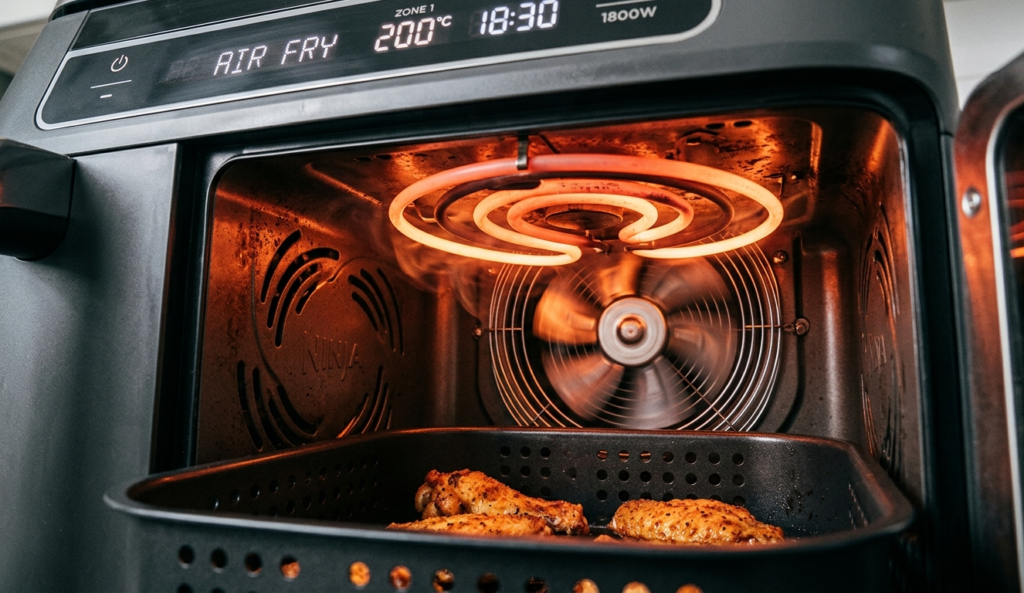
Air fryer wattage is how much electrical power the unit draws to heat up and move air around your food. Think of it like water pressure in a pipe — more pressure means heat gets there faster, and it recovers faster when you open the basket to flip something mid-cook.
Standard air fryers run between 1,000W and 1,800W. For most US households, the sweet spot lands somewhere between 1,400W and 1,600W.
The Misconception: Higher Wattage = Crispier Food
It doesn’t. Not by itself. Two air fryers at 1,700W can produce completely different results. Fan design, basket geometry, and airflow pattern carry just as much weight as the power rating. A well-engineered 1,400W unit will beat a poorly designed 1,800W unit every time. I’ve seen this pattern play out across dozens of products — the number on the box is a starting point, not the whole story.
What higher wattage actually gives you: faster preheat — often 2–3 minutes versus 5+. Faster heat recovery after you open the basket mid-cook. More consistent performance when you’re cooking larger loads. None of that is “crispier.” It’s “faster to get to the same crispy.”
The Real Factor: Basket-to-Power Ratio
Here’s the rule worth remembering: wattage has to match your basket size. Mismatch these two, and nothing else you do will fix it.
1–2.5 qt baskets, solo use and small portions, want 800–1,200W. 3–5 qt baskets, couples and small families, want 1,400–1,600W. 5+ qt baskets, families and batch cooking, want 1,600–1,800W or more.
An underpowered air fryer relative to its basket size does one thing consistently: soggy food. The heating element can’t recover fast enough after you load it up, steam builds instead of circulating, and you’re essentially steaming your fries instead of frying them. No amount of shaking the basket fixes that — it’s a wattage-to-volume mismatch, and the only fix is a stronger element or a smaller basket.
👉 COSORI 4-Qt Air Fryer, 1500W — $89.96
Nails the basket-to-power ratio for solo portions — right in the ideal range for one or two people from the table above.
Check Price on Amazon →
What I Wouldn’t Buy
A few patterns worth avoiding once you understand the ratio above. Any 5+ quart basket paired with under 1,400W — that’s the exact soggy-food mismatch described above, and it’s more common than you’d expect on budget large-capacity models chasing a low price point. Any listing that advertises wattage in huge letters but doesn’t state basket size clearly, or buries it — that’s a spec sheet built to sell on the bigger number, not to help you match it to your household. And I’d think twice about any “1800W” unit under $60 — hitting that wattage with genuinely cheap internals usually means a heating element that degrades fast under sustained high draw, which is exactly the opposite of what you’re paying the wattage premium for. One more thing worth a glance: watch for basket capacity listed in liters on some import listings without a US quart conversion nearby — a 4L basket sounds bigger than a 4qt one, but they’re close to the same size, and that framing alone has led people to buy a smaller unit than they intended.
The Thing Nobody in Buying Guides Mentions: Your Kitchen Circuit
A 1,500W air fryer draws roughly 12.5 amps when it’s running. Most standard US kitchen circuits top out at 15 amps. If you’ve also got a microwave or a toaster on the same circuit — that’s a breaker waiting to happen, usually mid-cook, usually at the worst possible moment with dinner half-done in the basket.
This is why the right question before buying isn’t just “how many watts” — it’s “what else is on that outlet?” A 1,200W air fryer might genuinely be the smarter choice for your kitchen, not because of food quality, but because of how your electrical setup works. Walk your kitchen and count what’s plugged into the same circuit before you shop for wattage.
👉 Ninja AF101 Air Fryer, 4Qt, 1550W — $89.99
The most consistent performer I’ve seen at this size for couples and small families — sits comfortably inside the safe range for a shared 15-amp circuit.
Check Price on Amazon →
Does Higher Wattage Cost More to Run?
Less than you’d think. Yes, a 1,800W model draws more power per minute than a 1,200W model. But it also finishes faster. Run the numbers: 20 minutes at 1,800W uses 0.6 kWh. Thirty minutes at 1,200W also uses 0.6 kWh. Same energy, different speed.
Compare either one to a conventional oven running at 2,400–4,000W for 45+ minutes, and the air fryer wins by a wide margin. The U.S. Department of Energy puts it plainly: smaller appliances draw a fraction of what a full-size oven does. The air fryer wattage debate between tiers is mostly noise — the real cost conversation is air fryer versus oven, not 1,400W versus 1,800W.
So — Does Air Fryer Wattage Actually Matter?
Yes. But the question you should be asking isn’t “how many watts” — it’s “does this wattage match my basket size, my household, and my kitchen circuit?” Get that right, and the wattage debate becomes irrelevant.
Cooking for 1–2 people → 1,200–1,400W is enough. Cooking for a family → 1,500–1,700W. Batch cooking, larger baskets → 1,700W+. Tight electrical setup or older kitchen wiring → stay under 1,500W and check what’s on that circuit first.
👉 Ninja AF161 Dual Basket, 8Qt — $159.94
Handles batch cooking without pushing into 1,800W territory — matters if your kitchen circuit is already busy, per the section above.
Check Price on Amazon →
Still figuring out if an air fryer belongs in your kitchen at all? I cover exactly that in my air fryer buying guide. Don’t buy the highest number on the box. Buy the right number for how you actually cook.
A Quick Gut-Check: What’s Actually on Your Circuit
Before you shop by wattage, walk to your kitchen and look at what shares an outlet or circuit with where the air fryer will sit. A coffee maker draws around 1,000-1,500W. A toaster runs 800-1,500W. A microwave pulls 1,000-1,800W. Run any two of those at the same time as a 1,500W+ air fryer on a shared 15-amp circuit and you’re at or past the limit — that’s roughly 1,800 watts of combined draw against a circuit rated for about 1,800 watts total, with zero margin for anything else, including the fridge compressor cycling on.
This is a five-minute check that most buying guides skip entirely, and it’s the single most common reason people end up disappointed with a “powerful” new air fryer — not because it cooks worse, but because it keeps tripping the breaker mid-dinner and they never connect the dots back to wattage.
THE BOTTOM LINE
1,700W and above is marketing, not performance, unless your basket is 5+ quarts. Match wattage to basket size and to what else runs on that kitchen circuit — get that right and the spec-sheet number stops mattering.
Cheers, Kazaan
Pingback: Air Fryer Vs Toaster Oven: Which One Should You Buy?