
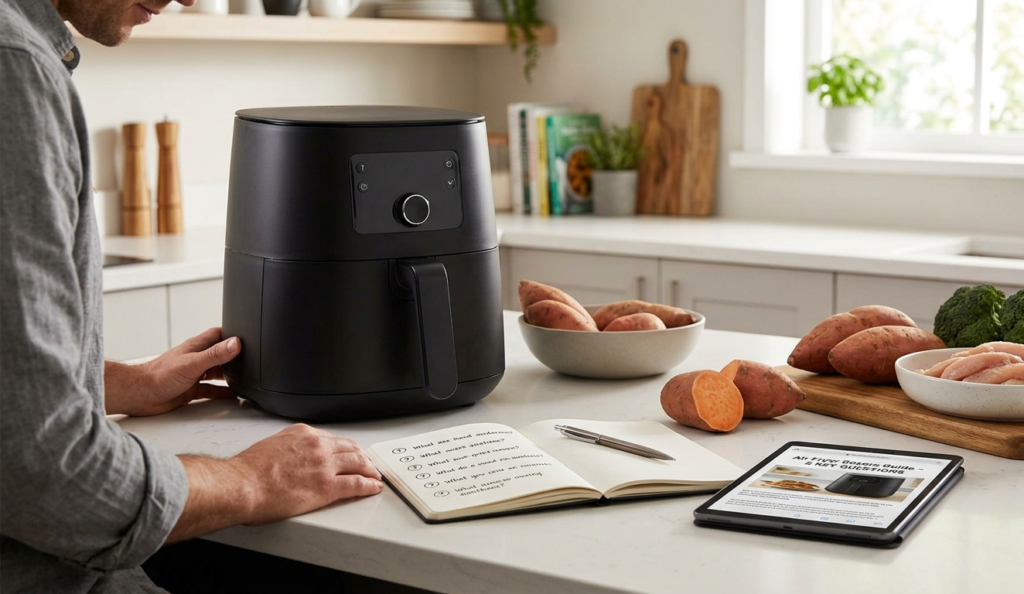
Every air fryer buying guide on the internet has an opinion. Your coworker swears by hers. Your brother-in-law thinks they’re overrated. The internet is full of “best air fryer” lists that all somehow recommend a different product.
This post contains affiliate links. If you click and buy, I may earn a small commission — at no extra cost to you.
None of that is an actual air fryer buying guide. None of it helps you figure out which one — if any — belongs in your kitchen. These five questions do. It isn’t built on affiliate lists or brand relationships. It’s built on what I saw from the inside — which specs matter, which ones don’t, and which brands are worth trusting before you spend a dollar.
1. How Many People Are You Cooking For?
This is the question that eliminates half the market before you spend a single minute reading specs. A 2-quart or 3-quart basket is built for one person, maybe two. It does the job — fast, efficient, easy to clean. But put three chicken thighs in it and you’re cooking in batches, which defeats most of the speed advantage that made you want an air fryer in the first place.
A 4-quart to 5-quart basket is the sweet spot for two to four people. This is where most of the mainstream models live, and it’s the size range that avoids both extremes — never so small you’re running three back-to-back batches for a family dinner, never so large you’re heating a mostly-empty basket for a single portion. 6 quarts and above is family territory, and it usually means a dual-basket design so you can run two temperatures at once rather than one oversized single chamber.
👉 COSORI Pro II Air Fryer, 5Qt — $72.99
Solid pick for two to four people in the 4-5 quart sweet spot — consistent results without paying for the Ninja name, and the right size to check against your own household count above.
Check Price on Amazon →
Buy for your real household, not for the version of yourself that hosts dinner parties twice a month. If you’re still deciding whether an air fryer is even the right appliance for your kitchen, I broke down that exact decision in Instant Pot vs Air Fryer — which one actually belongs in your kitchen.
2. Where Is It Going to Live?
Air fryers are not small. The 5-quart models are roughly the size of a large stockpot sitting on your counter. They need clearance above them — usually 5 to 6 inches — because the exhaust vents out the back or top, and blocking that vent against a cabinet is both a performance and a safety issue.
Measure your counter space before you buy. I’ve seen people return air fryers not because they didn’t work, but because they had nowhere to put them. If space is tight, look at the slimmer basket designs rather than the wider oval formats. Or consider a countertop oven with an air fry function — it replaces something rather than adding to the clutter.
3. Are You Actually Going to Use Multiple Functions?
Every mid-range air fryer now comes with 8, 10, sometimes 12 preset functions. Roast. Bake. Dehydrate. Reheat. Broil. Here’s the honest question: how many of those will you use more than once? Most people use two: air fry and reheat. If that’s you, don’t pay a $40 premium for a touchscreen with functions you’ll scroll past every single time.
If you genuinely want to dehydrate fruit or bake a small cake, those functions are real and useful. But they’re useful for a specific type of cook. Know which one you are before you add features to your cart — a longer preset list is a cost, not a free bonus, once you factor in what it does to the price and the learning curve on the control panel.
👉 Ninja AF101 Air Fryer, 4Qt — $89.99
Keeps the control panel simple — air fry, roast, reheat, dehydrate — without burying the two functions most people actually use inside a crowded touchscreen menu.
Check Price on Amazon →
What I Wouldn’t Buy
A few patterns worth avoiding. Any unit under $50 claiming 12+ cooking presets — that’s a control board cost that has to get cut from somewhere else, usually the basket coating or the fan motor, and neither is where you want the savings to come from. Any listing that markets “dishwasher-safe” without specifying which parts — often it’s just the tray, not the basket itself, and you find that out after the first greasy cleanup. And I’d skip any air fryer whose only stated capacity is in liters with no quart conversion anywhere in the listing — it’s a small tell that the listing was translated rather than written for the US market, and other specs on the page are worth double-checking too.
4. How Much Do You Hate Cleaning Things?
Air fryer baskets fall into two camps: non-stick coated and stainless steel. Non-stick is easier to clean on day one. It also scratches if you use metal utensils, and the coating degrades over time. Most non-stick baskets are dishwasher-safe in theory but hold up better with hand washing. If you’re concerned about coating safety, the FDA covers PFOA-free non-stick coatings — modern baskets are considered safe at normal cooking temperatures.
Stainless is more durable long-term but requires more effort to clean, especially after fatty foods. It’s the right call if you’re buying something to keep for five-plus years and you don’t mind a bit more scrubbing. There are also models with removable, dishwasher-safe trays versus models where the basket requires hand washing. If you run the dishwasher every night, that detail matters more than most spec sheet items.
5. What’s Your Honest Budget?
The $60–80 range: you get a functional air fryer. Basic controls, single basket, limited capacity. Brands like Chefman and PowerXL live here. Fine for occasional use, not for daily cooking. The $90–130 range: this is where quality starts — better build, more consistent cooking, longer lifespan. For most people, this is the right place to spend.
The $150–200 range: you’re paying for dual baskets, larger capacity, or smart features. Worth it if you regularly cook two things at once. If you don’t, it isn’t. Above $200: you’re entering multi-cooker territory — units that air fry, pressure cook, steam, and more. Real value if you’ll use all the functions. Expensive countertop decor if you won’t.
👉 Ninja AF161 DualZone, 8Qt — $159.94
Family territory from question 1 above, in the $150-200 tier — two baskets, two temperatures at once, the format that actually saves time feeding four or more people.
Check Price on Amazon →
Your Air Fryer Buying Guide: The Short Version
Before you open a single product listing, answer these five questions honestly: how many people? Where will it go? How many functions will you use? How much do you hate cleaning? What’s your real budget?
The right air fryer is the one that fits your answers — not the one with the highest rating or the biggest marketing budget. That’s the whole point of this site.
THE BOTTOM LINE
The right air fryer isn’t the highest-rated one — it’s the one sized to your household, sitting where you actually have counter space, with only the functions you’ll really use. Answer the five questions above before you open a single listing.
Cheers, Kazaan
Pingback: Instant Pot Vs Air Fryer: Which One Actually Belongs In Your Kitchen?
Pingback: Best Coffee Maker Easy To Clean (2025) — 3 Picks That Won't Make You Hate Mornings
Pingback: French Door Refrigerator Buying Guide: 8 Specs That Actually Matter (And What To Ignore) | Food Unites People
Pingback: Countertop Ice Maker: What Nobody Tells You Before You Buy | Food Unites People
Pingback: Air Fryer Wattage Explained: Does It Actually Matter? | Food Unites People
Pingback: Is Cosori Actually Worth It? An Insider Breakdown
Pingback: Air Fryer Vs Roaster Oven For Thanksgiving: Size Math