
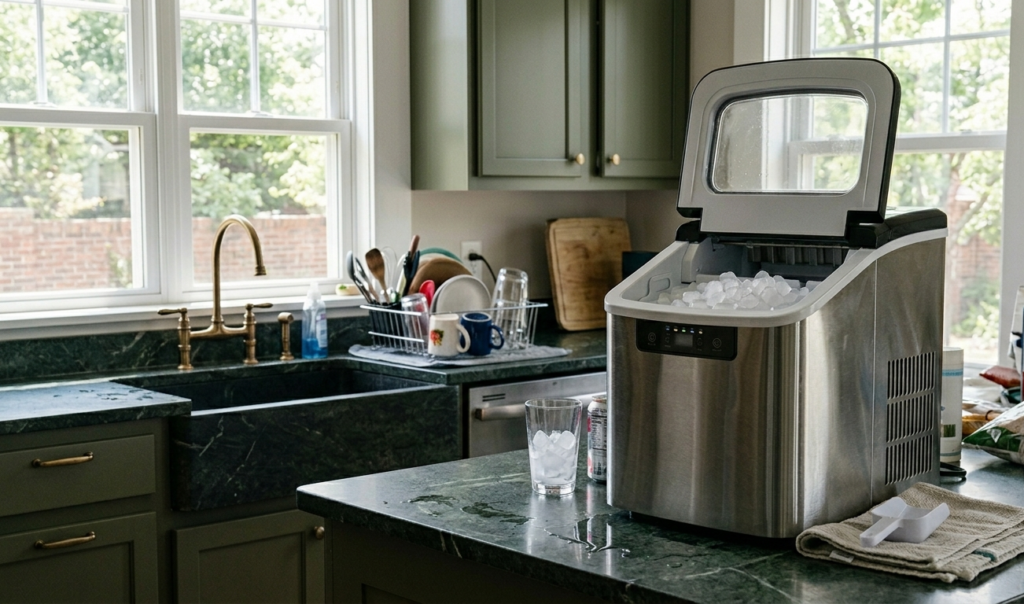
- What a Countertop Ice Maker Actually Is
- How It Actually Works — And Why That Creates Every Limitation on This List
- The Part Nobody Warns You About: No Insulation
- The Maintenance Issue That Gets Ignored
- Who This Is For — And Who Should Skip It
- What I Wouldn’t Buy
- Sizing It to How You Actually Use It
- Three Picks by Use Case
You found it. Compact, plugs into any outlet, and makes ice in under 10 minutes. Sounds like an easy buy.
This post contains affiliate links. If you click and buy, I may earn a small commission — at no extra cost to you.
It is — if you know what you’re getting. The questions I hear most often come from people who already bought one. That’s the wrong order. Let me fix that for you, starting with the mechanism, because almost every complaint about this category traces back to one thing people didn’t know going in.
What a Countertop Ice Maker Actually Is
A countertop ice maker is a portable appliance that makes ice on demand. No plumbing. No installation. You pour water in, plug it in, and it starts producing ice — usually within 6 to 15 minutes depending on the model.
It is not a freezer. That’s the first thing people misunderstand, and it matters more than you think — enough that I’m going to walk through the actual mechanism before anything else, because it explains almost every limitation on this list.
How It Actually Works — And Why That Creates Every Limitation on This List
Water from the reservoir gets pumped over a set of metal prongs that are chilled by a small refrigeration system — the same compressor-and-refrigerant cycle as a mini-fridge, just scaled down and pointed at a set of fingers instead of a box. Ice forms in a thin shell around those prongs over a few minutes, then the machine briefly reverses or warms the prongs just enough to release the ice into the basket below. That release step is why the ice comes out as hollow bullets or crescents instead of solid cubes — it’s shaped by how it has to let go of the metal, not by a mold.
Most models give you two size options — small bullets or larger bullets, controlled by how long each freeze cycle runs. Bullet ice has more surface area relative to its volume than a solid cube, which means it melts faster once it’s out of the machine. That’s a genuine trade-off: faster to make, faster to disappear.
The part that matters most, and the part no listing explains clearly: this whole mechanism only chills the prongs, never the basket. There’s no insulated compartment anywhere in the unit. Once ice drops into the basket, nothing is keeping it cold except the ambient temperature of your kitchen. That single design fact is the root of almost everything below.
The Part Nobody Warns You About: No Insulation
Countertop ice makers have no insulation. Zero. The basket where ice collects is just open air inside a plastic shell. The ice starts melting the moment it drops.
If you’re not using it immediately, it melts back into the reservoir and gets recycled into new ice. The machine handles this automatically — it’s actually a feature, not a flaw. But it means you can’t treat this like a freezer. You can’t make a batch, walk away for two hours, and come back expecting a full basket of solid ice. In a warm kitchen, a full basket can be noticeably diminished within 45 minutes to an hour.
It works best when you use it in real time — parties, backyard setups, a long afternoon with drinks, a camping trip. Fill your cup as it produces. If you need ice stored and ready at all times, you need a chest freezer with an ice tray, or a fridge with a built-in ice maker. A countertop unit isn’t built for that, and no amount of shopping around fixes it — it’s the mechanism, not the brand.
The Maintenance Issue That Gets Ignored
This one is important and almost nobody leads with it in product descriptions. Mold and mildew.
The water reservoir and internal components stay damp. If you leave standing water in the machine and don’t use it for a few days, you will get mold. It’s not a defect. It’s just what happens when water sits in a warm, enclosed space with no airflow — the same reason a damp sponge left in a closed container gets funky faster than one left open to dry.
What to do: after every use, drain the reservoir completely. Wipe it down. Leave the lid open to let it dry. Once a month, run a cleaning cycle with a mix of water and white vinegar or a dedicated ice maker cleaner. This takes five minutes. Most people skip it because the manual buries it on page 11. Now you know, and it’s the single habit that determines whether this machine is still pleasant to use in year two.
Who This Is For — And Who Should Skip It
Get a countertop ice maker if: you entertain regularly and your fridge ice maker can’t keep up. You have a home bar, a garage setup, or a patio you use in summer. You go camping, tailgating, or spend time on a boat. You’re renting and can’t modify the kitchen. You just want ice faster than your freezer tray delivers.
Skip it if: you want a constant supply of ice ready and waiting — you need a freezer for that. You’re looking for cubed ice — you’ll get bullet-shaped ice from most portable models, and nugget ice machines are a separate category, covered below. You’re not willing to do basic maintenance — mold is a real issue if you ignore it, not a rare edge case.
What I Wouldn’t Buy
A few patterns worth avoiding, based on the return and complaint patterns I’ve seen in this category. Any unit that doesn’t list a self-cleaning or descale cycle at all — you’ll be doing the vinegar rinse manually every time, and most people who skip a written reminder skip the task too. Units with a reservoir under 2 liters if you’re buying for entertaining — you’ll be refilling constantly during exactly the moment you don’t want to be walking back to the sink. And I’d be cautious of unusually cheap nugget-style units under $150 claiming Opal-like chewable ice — the auger mechanism that makes real nugget ice properly is expensive to build well, and a corner-cut version tends to produce ice that’s closer to crushed cubes than true chewable nugget texture.
Sizing It to How You Actually Use It
Two numbers matter here, and listings usually only give you one. Daily production (lbs per 24 hours) tells you total output over a full day. Batch time (minutes per cycle, usually 6-15) tells you how fast a fresh round of ice actually appears once the basket runs low. A machine that makes 26 lbs a day but takes 10 minutes per batch of roughly half a pound is a very different experience at a party than one built for continuous refills.
For occasional personal use — a few drinks a day — almost any unit is oversized for your needs, and you’re really just buying convenience and speed over ice trays. For regular entertaining, look for both a higher daily lbs number and a shorter batch cycle, since you’ll be refilling the basket mid-gathering more than once. Basket capacity matters too: a small 1.5 lb basket on a fast-cycling machine still means frequent small top-ups rather than one big batch sitting ready.
Three Picks by Use Case
I’m not going to rank these against each other — they solve different problems. Here’s who each one is actually for, based on everything above.
Best Budget: Silonn Countertop Ice Maker ($68.99)
👉 Makes 9 cubes in about 6 minutes, two size options, easy to clean. The right starting point if you’re testing whether this category even fits your routine before spending more — occasional personal use, not regular entertaining.
Check Price on Amazon →
Best Overall: Frigidaire EFIC189 (~$94)
👉 Slightly faster production, holds more ice in the basket, 26 lb per day. This is the sizing sweet spot from the section above — enough daily output and basket capacity for regular entertaining without jumping to nugget-ice pricing.
Check Price on Amazon →
Best for Nugget Ice: GE Profile Opal 2.0 Ultra ($448)
👉 Different category technically — makes nugget/pellet ice, the chewable kind from restaurants and cafeterias, 38 lbs in 24 hours with WiFi connectivity. Worth the jump specifically because the auger mechanism behind real nugget texture is the expensive part to build properly — see the section above on cheaper nugget-style units.
Check Price on Amazon →
Before you buy any of them, ask yourself the five questions I wrote about in my air fryer piece — the same decision logic about matching capacity to your real routine, not your best-case routine, applies here too.
A countertop ice maker is a genuinely useful appliance for the right situation. Portable, fast, no installation. But it’s not a freezer, it doesn’t keep ice for long, and it needs regular cleaning or you’ll have a mold problem. Know that going in and it’s a solid buy. Don’t know that and you’ll be disappointed by something that was working exactly as designed.
THE BOTTOM LINE: Countertop ice makers trade insulation for portability — no chilled compartment means ice melts back into the reservoir if you don’t use it, and the reservoir needs draining and cleaning or you’ll get mold within days. Occasional or casual use: the $69 Silonn covers it. Regular entertaining: the Frigidaire EFIC189 holds more and produces faster, matching the sizing math above. Want restaurant-style chewable nugget ice specifically: the GE Profile Opal 2.0 is worth the jump to $448 for the auger mechanism alone.
Cheers,
Kazaan
Pingback: Nugget Ice Maker Comparison: Budget Vs Premium Models