
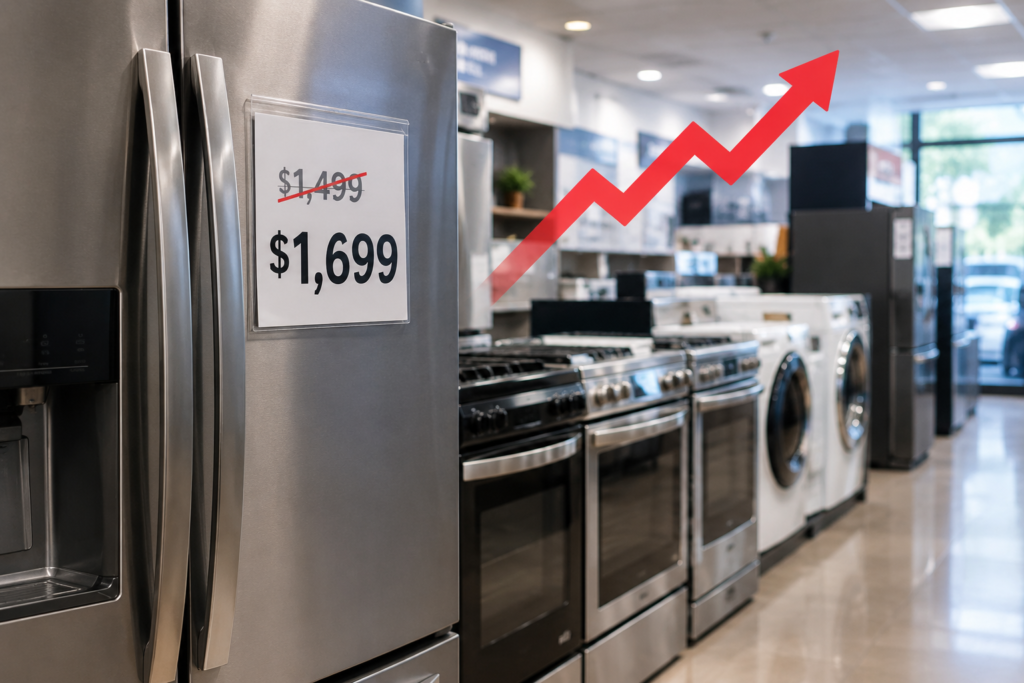
Your new refrigerator costs more than it would have in January — and it’s not inflation, it’s not “supply chain issues,” and it’s not a coincidence that six major brands moved their price lists within nine weeks of each other this summer.
This post contains affiliate links. If you click and buy, I may earn a small commission — at no extra cost to you.
The 25% Tariff Nobody Told You About
In April 2026, a Section 232 tariff of 25% went into effect on imported home appliances. If you don’t follow trade policy, that’s understandable — retailers didn’t exactly put up signage explaining it. But it’s the single biggest driver behind why the appliance aisle feels more expensive right now than it did at the start of the year.
Section 232 tariffs are framed as national security measures, and they apply at the border, before an appliance ever reaches a distribution center. That means the cost hits before a single unit is marked down, bundled into a sale, or shown to you with a strikethrough price. The tariff isn’t a retail decision. It’s a cost that gets absorbed somewhere in the supply chain — and “somewhere” almost always means the manufacturer decides how much of it to pass along, and when.
How a Tariff Actually Turns Into a Higher Price Tag
Here’s the part that doesn’t get explained anywhere: a 25% cost increase at the border does not turn into a 25% price increase on the shelf, and it doesn’t happen all at once.
Manufacturers don’t reprice everything the moment a tariff takes effect. They stagger it. Existing inventory that already cleared customs before April keeps selling at the old price. New price lists go out to retailers weeks or months later, timed around existing promotional calendars, contract renewals with big-box retailers, and — this is the part that matters to you — timed to land *before* the heaviest shopping season of the year, not during it.
That’s exactly what happened here. Between June 1 and August 1, 2026, ASKO, GE, KitchenAid, LG, Whirlpool, and Bosch/Thermador all raised prices. Not in April, when the tariff hit. Three to four months later, once the pre-tariff inventory had worked its way through the system and the new cost basis had to show up somewhere.
This is also why the increase isn’t uniform. A washer built mostly from domestically sourced steel absorbs less tariff exposure than a compact dishwasher assembled overseas and shipped in as a finished unit. Manufacturers price by category and by how exposed each product line actually is to the tariff — not by an across-the-board percentage.
Who Raised Prices, and By How Much
The Brands That Moved 3.5%–12%
Across the six brands that repriced this summer, increases ranged from 3.5% on the low end to 12% on the high end, depending on the brand and the specific category. That’s a wide spread, and the spread itself tells you something: manufacturers with more U.S.-based manufacturing capacity had more room to absorb the tariff internally before passing it to you. Manufacturers more dependent on imported finished goods or components had less room, and it shows in the number.
Whirlpool CEO Marc Bitzer addressed this directly on the company’s Q1 2026 earnings call, describing the April price move — over 10%, the largest in more than a decade for the company — against what he called a “perfect storm”: falling consumer sentiment, falling demand, and what he termed irrational pricing across the industry. That’s a notable thing for a CEO to say publicly. It means the increase wasn’t purely a tariff pass-through calculation — it happened while demand was already softening, which is normally when companies cut prices, not raise them.
Why Whirlpool Feels This More Than Its Competitors — And Less
Whirlpool put a number on its own exposure: it estimates the tariff impact at roughly 5% of its North American net sales. For its competitors, Whirlpool estimated the hit at 10% to 15%.
That gap exists because Whirlpool manufactures a larger share of its North American appliances domestically compared to brands that rely more heavily on imported units or imported components. KitchenAid is a Whirlpool brand, which is why it moved in the same window as Whirlpool’s core lineup — but that doesn’t mean every KitchenAid product absorbed the tariff identically. Small appliances built or finished overseas carry different exposure than large kitchen appliances assembled domestically.
The practical takeaway: brands that lean harder on imports had more pricing ground to make up, which is part of why the percentage increases you’re seeing vary so much between manufacturers, even for comparable products.
What This Means for Black Friday 2026
Thanksgiving falls on November 26 this year, Black Friday on November 27, and Cyber Monday on November 30. Those dates haven’t changed. What’s changed is the number the discount is calculated from.
If a refrigerator’s list price moved up 8% between June and August, and it goes “30% off” on Black Friday, you’re getting 30% off a price that’s already 8% higher than it was in the spring. The discount is real, but the floor moved. This is the single most important thing to understand before you shop the holiday sales this year: a familiar-looking percentage-off tag does not guarantee a familiar-looking final price compared to what the same unit cost you a year ago.
There’s a second-order effect worth understanding too: retailers themselves are caught between the same pressures you are. A big-box chain that committed to a promotional calendar back in the spring — before the summer price increases landed — is now running Black Friday math against a cost basis that shifted underneath the plan. Some of what looks like aggressive discounting this November is retailers eating margin to hit promotional numbers they’d already promised, not manufacturers giving anything back. That’s genuinely good news for shoppers in the short term, but it’s not a signal the underlying price floor has moved down — it’s a one-time squeeze on retailer margin during the one week of the year they can’t afford to look uncompetitive against each other.
What I Wouldn’t Do Right Now
I wouldn’t assume a Black Friday tag means you’re getting the best price of the year just because it says so on the sign. Check a price history tool — CamelCamelCamel for anything sold on Amazon, or a retailer’s own price-drop history where available — before you buy. If a unit was quietly repriced upward in July and then “discounted” back down to roughly its June price in November, that’s not really a Black Friday deal. It’s a round trip.
I also wouldn’t wait indefinitely hoping prices reverse. Tariff-driven price increases very rarely unwind once they’re baked into a manufacturer’s price list — the cost stays in the supply chain, and rolling prices back would mean a company voluntarily eating margin it already gave up. If you’re waiting for a return to January 2026 pricing, that’s not the realistic scenario to plan around.
THE BOTTOM LINE
Appliance prices went up in 2026 because of a 25% Section 232 tariff that took effect in April and got passed through in staggered increases of 3.5% to 12% across major brands between June and August — timed to land before, not during, the holiday shopping season. Black Friday and Cyber Monday will still be the cheapest window of the year to buy, but the discounts are being calculated from a higher starting point than last year. Buy based on what you need and what the unit actually costs today against its own price history — not based on how big the percentage-off sign looks.
If you’re trying to time a purchase around this, I’ve also mapped out the best time of year to buy appliances, and once you’ve settled on a brand, my Whirlpool vs GE vs Samsung breakdown picks up right where this leaves off.
Cheers, Kazaan.
Pingback: Energy Star Most Efficient: The Rebate Math In 2026