
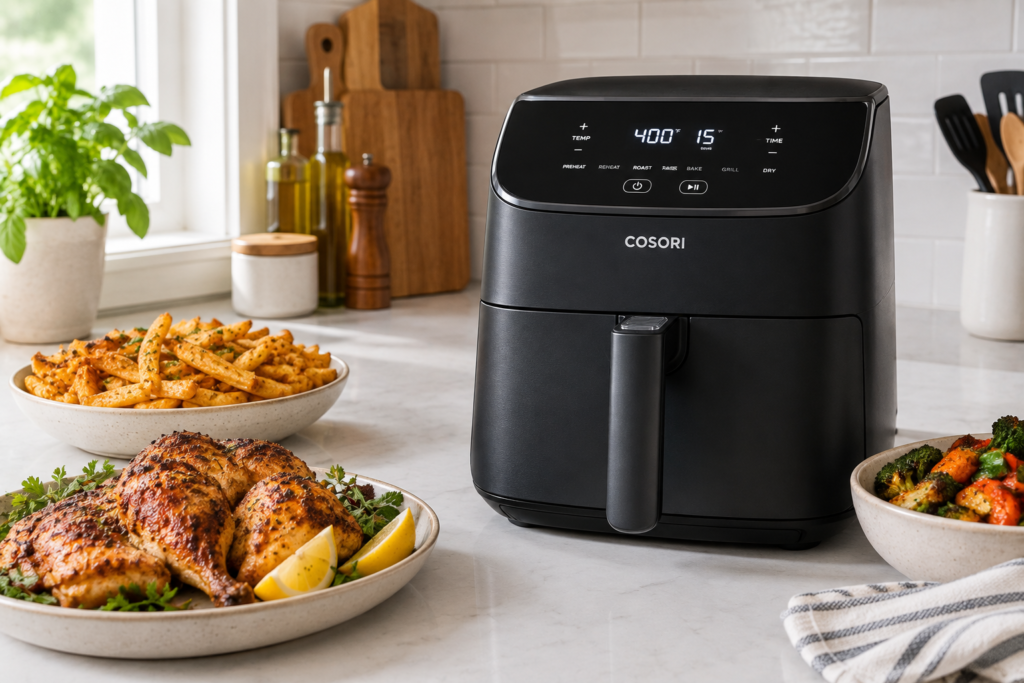
Cosori didn’t exist as a company until 2016, which means every single thing you think you know about “trusted appliance brands” doesn’t apply to it — and that’s exactly why it’s confusing to shop.
This post contains affiliate links. If you click and buy, I may earn a small commission — at no extra cost to you.
What Cosori Actually Is (And Isn’t)
Cosori is not an appliance company that added smart features. It’s a consumer electronics company — VeSync Co., Ltd. — that happens to make kitchen appliances. VeSync also owns Levoit (air purifiers) and Etekcity (kitchen scales, smart plugs). That parentage matters more than it looks like it should, because it tells you where the company’s core competency actually sits: connected hardware, app integration, and fast product iteration cycles. Not decades of thermal engineering on convection ovens.
That’s not a knock. It’s a different starting point than GE or Cuisinart, and it explains both Cosori’s biggest strength and its biggest weakness. The strength: Cosori ships new models faster and prices more aggressively than brands carrying legacy manufacturing overhead. TurboBlaze, launched with a DC brushless motor and five fan speeds, undercuts comparable specs from older brands by $50–$100. The weakness: there’s no multi-decade reliability track record to lean on. You’re buying into a company that’s about ten years old, in a product category where “how does it hold up in year six” is the question that actually matters.
Products are designed in California, manufactured in China — which, to be clear, is standard for essentially the entire small-appliance category, Ninja and Instant Pot included. Manufacturing location isn’t the differentiator here. Company age and track record are.
Where the Money Goes at Each Price Tier
Cosori runs three real tiers, and the jump between them isn’t marketing fluff — it’s a genuine hardware difference.
The Pro LE (5 Qt, roughly $70) is the base tier: ceramic-coated basket, simple touch controls, single fan, no app. This is the “does an air fryer even fit my life” tier. It’s not underpowered, it’s just not trying to do anything beyond air fry, roast, and reheat.
The TurboBlaze (6 Qt, $119.99 list, frequently discounted into the $85–$100 range) is where the real engineering upgrade shows up: a DC brushless motor instead of the more common AC motor, five fan speeds instead of a fixed speed, and a genuine 90°–450°F range. That motor is the actual reason it preheats faster and runs quieter — it’s not a marketing number, it’s a different, more expensive component than what ships in the Pro LE.
The Dual Blaze (6.8 Qt, $179.99) adds a second heating element on the bottom of the basket, which is the mechanism that lets you skip shaking or flipping food halfway through. It also adds Wi-Fi and app control through VeSync. The trade-off: it tops out around 400°F instead of 450°F, so if you specifically want maximum-crisp high-heat cooking, the cheaper TurboBlaze actually out-specs it on that one dimension.
If you just want a basic air fryer and nothing else, the Pro LE tier is genuinely enough — you’re not missing meaningful functionality, you’re missing convenience features.
👉 Cosori Pro LE Air Fryer, 5 Qt — ~$70
the base-tier ceramic basket and single-fan design cover 90% of what most people actually cook, at the lowest real entry price in the current Cosori lineup.
The 2023 Recall — What It Actually Means for You in 2026
In early 2023, VeSync recalled roughly 2 million Cosori air fryers sold between June 2018 and December 2022, after 205 reports of units overheating, smoking, or catching fire, tied to a wiring defect. The company set up a dedicated replacement program and worked directly with the CPSC.
Here’s what that recall doesn’t mean: it doesn’t mean the current generation of hardware — TurboBlaze, Dual Blaze, Pro LE — shares the defect. Those product lines launched after the recall, with different internal wiring and, per VeSync, corrected manufacturing processes. What it does mean is worth sitting with for a second: a company with roughly seven years of operating history had a safety failure affecting a meaningful share of its installed base. That’s a real data point about a young company scaling manufacturing fast, and it’s the kind of thing a 50-year-old appliance brand is statistically less likely to have happen at that scale, purely because of how many product cycles they’ve already been through.
If you’re buying secondhand, off a resale marketplace, or from an unfamiliar third-party seller, checking the model and manufacture date against Cosori’s recall page before you buy is a five-minute step that’s worth taking. If you’re buying current-generation, new, from Amazon or Cosori directly, this is a closed chapter, not an active risk.
Decision Framework: When Cosori Makes Sense
Buy Cosori if your budget ceiling is around $70–$180, you want a single well-reviewed brand with a coherent lineup instead of comparison-shopping ten different manufacturers, and you value app control or a faster motor over decades of brand history. Cosori’s price-to-feature ratio at the TurboBlaze tier specifically is hard to beat — you’re getting a component (the DC motor) that shows up on machines $50+ more expensive from other brands.
Skip Cosori if reliability track record over a 7–10 year ownership window is your top priority, or if you specifically want a single basket large enough to handle a small turkey or big roast in one shot — Cosori’s largest current single-basket unit tops out around 6.8 quarts, which isn’t in true “holiday bird” territory.
👉 Cosori TurboBlaze Air Fryer, 6 Qt — $119.99 (frequently $85–$100)
the DC brushless motor and five fan speeds are a real hardware upgrade over the Pro LE, not a marketing repackage, and it regularly sells near the Pro LE’s price point.
What I Wouldn’t Buy
I wouldn’t buy a used or resale Cosori unit from before 2023 without checking it against the recall list first — that’s not fear-mongering, it’s a five-minute lookup for a fire-risk recall, and there’s no reason to skip it.
I also wouldn’t buy Cosori expecting a repair network or in-home service the way you’d get with a major legacy appliance brand. VeSync’s support model is built around replacement, not repair — which is fine for a $70–$180 countertop appliance, but it’s a different ownership experience than what you’d get from a brand with a 40-year-old service infrastructure.
👉 Cosori Dual Blaze Air Fryer, 6.8 Qt — $179.99
the second heating element genuinely removes the need to flip or shake food mid-cook, and the added VeSync app control is a real convenience, not just a badge on the box — worth the jump if hands-off cooking matters more to you than maximum peak heat.
THE BOTTOM LINE
Cosori is worth it if you understand what you’re actually buying: a ten-year-old consumer electronics company’s take on an air fryer, priced aggressively because it doesn’t carry legacy manufacturing overhead, with real hardware differences between its three tiers and one closed-chapter recall from 2018–2022 hardware that doesn’t touch the current lineup. Buy the Pro LE if you want the cheapest real entry point, the TurboBlaze if you want the best price-to-performance ratio in the lineup, and the Dual Blaze if hands-off, no-flip cooking is worth $60 more to you. Don’t buy it expecting a 20-year service history, because that’s not what you’re paying for.
If you haven’t settled on the air fryer category yet, our general air fryer buying guide is the right place to start, and if you’re also cross-shopping Ninja, how Ninja’s pricing compares covers that side of the decision.
Cheers, Kazaan.