
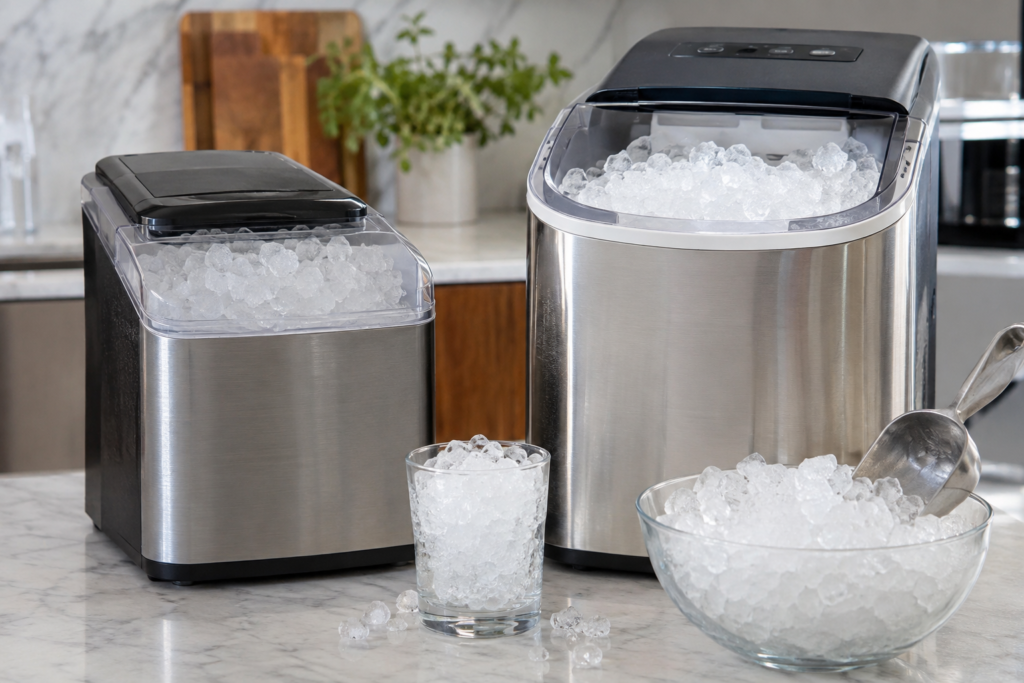
- How Nugget Ice Is Actually Made — And Why It Costs More
- Production Speed Is the Number Everyone Ignores
- Self-Fill vs Plumbed-In Changes Everything About Daily Use
- The Compressor Question Nobody Explains Clearly
- What I Wouldn’t Buy
- Sizing It to How You Actually Entertain
- Nugget Ice Maker Comparison: My Actual Take
- Water Pressure Is the Spec Nobody Checks First
- Does Cheaper Ice Actually Taste Different?
Nugget ice — the soft, chewable stuff — went from a niche Sonic drive-in obsession to one of the most searched kitchen appliance categories in the country. And the price spread is brutal: some units run $100, others push past $500 for what looks like the same machine on the box.
This post contains affiliate links. If you click and buy, I may earn a small commission — at no extra cost to you.
I’ve spent enough time inside appliance category management to know exactly where that $400 gap goes, and it’s not marketing. It’s four things: how the auger actually makes the texture, production speed, storage capacity, and compressor type. Let’s go through them in the order they actually affect your daily use.
How Nugget Ice Is Actually Made — And Why It Costs More
Cube and bullet ice makers freeze water against a chilled surface and release it whole. Nugget ice works differently: a rotating auger inside a chilled cylinder continuously scrapes a layer of soft ice flakes off the cylinder wall, then compresses those flakes together under pressure into the soft, chewable pellet you’re actually after. That compression step is the entire reason nugget ice chews instead of cracks — and it’s mechanically more complex than a simple freeze-and-drop cycle, which is the real reason this category costs more across the board than basket-style cube or bullet units.
The auger itself needs a motor strong enough to continuously scrape and compress against resistance, hour after hour, without binding or overheating. Budget units use a lighter-duty auger motor that works fine but degrades faster under heavy daily cycling. That’s the actual seed of the price gap — everything else below is downstream of it.
Production Speed Is the Number Everyone Ignores
Budget units produce roughly 1-1.5 lbs of ice per hour. Mid-range units hit 2-3 lbs. Premium units, the ones plumbed into your water line, can push 4+ lbs per hour with continuous cycling. If you host, or you’re filling a cooler for the weekend, that difference is the entire experience — waiting six hours for a full bin versus two.
👉 EUHOMY Nugget Ice Maker Countertop, 35 Lbs/24H — $149.92
The entry point that still gets the chew texture right — you’re just filling the tank by hand instead of a plumbed line, and production speed sits in the budget tier described above.
Check Price on Amazon →
Self-Fill vs Plumbed-In Changes Everything About Daily Use
Self-fill units need a manual water refill every day or two. Plumbed units connect directly to your water line and just run. This isn’t a luxury feature for luxury’s sake — it’s the difference between an appliance you maintain and one you forget exists. If you’re buying this for daily household use, not occasional entertaining, the plumbed version pays for itself in convenience within a month.
👉 Avalon Nugget Ice Maker, 38 Lbs/Day, Self-Filling — $299.99
This is where you stop refilling a tank every day — plumb it in once and forget it, at the mid-to-upper end of the production speeds above.
Check Price on Amazon →
The Compressor Question Nobody Explains Clearly
Cheaper units use a single-stage compressor, which works fine but runs louder and cycles less efficiently in warm environments — think garages or non-air-conditioned kitchens in summer. Higher-end units often use a two-stage or higher-grade compressor, which is quieter and holds performance better when the room temperature climbs. If your machine lives somewhere hot, this spec matters more than the brand name on the front, because a struggling compressor in a warm room directly slows the auger cycle discussed above.
👉 COWSAR Nugget Countertop Ice Maker, Dual Compressor, 33 Lbs/Day — $269.97
Dual compressors mean faster recovery between batches — the upgrade that actually matters if you’re using this daily or the machine lives somewhere warm.
Check Price on Amazon →
What I Wouldn’t Buy
A few patterns worth avoiding. Any unit that advertises nugget ice at a suspiciously low price with no mention of auger material — stainless steel augers hold up far longer than the plastic composite ones used to hit an aggressive price point, and a degraded auger is what actually kills these machines, not the compressor. Units with no listed self-cleaning cycle — you’ll be manually descaling with vinegar every few weeks instead of pressing a button, and the auger housing is a genuinely awkward shape to clean by hand. And I’d be skeptical of any plumbed unit under $200 — real plumbing hardware, valves, and a filtration stage cost real money, and a corner-cut version tends to leak or clog at the connection within the first year.
Sizing It to How You Actually Entertain
Storage bin capacity gets overlooked in favor of the daily pounds-per-day number, but it’s the more practical spec for real-world use. A unit that makes 35 lbs a day but only holds 3 lbs in the bin means constant small batches — fine for solo use, frustrating if you’re filling a cooler for guests. If you host regularly, look for at least a 3-4 lb storage bin so you’re not waiting on a fresh batch mid-party.
Countertop footprint is worth measuring before you buy, not after. Plumbed units especially tend to run larger than their listed dimensions suggest once you account for the back clearance needed for water lines and drainage. Measure your actual spot, not just the box dimensions.
Nugget Ice Maker Comparison: My Actual Take
Occasional use, tight budget, kitchen counter placement → budget self-fill unit, and don’t feel bad about it. Daily use, entertaining regularly, or replacing a broken fridge ice maker → plumbed unit is worth the jump. Skip the mid-tier unless it’s specifically on sale — it usually just splits the difference without solving either problem well.
Water Pressure Is the Spec Nobody Checks First
Almost nobody mentions this: plumbed units need real household water pressure to fill efficiently, and if your line pressure is already marginal — common in older homes or upper floors of apartment buildings — a plumbed unit will fill slower than advertised and may trigger error codes. A self-fill model sidesteps this completely since you’re manually pouring water in, which is one reason I don’t automatically push people toward the “premium” plumbed option. Check your pressure before you commit to plumbing one in.
Noise is the other spec that surprises people after purchase. Compressor-based nugget ice makers run closer to a mini-fridge than silent — somewhere in the 45-50 dB range during active ice production. Fine for a kitchen or garage, noticeable if you’re placing one in a home office or bedroom wet bar.
Does Cheaper Ice Actually Taste Different?
Texture depends more on the auger and mold design than price point — budget and premium units both use variations of the same extrusion mechanism described above, which is what makes nugget ice chewable in the first place. What you’re actually paying for as price climbs is production speed, plumbing convenience, and build quality on the compressor and auger, not fundamentally different ice. That said, self-cleaning cycles do matter for taste over time: a unit without one will start producing ice with a faint mineral or plastic taste within a few months if you’re not manually descaling it yourself.
If you’re also dealing with humidity near where you’d place the unit, our countertop ice maker guide covers ventilation needs too. For the mechanics behind why nugget ice comes out softer than cube ice, Wikipedia’s ice maker overview explains the auger-extrusion process.
THE BOTTOM LINE
The $400 price gap in this category comes from the auger and compressor, not marketing — a stronger auger motor and a better compressor are what actually survive daily use. Occasional use, tight budget → a self-fill unit does the job. Daily use or regular entertaining → the plumbed model earns its price in pure convenience. Skip the mid-tier unless it’s specifically on sale.
Cheers, Kazaan.