
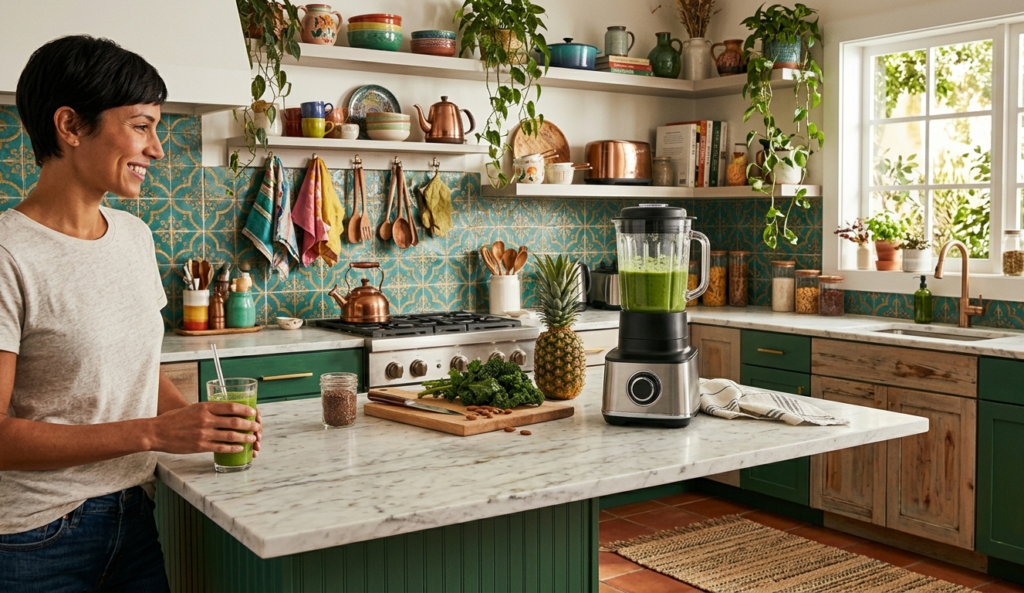
Here’s a number every blender wattage listing leads with: 1,500 watts.
This post contains affiliate links. If you click and buy, I may earn a small commission, at no extra cost to you.
In this post
It sounds serious. It sounds like power. It sounds like the kind of thing that justifies a $120 price tag over the $60 blender sitting right next to it on the shelf.
Blender wattage is one of the most misused specs in the entire category. I’ve sat in rooms where brand teams debated how high to print the wattage number on the box, not how to improve the motor.
Let me explain what’s really going on.
Wattage Is Peak Draw, Not Actual Performance
When a blender says 1,200 watts, that’s the maximum power it can pull from the outlet, usually for about half a second when the motor is under peak stress. It is not a measure of how efficiently that motor converts power into blade speed. It is not a measure of how well the blades are designed. It is not a measure of how good the jar geometry is at pulling ingredients down into the blade path.
All of those things matter more than wattage for most blending tasks.
A well-designed 600-watt blender with a good jar and sharp blades will outperform a poorly designed 1,200-watt blender every single time. I’ve seen it happen. I’ve watched spec sheets get written to impress retail buyers, not to help actual consumers.
There’s a second layer most spec sheets skip. Wattage is what the motor takes from the wall. What reaches the blade is a different number, and the gap between them is lost as heat and friction. A motor with better windings and proper cooling wastes less, so two blenders with the same sticker can deliver very different torque.
The sticker also has a ceiling. A standard US kitchen outlet is a 15-amp circuit at 120 volts. That’s 1,800 watts at the absolute maximum, and plenty of kitchens put several outlets on the same circuit. A 1,500-watt blender is already pulling most of what that circuit has to give. That’s why household blender wattage stops climbing where it does, and why a bigger number isn’t a strategy.
So When Does Blender Wattage Actually Matter?
It matters at the extremes.
If you’re blending frozen fruit from frozen, not slightly thawed, actually frozen, you need a motor strong enough to handle that resistance without burning out. In that case, anything under 700 watts is probably going to struggle over time.
If you’re making nut butter, blending dates, or processing fibrous vegetables like raw beets, you’re in similar territory. These tasks require sustained power, not just peak draw.
For everything else (smoothies with fresh fruit, soups, sauces, pancake batter, protein shakes) you don’t need 1,500 watts. You need a decent motor, a well-made jar, and sharp blades that stay sharp.
The NutriBullet 600 has been destroying smoothies for over a decade at 600 watts. The Vitamix E310 runs at 1,380 watts and is worth every dollar, but not because of the number on the spec sheet. It’s because of the motor quality, blade design, and the 5-year warranty that tells you something real about how it’s built.
Wattage is a proxy. It’s not the thing itself.

The Spec That Actually Predicts Longevity
If you want one number that tells you more about blender wattage performance than the watt rating itself, look for RPM, revolutions per minute. Some brands publish it, most don’t. When they do, it tells you something closer to actual blade performance.
Even RPM isn’t a silver bullet. A fast blade in a badly shaped jar just spins the smoothie in place. The best test is a boring one: does the jar pull ingredients down into the blades without you stopping to scrape? Read reviews for that sentence, not for the biggest number on the box.
The other thing that tells you more than wattage: the warranty. A 5-year warranty (Vitamix) means something different than a 1-year warranty (most of the $50–80 range). The brand is telling you, in the clearest possible terms, how long they expect their product to last.
That’s the real spec.
Now run the price per watt, and the logic falls apart fast. The $69.99 NutriBullet at 900 watts is about 8 cents a watt. The $99 Ninja at 1,000 watts is about 10 cents. The $379 Vitamix at 1,380 watts is about 27 cents. Going from the Ninja to the Vitamix costs roughly $280 for 380 more watts, which works out to about 74 cents per added watt. Nobody charges that much for a watt. You’re paying for the motor, the blade assembly and the warranty. Wattage is just the part that fits on the box.
Does the Vitamix pay for itself? Not in a straight price comparison. At $379 against a $70 blender, it has to last about 5.4 times as long just to break even. If the cheap one dies in two years, the Vitamix needs roughly eleven. So don’t buy it to save money. Buy it if you blend something hard every day and you’re tired of replacing a motor that struggles. Prices move, so check current numbers before you run this math yourself.
A Practical Guide by Use Case
Daily smoothies, fresh fruit, protein shakes: 500–700 watts is enough. Look at the NutriBullet 900 or the Ninja BN701. You don’t need more.
👉 NutriBullet Pro 900W, $69.99
This is the one I’d point a daily-smoothie person to. 900 watts is plenty for fresh fruit and protein shakes, and you’re not paying for power you’ll never use.
Check Price on Amazon →
Frozen fruit, ice crushing, occasional nut butter: 900–1,100 watts starts to make sense. The Ninja BL610 or the Oster Versa handles this range well.
👉 Ninja Professional BL610, 1000W, $99.00
Handles frozen fruit and ice without hesitation. The Total Crushing blades were built for exactly this. It’s the sweet spot before you’re paying Vitamix money.
Check Price on Amazon →
Daily heavy use, nut butters, hot soups, you want it to last 10 years: This is Vitamix territory. The E310 or the A2300 are the ones I’d look at. Yes, they’re expensive. Yes, they’re worth it, but for a specific type of user.
👉 Vitamix E310 Explorian, $379.00
The 5-year warranty tells you what you need to know. If you’re blending daily for a decade, this is the one that actually gets there, nut butters included.
Check Price on Amazon →
If you’re blending a banana and some almond milk every morning, you are not that user. And that’s completely fine.
A Simple Way to Decide
Skip the spec sheet and start with what you actually put in the jar. Then find the line that fits.
- Fresh fruit, shakes, soups: a 500 to 900 watt blender is enough. Don’t pay for more.
- Frozen fruit and ice most days: look at 900 to 1,100 watts, then check the blade assembly and jar shape, not the sticker.
- Nut butters, hot soups, daily use for a decade: this is the only case where the Vitamix math works.
- Whatever you pick: read the warranty length before the wattage. A longer warranty is the brand putting money behind its own motor.
What I Wouldn’t Buy
A $50 to $80 blender sold on a giant wattage number. When the number is the loudest thing on the box, it’s usually doing the selling because nothing else can. Look for the warranty and a real description of the blade assembly instead.
Anything that prints a peak figure and nothing else. Peak numbers describe a moment, not a blend. If a brand won’t tell you the rated power or the warranty terms, I’d move on.
A Vitamix for a banana-and-almond-milk morning. You’d pay about $280 more than the $99 Ninja to solve a problem you don’t have.
The Honest Bottom Line
Don’t let a blender wattage number make your decision. Ask instead: what am I blending, and how often?
Answer that honestly, and the right blender becomes obvious, without the extra $80 the spec sheet was trying to charge you for.
That’s what this site is here for. If you’re evaluating other kitchen appliances too, read 5 Questions to Ask Before You Buy an Air Fryer, same approach, different category.
Wattage tells you the motor’s ceiling, not what it actually delivers. A 1000W blender with a better blade design will outperform a 1500W blender with a cheap one. Look at the blade assembly and the warranty instead.
Cheers, Kazaan
From Kazaan
New guides, before they hit Google.
No sponsored content. No affiliate-first takes. Just the stuff that actually helps you decide.
Pingback: Is Ninja Worth It? The Essential 7-Point Honest Review
Pingback: Is A Juicer Worth It? The Real Answer Before You Spend $150+ | Food Unites People