
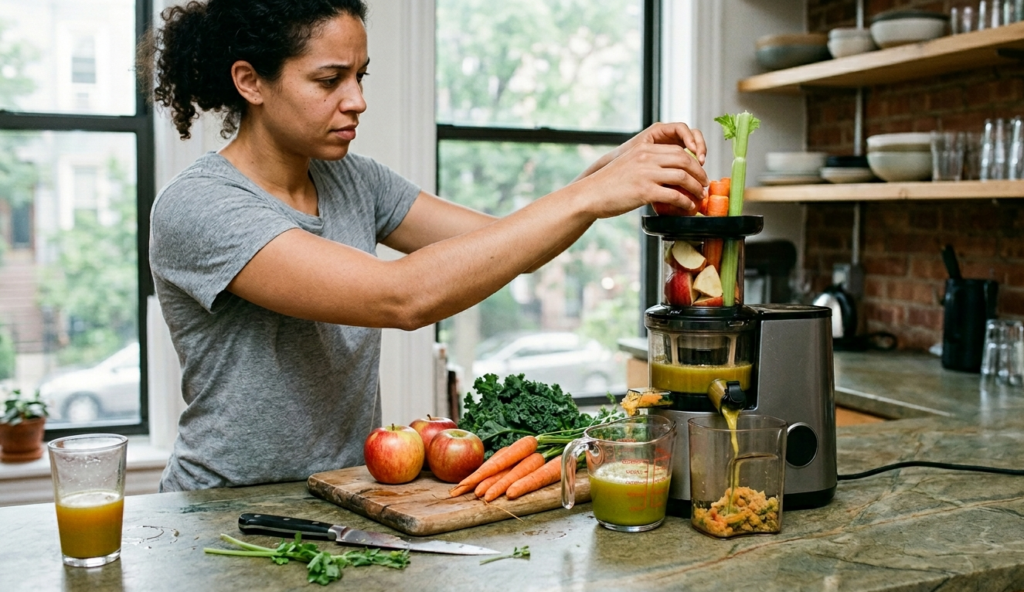
You saw a reel. Someone at a clean countertop, feeding oranges into a machine, full glass in 30 seconds. The whole thing looked effortless. Looked like a decision that would change your mornings.
This post contains affiliate links. If you click and buy, I may earn a small commission — at no extra cost to you.
So you Googled “is a juicer worth it” — and now you’re here, probably with a tab open to Amazon.
Here’s what nobody in those reels shows you.
The 20-minute secret nobody mentions
That 30-second clip? They cut most of it.
Before the juice: wash your fruit. Cut it to size — a juicer’s feed chute is narrower than you think, especially with oranges and beets. Then you juice. Then the real part starts.
After 2–3 minutes of actual juicing, you’re taking apart 6–8 components: the basket, the mesh filter, the pulp container, the lid, the pusher, the juice collector. Every single one needs to be rinsed and scrubbed individually. The mesh filter — the one that does the actual work — clogs with pulp fiber and takes 3 minutes with a dedicated brush under running water to get clean.
Real timeline of a “quick morning juice”:
- Wash and prep fruit: 4–5 min
- Juice: 2–3 min
- Disassemble and clean: 10–15 min
You’re looking at 20 minutes minimum. Before you’ve had your first coffee.
That’s not a healthy morning routine. That’s a second job.
Why the return rate on juicers is brutal
Juicers are one of the highest-return small appliance categories. You don’t hear that often because nobody has an incentive to tell you. But the pattern is consistent: high purchase intent, low sustained usage.
People buy full of motivation. Week one, they’re making juice every day. Week three, they’re skipping days. Month two, the machine is on the counter collecting dust because cleaning it after a long day just isn’t happening. Six months in, it’s in a cabinet. A year later, it’s at someone’s garage sale for $15.
The machine didn’t fail. The routine did.
That’s the honest answer to “is a juicer worth it” — it’s not about the juicer, it’s about whether your actual life has room for the habit.
3 questions to answer before you spend anything
Before you look at a single product, answer these honestly.
Do you have 20–25 minutes in your morning, consistently? Not on motivated days — right now, as your mornings actually run. “I could make time” doesn’t count.
Are you juicing for a specific reason? A health condition, an athletic protocol, something concrete — or just a general sense that you should be eating better? The people who stick with it almost always have a specific reason. “To be healthier” is not a reason. It’s a feeling.
Are you making one glass at a time, or batches? Single glass every morning is the routine most people imagine and the one most people abandon. Batch juicing — making 3–4 days worth at once — changes the math on effort significantly. If you’re planning one glass daily, that’s the highest-risk use pattern.
If your honest answers are “not really,” “not specifically,” and “one glass” — you don’t need a juicer. A good blender handles smoothies in under 5 minutes, cleanup included, and you actually keep the fiber. For most people, that’s the better trade.
If you’ve read this and still want one
Good. Here’s what matters.
Two categories. The rest is noise.
Centrifugal juicers spin at high speed to extract juice. Fast, loud, more affordable — you’re looking at $50–$150 for mainstream options. The spinning generates some heat which technically degrades a small amount of nutrients, but in practice the difference isn’t significant for everyday use. These are the right starting point if you’re not yet sure the habit will stick.
The benchmark here is the Breville Juice Fountain Plus (JE98XL) — around $150, 3-inch feed chute that means less prep cutting, and a design that’s noticeably easier to clean than most competitors in this price range. If you want to test the habit first without committing $150, the Hamilton Beach 67608A sits around $55 and does the job without the Breville build quality. It’s fine for finding out if juicing fits your life.
Cold press (masticating) juicers press and squeeze slowly instead of spinning. Quieter, better juice quality, more nutrients retained, and the juice oxidizes more slowly — which means it actually stores in the fridge for 48–72 hours without losing much. More expensive ($150–$400+) and more components to clean, but if you’re serious about daily juicing, the quality difference is real and the storage advantage changes the habit equation.
The best value in this category is the Omega J8006HDS — around $220, handles hard and soft produce equally well, comes with a 15-year warranty (which tells you something about build confidence), and doubles as a food processor for nut butters and baby food. At the higher end, the Hurom H-AA (~$350) is where dedicated juicers land when they outgrow the Omega.
One thing to do before buying either: search [model name] how to clean on YouTube. Watch the full process. If it looks manageable at room temperature, fine. If it looks like a hassle — multiply that feeling by 365 days and a tired Tuesday evening. That single video tells you more than any spec sheet ever will.
My 3 Picks — Juicers
Best to Test the Habit: Hamilton Beach Big Mouth Juicer (~$76)
👉 3-inch feed chute, 800W motor. Around $55–$76 depending on sales — cheaper than the Breville, without the build quality. Fine for finding out if juicing actually fits your life before you commit more.
Check Price on Amazon →
Best Overall (Centrifugal): Breville JE98XL Juice Fountain Plus (~$150)
👉 The benchmark centrifugal juicer. 3-inch feed chute means less prep cutting, 850W motor, dual speed. This is the right starting point if you’re not yet sure the habit will stick but want something reliable.
Check Price on Amazon →
Best Value (Cold Press): Omega Cold Press Masticating Juicer (~$264)
👉 Handles hard and soft produce equally well, triple-stage 80-RPM slow masticating, 15-year warranty — which tells you something about build confidence. Also doubles as a food processor for nut butters and baby food.
Check Price on Amazon →
So, is a juicer worth it?
For the right person — genuinely yes.
If you have a consistent 25-minute window every morning, a real reason to juice beyond general wellness, and you’re thinking in batches rather than single glasses — a juicer pays for itself fast. A bottle of cold-pressed juice at Whole Foods runs $8–$12. Make two glasses a day at home and you recover the cost of a $150 centrifugal juicer in about three weeks.
If you’re buying because a reel made it look easy — you’re buying a $100–$300 cabinet decoration. I’m not being harsh. I’m being honest about a pattern that plays out thousands of times a year.
The question isn’t whether juicers work. They work. The question is whether your actual morning has room for one.
If you’re on the fence: start with a blender. Build the habit of drinking something fresh every morning first. Upgrade to a juicer when you know — not think, know — that you want more.
Thinking about other kitchen appliances too? Read What Blender Wattage Actually Means — most people overthink that one too.
THE BOTTOM LINE: A juicer is only worth it if you’ll actually use it — and the honest failure point is cleanup, not taste. Testing the habit: start with a sub-$80 centrifugal like the Hamilton Beach. Committed to daily juicing: the Breville JE98XL is the reliable centrifugal benchmark, or step up to a cold press like the Omega for better juice quality and 48–72 hour fridge storage. Watch a cleaning video before you buy — it tells you more than any spec sheet.
Cheers,
Kazaan