
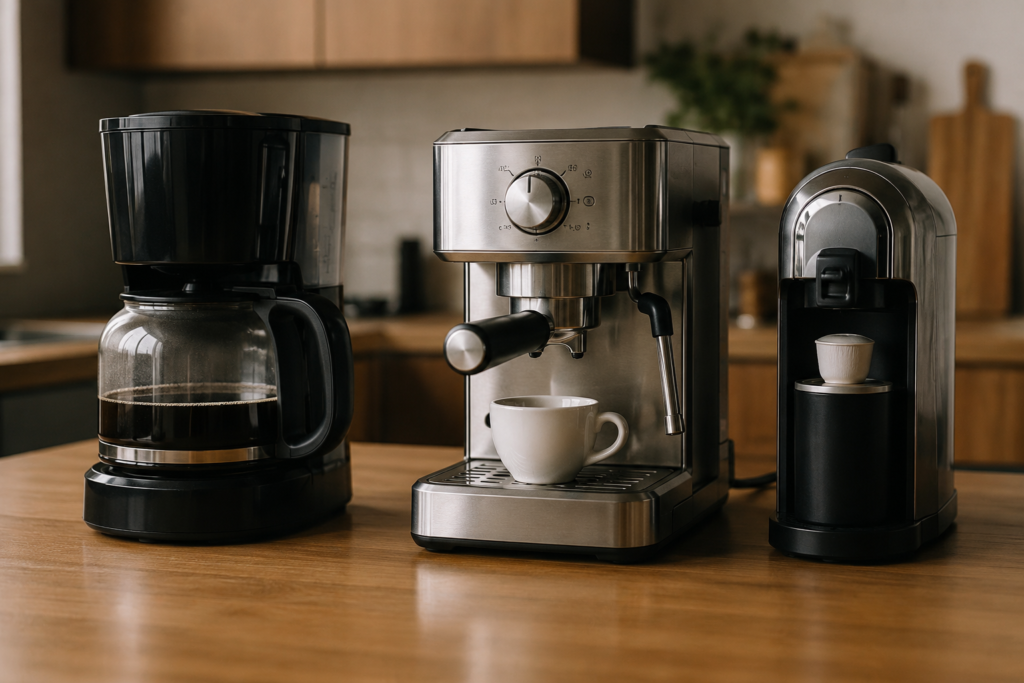
- Drip: The One People Underrate
- Espresso: Buy It for the Ritual, Not the Convenience
- Pod Machines: The Real Cost Nobody Calculates
- Drip vs Espresso vs Pod Coffee Maker: Match It to Your Morning
- What the Numbers on the Box Really Mean
- The Grinder Question Most People Skip
- The Real Cost Gap Nobody Runs the Numbers On
- Can a Pod Machine Actually Pull Real Espresso?
- Three Questions That Settle It
- What I Would Not Buy
Nobody needs a $2,000 espresso machine to make good coffee. And almost nobody actually knows which category fits their real morning, versus the one they think looks best on the counter.
This post contains affiliate links. If you click and buy, I may earn a small commission, at no extra cost to you.
Drip: The One People Underrate
Modern drip machines with a good showerhead design and proper brew temperature (around 195-205°F, check the spec sheet, most budget units run cooler and under-extract) produce coffee that competes with pour-over. If you drink 2+ cups a day and want consistency without a learning curve, this is still the most underrated category in the store.
👉 Amazon Basics Programmable 12-Cup Drip Coffee Maker, $34.99
The baseline drip experience, set it the night before, wake up to coffee. No learning curve, no upkeep beyond a rinse.
Check Price on Amazon →
Espresso: Buy It for the Ritual, Not the Convenience
A real espresso machine, even an entry-level semi-automatic, has a learning curve measured in weeks, not days. Grind size, tamp pressure, dial-in time. If you want that process, it’s genuinely rewarding. If you just want a latte in the morning without thinking, you’re better off with a pod machine or a super-automatic that grinds and tamps for you.
👉 Espresso Machine with Grinder, 20 Bar ULKA Pump, $298.31
Built-in grinder means fresh beans every shot. This is the tier where espresso actually starts tasting like espresso.
Check Price on Amazon →
Pod Machines: The Real Cost Nobody Calculates
Pod machines win on convenience and lose on cost-per-cup, you’re often paying triple or more per cup compared to drip. That’s a fair trade if you make 1 cup a day and value zero cleanup. It stops making sense the moment you’re brewing for a household of 3-4 people daily.
👉 Nespresso Vertuo Next by Breville, $125.00
Pods trade cost-per-cup for zero mess and zero decisions, worth it if convenience matters more than dialing in your own shot.
Check Price on Amazon →
Drip vs Espresso vs Pod Coffee Maker: Match It to Your Morning
Solo, low-maintenance, one cup → pod. Household, daily volume, value consistency → drip. Want to learn a craft and don’t mind the extra 5 minutes → espresso. The mistake is buying the machine that photographs well instead of the one that matches your actual routine.
What the Numbers on the Box Really Mean
The 20 bar figure on many home espresso machines is the peak pressure the pump can reach. Espresso itself is usually extracted at around 9 bar, held there by a pressure valve. So a bigger bar number does not mean better coffee. The grinder, the boiler and the freshness of the beans decide the cup. When I compare machines, I ignore the pump spec and look at what grinds the coffee and heats the water.
Drip works on a different principle. Hot water, ideally between 195 and 205°F, runs through ground coffee over four to six minutes. No pressure, just time. That is why a drip maker that holds its temperature matters more than one with a long feature list. Pod machines skip all of this. The machine reads the capsule and handles the brew for you, and what you are paying for is repeatability.
The Grinder Question Most People Skip
Whichever side of this drip vs espresso vs pod coffee maker decision you land on, grind freshness changes the result more than the machine does. Pre-ground coffee starts losing aroma within days of opening the bag. A cheap drip machine with fresh-ground beans will consistently out-taste an expensive pod system running on beans that sat on a shelf for months. If you’re serious about any of these three options, a basic burr grinder is a better first upgrade than a pricier machine.
Water quality matters too, more than most people expect. Hard water leaves mineral buildup that affects both taste and machine lifespan. This applies across drip, espresso, and pod machines equally. A basic filter pitcher solves most of it for under $30.
The Real Cost Gap Nobody Runs the Numbers On
Drip wins long-term cost comparisons by a wide margin, and that gap holds no matter how you slice it. A pod costs roughly $0.50-0.80 per cup. Drip coffee, even with decent beans, runs closer to $0.15-0.25 per cup. Over a year of daily coffee, that’s a $150-200+ difference, enough to buy a genuinely good espresso machine outright if you’d rather redirect that money into a one-time purchase instead of an ongoing pod subscription.
Espresso sits in between depending on how you source beans, buying whole bean in bulk keeps cost-per-shot reasonable, but specialty or single-origin beans push it closer to pod-machine territory per cup.
Can a Pod Machine Actually Pull Real Espresso?
Some can get close, but true espresso needs roughly 9 bars of pressure and a fine, consistent grind. Most pod systems compromise on one or both to keep the pod format simple and mess-free. What you get from a pod-based “espresso” setting is usually closer to a strong, concentrated coffee than genuine espresso with real crema. If crema and proper extraction actually matter to you, a semi-automatic machine with its own grinder is the only category that reliably delivers it.
If your kettle habits overlap with your coffee routine, our electric kettle buying guide is a natural next read. For the pressure science behind real espresso extraction, Wikipedia’s espresso overview covers it well.
Three Questions That Settle It
How many cups do you make each morning? If it is two or more, drip wins on time. A 12-cup carafe takes about five minutes and you can walk away. How much milk do you drink? If most of your cups are lattes, the steam wand or frother matters more than the coffee machine itself. How much attention will you give it at 6:45 a.m.? Espresso with a grinder is five to ten minutes of hands-on work. A pod machine is about a minute. Be honest about the morning you actually have, not the one you imagine.
If you drink coffee black and in a hurry, buy drip. If you drink milk drinks and enjoy the process, buy espresso. If you want consistency and zero cleanup and accept the cost, buy pods.
What I Would Not Buy
I would not buy a drip maker with a glass carafe on a hot plate if you drink coffee slowly. The hot plate holds the coffee at around 175°F, and after half an hour it tastes burnt. A thermal carafe fixes that for a few dollars more. I would not buy an espresso machine and then skip the grinder budget. Pre-ground coffee goes stale fast and a cheap machine cannot rescue it. And I would not buy pods on autopilot. Work out your cost per cup at three cups a day before you sign up for any subscription. One more filter before I buy any of the three: I check that replacement parts such as carafes, gaskets and water tanks are sold separately. A machine you cannot repair is a machine you replace the first time something small breaks.
THE BOTTOM LINE
Drink coffee daily and want zero fuss → drip. Want café-quality without learning the process → pod. Willing to learn and refine your technique → espresso earns the extra cost and counter space.
Cheers, Kazaan.