
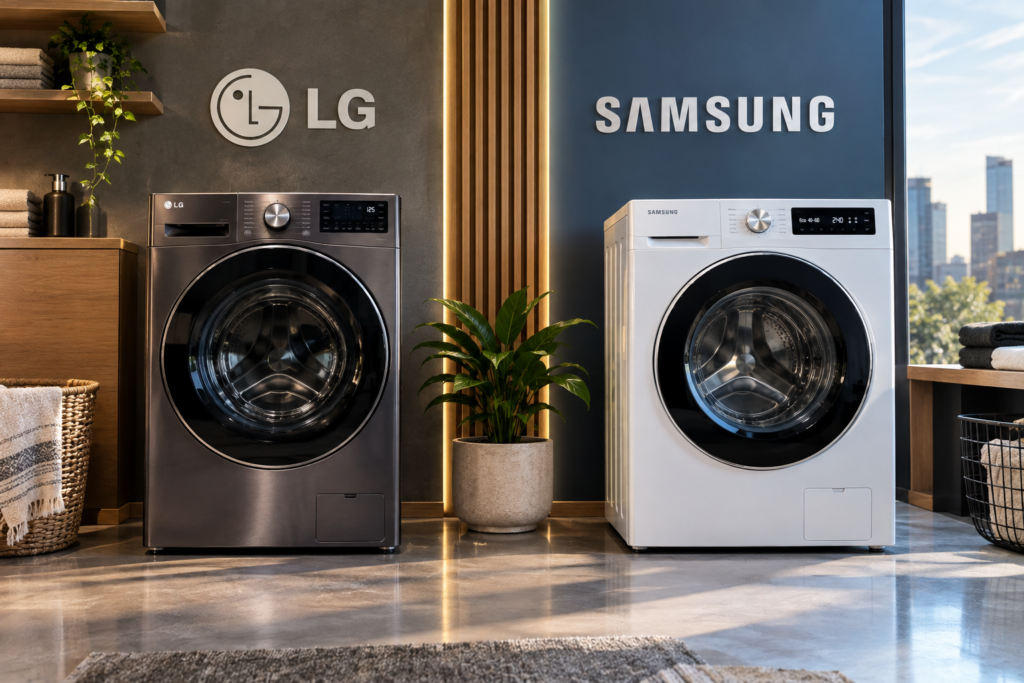
People confuse LG and Samsung for the same company often enough that it’s worth saying plainly: they’re not related, they’re not the same factory under two badges, and they’ve spent two decades trying to out-engineer each other in the exact same product categories.
This post contains affiliate links. If you click and buy, I may earn a small commission — at no extra cost to you.
Same Country, Same Category, Two Completely Separate Companies
LG Electronics and Samsung Electronics are two of South Korea’s largest conglomerates, and in home appliances specifically, they’ve been direct rivals since both brands pushed hard into the U.S. market in the 2000s. Neither owns a stake in the other. Every design decision — the compressor architecture, the ice maker layout, the app ecosystem — is a genuinely separate engineering choice made by a competing company, not a shared platform with different branding. That matters because it means the reliability differences between them are real engineering differences, not marketing variation on the same hardware.
The Compressor Story: What Actually Happened, and What’s True Now
LG’s linear compressor earned a real reputation problem in the 2010s, well-documented enough to result in class-action settlements. The technology itself — a linear inverter design intended to reduce vibration and hold tighter temperature control than a standard rotary compressor — was sound in principle, but early implementations failed at a rate that generated genuine, warranted complaints.
Here’s what’s different now: LG redesigned the linear compressor, and current-generation units perform meaningfully better. One appliance retailer’s five-year service data puts the current failure rate around 1.1% — low enough that LG backs it with a 10-year compressor warranty, a length of coverage a manufacturer doesn’t typically offer on a component it’s still nervous about. The reputation lingers online because complaints from the older generation are still searchable and still get cited, but if you’re buying a 2022-or-newer LG unit, you’re not buying into the same failure pattern that generated the original headlines.
Samsung’s compressor technology — a Digital Inverter design that adjusts cooling in smaller increments — hasn’t carried the same public reputation problem, but it’s not because Samsung’s compressor is definitively more reliable. It’s because Samsung’s most visible failure point has been somewhere else entirely.
Where Each Brand Actually Fails
LG’s Failure Pattern
Beyond the historical compressor issue, LG’s more common current-generation failures tend to be smaller components — ice maker sensors, water inlet valves — the kind of repair that one appliance-repair company’s service data put in the $80–$150 range. These are annoying but cheap, and LG’s parts availability for them is generally strong.
Samsung’s Failure Pattern
Samsung’s most consistently reported weak point across refrigerator models is the ice maker — fill-tube freeze-ups, drain leaks, and dispensers that quit working. It’s common enough that it shows up as the single most-cited Samsung refrigerator complaint across independent reliability sources. Samsung has addressed this on newer Bespoke models by relocating the ice maker into the freezer compartment instead of the door, which reduces the freeze-up pattern tied to the door-mounted design — a real fix, not a repackaging.
The Real Tiebreaker: Service Network and Parts
This is the part that actually determines your ownership experience more than the spec sheet: LG manufactures a larger share of its own parts and tends to run a more consistent, centralized service network. When something needs fixing, LG’s supply chain for that specific part is generally more predictable, and technician familiarity with LG-specific repairs tends to be more consistent from region to region.
Samsung, by contrast, leans more heavily on third-party authorized service providers in many markets rather than a fully centralized network. That doesn’t mean Samsung repairs are categorically worse — but it does mean your specific experience is more dependent on which third-party shop services your area, which is a genuinely different variable than what you’d face with LG.
👉 LG Craft Ice 4-Door French Door Refrigerator, ~27.8 Cu Ft — typically $2,000–$2,600
dual ice makers with LG’s current-generation compressor and the 10-year compressor warranty — a representative pick for anyone weighing LG’s post-redesign reliability story against the price.
Decision Framework
Choose LG if you want the more centralized, predictable service and parts experience, if the historical compressor concern is what’s holding you back but you’re shopping a 2022-or-newer model, or if door-in-door / InstaView-style access matters more to you than smart-home ecosystem depth.
Choose Samsung if you’re already invested in the SmartThings ecosystem through a Samsung TV or Galaxy phone and want that integration to extend to your kitchen, if Bespoke’s customizable panel colors and design flexibility matter to your kitchen’s look, and if you’re comfortable with the ice maker being the component most likely to need attention over the appliance’s life.
👉 Samsung Bespoke 4-Door French Door Refrigerator with Beverage Center, ~29 Cu Ft — typically $2,200–$3,000
represents Samsung’s current Bespoke lineup with the redesigned ice maker placement — the clearest current answer to Samsung’s most historically reported weak point.
What I Wouldn’t Buy
I wouldn’t buy an older-generation (pre-2022) LG unit secondhand or from clearance stock expecting the same reliability numbers as the current lineup — the redesign is specifically what improved the compressor’s track record, and older stock doesn’t carry that fix.
I also wouldn’t buy a Samsung refrigerator with a door-mounted ice maker if ice maker failures are your top concern and a Bespoke model with the freezer-relocated ice maker is available in your budget — it’s a documented, meaningful design fix, not a marginal upgrade.
👉 LG Standard-Depth Craft Ice Refrigerator with Dual Ice Maker — typically $1,800–$2,400
a more accessible price point in LG’s current lineup that still carries the redesigned linear compressor and its 10-year warranty — useful if the flagship 4-door pricing is out of range.
THE BOTTOM LINE
LG and Samsung are genuinely separate rivals with genuinely different failure patterns, not the same appliance under two names. LG’s historical compressor problem is real but largely resolved on current-generation units, backed by a 10-year warranty and a more centralized, predictable service network. Samsung’s main documented weak point is the ice maker, meaningfully improved on newer Bespoke models, offset by a stronger smart-home ecosystem if you’re already in it. Buy based on which specific failure pattern and service experience you’re more willing to live with — not based on which logo looks more premium in the showroom.
For the wider portfolio context behind these two companies, our broader Whirlpool vs GE vs Samsung breakdown is a useful next read, and if you’re also shopping dishwashers specifically, how to choose a dishwasher.
Cheers, Kazaan.