
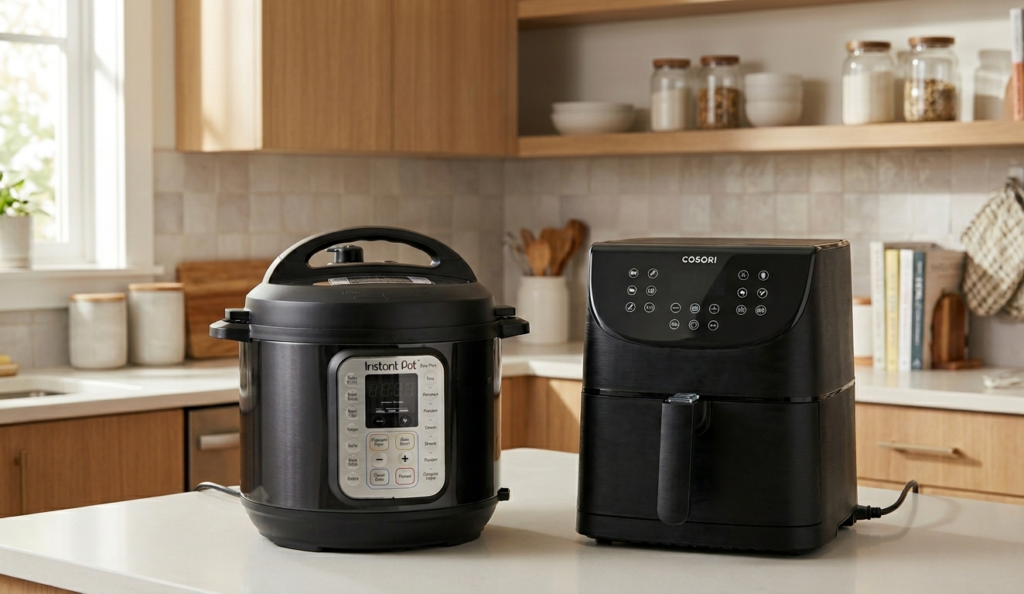
People ask me this all the time. Usually after they’ve already bought one of them and are wondering if they made the wrong call. Short answer: you probably didn’t. But the longer answer — the one that helps — depends entirely on one thing: how you cook on a regular Tuesday night.
This post contains affiliate links. If you click and buy, I may earn a small commission — at no extra cost to you.
Not how you cook when you have time. Not how you cook when you’re entertaining. How you cook when you’re tired, there’s nothing prepped, and you need food on the table in under 40 minutes. That’s the question an instant pot vs air fryer comparison needs to answer. If you’ve already decided on an air fryer, check out my air fryer buying guide — it covers exactly which one to get.
What an Instant Pot Is Actually Good At
An Instant Pot is a pressure cooker with extras. The pressure cooking function is what makes it useful — it cuts cooking time for things like dried beans, tough cuts of meat, and bone broth from hours to under an hour. Chicken thighs from frozen to shredded in 25 minutes. Lentil soup from scratch in 15. A pot roast in 45 minutes instead of 4 hours. Under the hood, it works by sealing steam inside the pot to raise the internal pressure and boiling point well above 212°F — that’s the entire trick, and it’s why a tough cut of meat that normally needs low-and-slow hours breaks down in a fraction of the time.
The slow cooker, rice cooker, and yogurt maker functions exist. Most people use them occasionally. The pressure cooker is what justifies the purchase. What it’s not good at: anything requiring dry heat, texture, or crispiness. A chicken breast cooked in an Instant Pot is soft, tender, and a little sad-looking. It works in a soup or shredded over rice. It doesn’t work when you want a proper roasted meal — the sealed, moist environment that makes pressure cooking fast is the exact opposite of what produces a crisp skin or a browned crust.
👉 Instant Pot Duo 7-in-1, 6Qt — $89.99
The pressure cooking function alone justifies the price — dried beans and pot roast in a fraction of the usual time, using the same sealed-pressure mechanism described above.
Check Price on Amazon →
What an Air Fryer Is Actually Good At
An air fryer is a small, powerful convection oven. It moves hot air around food at high speed, which gives you results closer to deep frying or roasting than a regular oven — but faster and without the oil. Chicken thighs get genuinely crispy skin. Frozen fries taste like fries. Vegetables roast in 12 minutes instead of 30. That speed and crispness comes from the same airflow principle in every convection appliance, just concentrated into a much smaller chamber than a full oven — less air to move means faster heat-up and a tighter, more direct blast at the food’s surface.
It’s also the best reheating appliance I’ve seen. Leftover pizza comes out crispier than fresh. Leftover fries hold up. A microwave makes food hot. An air fryer makes food good again. What it’s not good at: anything that needs liquid, low-and-slow cooking, or significant depth. You can’t make soup in an air fryer. You can’t braise short ribs. You can’t cook a large roast evenly — the same tight, fast-moving air that crisps a chicken thigh will dry out a thick roast before the center catches up.
👉 Ninja AF101 Air Fryer, 4Qt — $89.99
Genuinely crispy skin without the oil — the best reheating appliance in this comparison, hands down, for exactly the airflow reasons above.
Check Price on Amazon →
The Only Question Worth Asking
One question cuts through all of it. Not which appliance is better — how do you actually cook on a regular weeknight?
If your weeknight meals are mostly protein + vegetable — chicken, fish, chops, roasted vegetables — an air fryer makes your life significantly easier. Faster than an oven, crispier results, less cleanup, and it reheats leftovers properly. If your weeknight meals involve soups, stews, beans, grains, or any kind of braised or slow-cooked protein — an Instant Pot will save you more time over a year than almost any other appliance in your kitchen. If you meal prep on Sundays and cook quick meals during the week — you might actually want both. The Instant Pot handles the Sunday batch cooking. The air fryer handles the Monday through Friday reheating and quick proteins.
What You Already Own Matters
Before you make this instant pot vs air fryer call, look at what’s already in your kitchen. If you have a slow cooker: the Instant Pot does everything your slow cooker does, plus pressure cooking. It’s an upgrade worth making eventually. But if you’re happy with your slow cooker and mostly need something for quicker weeknight meals, an air fryer fills a gap your current setup doesn’t.
If you have a decent oven: an air fryer is still worth it. The speed difference alone — most things cook 30–40% faster — makes it useful even when you could use the oven. Especially for smaller portions and reheating. If you have neither: I’d go air fryer first for one or two people, Instant Pot first for a family of three or more who cooks at home regularly.
What I Wouldn’t Do
Buy both on day one before you’ve confirmed you actually have counter space for both — see the section below on how much room these genuinely take up. Buy the combo unit purely to save money without checking whether you’ll actually use both functions regularly — a mediocre version of two appliances isn’t a bargain if you only needed one of them well. And don’t buy an Instant Pot expecting it to replace your oven for a Sunday roast, or an air fryer expecting it to replace a stockpot for soup — matching the appliance to the physics above saves you a return and a lot of disappointment.
The Space Problem Nobody Talks About
Both appliances are large. A 6-quart Instant Pot is roughly the size of a large mixing bowl. A 5-quart air fryer is about the same footprint, and needs 5–6 inches of clearance above it for the exhaust. Together, they take up serious counter space.
I’ve seen people buy both, use them for a month, and then put one in a cabinet because they don’t have room for both on the counter. An appliance in a cabinet is an appliance you stop using. If your kitchen is small, pick one. Don’t buy both hoping you’ll figure out the space situation later.
The Budget Breakdown
The Instant Pot Duo 7-in-1 (6 quart) runs $80–100 on Amazon regularly and drops to $60–70 during Prime Day and Black Friday. It’s one of the best-value kitchen appliances available. The Cosori and Ninja air fryers in the 5-quart range sit at the same price point — $80–100 normally, less during sales.
The Ninja Foodi combines both functions in one unit for $200–250. It works. The air frying isn’t quite as good as a dedicated air fryer, and the pressure cooking isn’t quite as good as a dedicated Instant Pot. But if counter space is the limiting factor and you want both functions, it’s a legitimate option — as long as you’re honest with yourself about the “what I wouldn’t do” section above.
👉 Ninja Foodi OS300 10-in-1, 6.5Qt — $219.99
Both functions in one unit if counter space is the real constraint — not quite as good at either job as a dedicated machine, but a legitimate one-appliance answer.
Check Price on Amazon →
I wouldn’t pay the Foodi premium just to save space unless space is genuinely the deciding factor for you.
The Instant Pot vs Air Fryer Decision: Short Version
One person or two, mostly quick weeknight meals, value reheating: get the air fryer first. Family, regular soup and stew cooking, batch meal prep, or you cook dried beans more than once a month: get the Instant Pot first. Both cooking styles apply to you and you have the counter space: get both. They don’t overlap. They complement.
Neither answers the question of what you should actually cook with them — but that’s a different article.
THE BOTTOM LINE
One or two people, mostly quick weeknight meals, value reheating → get the air fryer first. Family, regular soups and stews, batch meal prep → get the Instant Pot first. Both apply and you have the counter space → get both, they don’t overlap.
Cheers, Kazaan
Pingback: Air Fryer Buying Guide: 5 Questions To Ask Before You Buy