
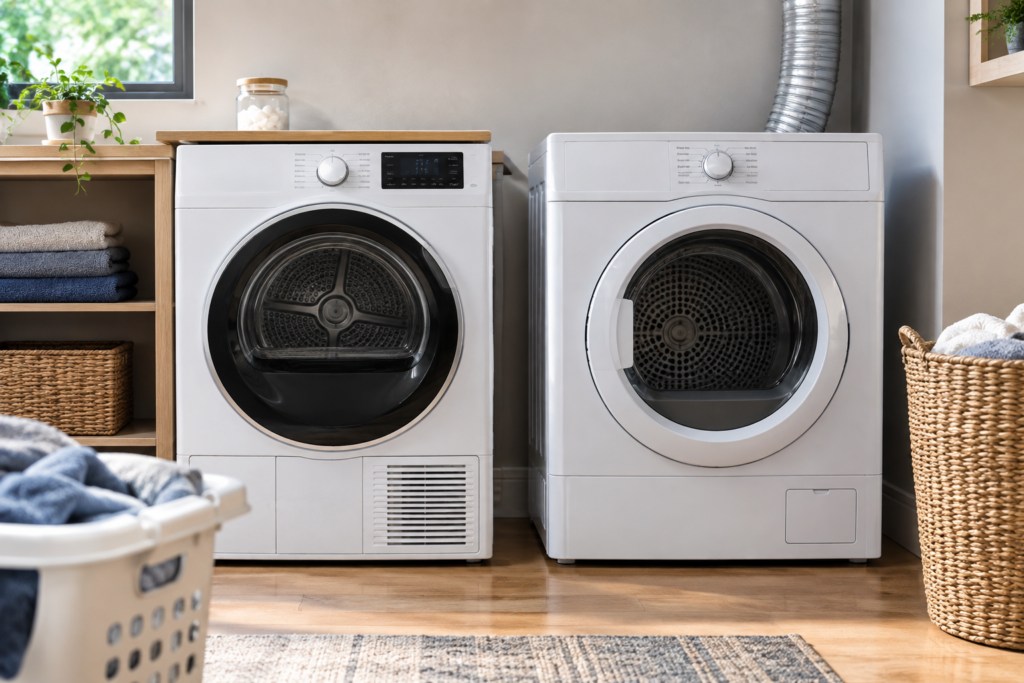
A heat pump dryer used to take five to seven years of energy savings to pay off its higher price tag — long enough that most people reasonably decided it wasn’t worth the wait. In 2026 the category matured enough to narrow that gap on its own, even after the federal tax credit that used to sweeten the deal quietly expired.
This post contains affiliate links. If you click and buy, I may earn a small commission — at no extra cost to you.
Why This Comparison Used To Be Easy (And Isn’t Anymore)
For most of the last decade, the advice on heat pump dryers in the U.S. was simple: interesting technology, popular in Europe, not worth the upfront premium here unless you had no vent option at all. That advice was built on a payback period long enough to outlast most people’s patience — five to seven years before the energy savings actually caught up to the higher purchase price.
One thing that’s genuinely changed the math in 2026: the heat pump appliance segment matured fast. It was already a $5 billion category in 2025 and is projected to grow at a 15.4% compound annual rate through 2035, which means more competition, more models, and steadily falling prices at the premium end — the Samsung DV45DG6000HW below is a direct example of that. What hasn’t changed in your favor: the federal Section 25C tax credit that used to offer up to $2,000 toward qualifying heat pump equipment expired December 31, 2025, under the One Big Beautiful Bill Act, and does not apply to anything purchased in 2026. If you’ve seen articles promising that credit this year, they haven’t been updated. What’s left is narrower — state-administered HEAR/HEEHRA rebates for income-qualifying households, covered below — so the payback case now rests more on falling prices and electricity savings than on a guaranteed federal check.
The Real Mechanism Difference
A vented dryer heats air with an electric element, tumbles it through your wet laundry, and pushes that hot, moisture-loaded air straight outside through a duct. Simple, fast, and it’s why vented dryers have stayed the default for decades — there’s very little that can go wrong mechanically.
A heat pump dryer works closer to how your refrigerator or air conditioner works than how a traditional dryer works. It uses a refrigerant cycle to pull heat out of the air, dry your clothes with it at a lower temperature, and then condense the resulting moisture into a drain or a removable tank — all without ever needing to exhaust air outside. That closed loop is the entire reason it uses so much less electricity: it’s not constantly heating fresh room-temperature air from scratch every cycle the way a vented dryer does, it’s recycling the heat it already generated.
That lower operating temperature is also why heat pump dryers are gentler on fabric — genuinely useful if you own a lot of delicates or activewear — and why the cycle takes longer. Physics doesn’t offer a way around that particular trade-off.
The Trade-offs, With Real Numbers
Purchase Price
A comparable capacity vented electric dryer (7–7.5 cu ft) typically runs $500–$900 depending on brand and features — the Whirlpool WED4815EW, for example, regularly sells in the $500–$700 range. A heat pump dryer at similar capacity runs meaningfully higher: the Samsung DV45DG6000HW (7.5 cu ft) launched at a $1,499 MSRP and has settled to roughly $1,199–$1,299 in 2026 as the category has matured and more competition entered.
Cycle Time
Expect 45–60 minutes for a full load in a vented dryer versus 75–120 minutes in a heat pump model. If your household runs back-to-back loads on a tight schedule — a family doing laundry for six people on a Sunday, for example — that gap is a real lifestyle consideration, not just a spec sheet number.
Installation
This is where the heat pump dryer’s advantage is least disputable. No exterior vent means no cut hole in an exterior wall, no duct to clean or maintain, and installation options a vented dryer simply doesn’t have — interior closets, basements without exterior access, apartments. If you’re in a space where venting outside is expensive or structurally impossible, this alone can outweigh every other factor in the comparison.
👉 Samsung DV45DG6000HW Heat Pump Dryer, 7.5 Cu Ft
2026 pricing has settled around $1,199–$1,299, down from its $1,499 launch MSRP, putting it within reach of the payback math below for a typical household running several loads a week.
The Payback Math Without a Federal Credit
Take the roughly $400–$600 price gap between a comparable vented and heat pump model. Without the expired federal credit, that gap has to be closed by electricity savings and, for some households, a state rebate — not by a guaranteed check at tax time.
Two paths are worth checking before you buy. First, see whether your state has an active HEAR/HEEHRA rebate program — it’s income-gated (generally households under 150% of area median income qualify for something, with the largest rebates under 80% AMI) and administered state by state, so a program that’s fully funded in one state may be waitlisted or not yet launched in another. Second, run the electricity savings on their own: at 50–70% less energy per cycle and roughly 280 dryer cycles a year for an average household, the savings on a typical electric rate can close a $400–$600 price gap over roughly 4–7 years on energy alone — slower than the old tax-credit-assisted math, but still a real, positive payback over the appliance’s typical 10+ year lifespan, especially if you also qualify for a state rebate on top of it.
That’s the honest 2026 picture: heat pump dryers are still a legitimate buy for the right household, but the case now rests on your specific electricity rate, your laundry volume, and whether your state has funding — not on an automatic federal credit that no longer exists.
👉 Whirlpool WED4815EW Vented Electric Dryer, 7 Cu Ft — approx. $498–$699
a straightforward, reliable vented option if your household doesn’t run enough laundry volume to make the heat pump math worthwhile, or if you already have a code-compliant vent in place and no reason to change it.
Decision Framework
Buy a heat pump dryer if you have no practical vent option, if your state has an active HEAR/HEEHRA rebate you qualify for, or if you run enough loads weekly that the energy savings compound meaningfully over the dryer’s lifespan. It’s also the better call if you’re regularly drying delicates or performance fabrics that benefit from lower heat.
Buy vented if speed matters more than anything else in your laundry routine — large families, frequent back-to-back loads — or if you already have vent infrastructure in place and the cost premium isn’t offset enough by your specific usage pattern to justify switching.
What I Wouldn’t Buy
I wouldn’t buy a heat pump dryer assuming a federal tax credit will offset the price — that credit expired at the end of 2025, and several older buying guides still circulating haven’t been corrected. Check your specific state’s HEAR/HEEHRA program status directly before counting on any rebate.
I also wouldn’t switch to a heat pump dryer if your household’s laundry pattern genuinely needs the speed of a vented cycle. A 75–120 minute cycle stacked back-to-back for multiple loads in a day adds up to real wait time, and no energy savings figure changes that math if the appliance doesn’t fit how you actually live.
👉 Whirlpool WHD862CHC Hybrid Heat Pump Dryer, 7.4 Cu Ft, Ventless
a closet-depth, ventless design built specifically for installations where cutting an exterior vent isn’t an option — a real solution for apartments and interior laundry closets, not just an efficiency upgrade.
THE BOTTOM LINE
The federal tax credit that used to make heat pump dryers an easy sell expired at the end of 2025 — don’t buy expecting it. What’s left is a category that’s matured and gotten more competitively priced on its own, plus state-by-state HEAR/HEEHRA rebates for households that qualify. Buy heat pump if you lack venting options, qualify for a state rebate, or run enough laundry volume that the electricity savings add up over a decade of ownership. Buy vented if cycle speed is non-negotiable for your household or you already have a working vent and no compelling reason to switch.
For the pricing backdrop behind these numbers, why appliance prices moved this year, and for the state-by-state rebate picture beyond the HEAR program covered here, what rebate money is actually still available in 2026.
Cheers, Kazaan.
Pingback: Energy Star Most Efficient: The Rebate Math In 2026