
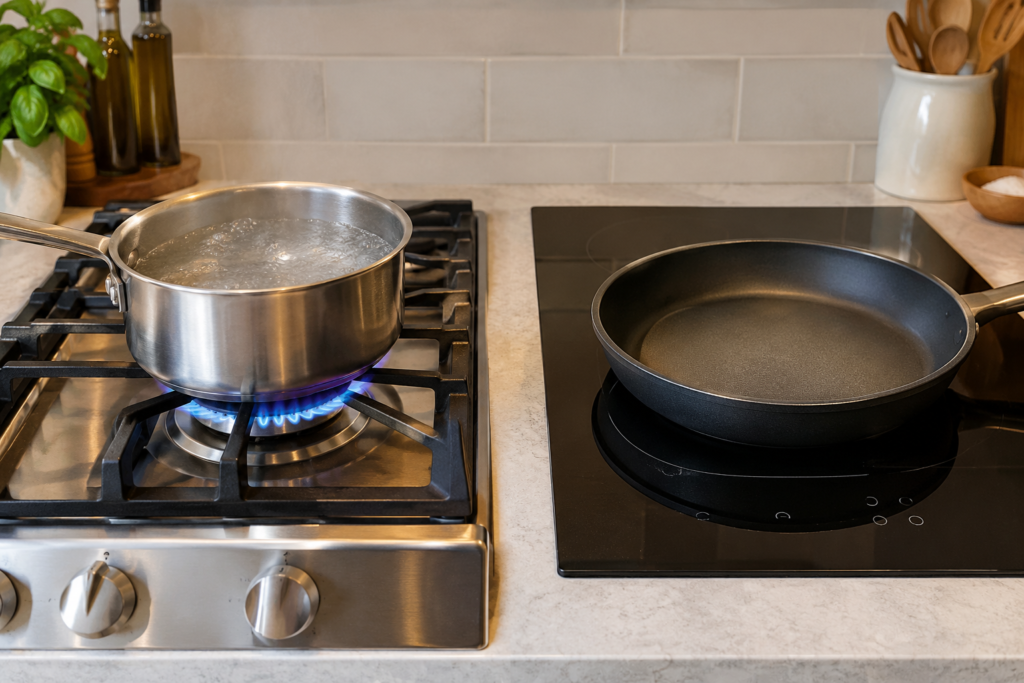
- Why This Debate Gets Heated
- The Efficiency Numbers, and What They Actually Mean for Your Bill
- The Real Installation Cost Nobody Puts on the Box
- Cookware: The Hidden Tax on Switching to Induction
- The Health Question: What’s Established, What’s Contested
- What Chefs Actually Prefer, and Why It Matters Less Than It Used To
- Decision Framework
- What I Wouldn’t Buy
Induction transfers roughly twice as much of its energy into your food as gas does, and gas still costs less to cook with in most of the country. Both of those things are true at the same time, which is why this argument never actually resolves in comment sections.
This post contains affiliate links. If you click and buy, I may earn a small commission, at no extra cost to you.
Why This Debate Gets Heated
Gas versus induction has turned into one of those arguments where people talk past each other because they’re optimizing for different things, efficiency, running cost, cooking feel, indoor air quality, upfront price, and whichever one you care about most tends to make the decision look obvious. It isn’t. Each side has a real, defensible case, and the honest answer depends heavily on your specific electricity rate, your existing electrical panel, and what you actually cook.
The Efficiency Numbers, and What They Actually Mean for Your Bill
Induction is, without much argument, the more efficient technology. Department of Energy and ENERGY STAR testing consistently puts induction at roughly 84% to 90% pan-level efficiency, meaning that share of the energy you put in actually ends up in your food, against roughly 32% to 42% for gas, where most of the heat escapes around the pot into your kitchen air instead of into the pan.
Here’s the part that trips people up: higher efficiency doesn’t automatically mean a lower bill, because natural gas and electricity aren’t priced the same per unit of delivered energy. At national average rates, cooking for an hour a day typically runs somewhere around $50 to $115 a year on gas, versus roughly $95 to $195 a year on induction, gas usually wins on raw annual running cost in most states, specifically because electricity costs more per kWh than gas costs per equivalent therm, even after accounting for induction’s efficiency advantage. That gap narrows or flips in states with high electricity rates or unusually cheap gas trending upward, and it narrows further if you qualify for a state rebate, but as a national default, don’t buy induction expecting a lower utility bill, buy it for the other reasons covered below.
The Real Installation Cost Nobody Puts on the Box
This is the number that gets buried in “induction is the future” articles. If you’re replacing an existing electric coil or radiant range, switching to induction is straightforward, both use the same standard 240V circuit, so you’re often looking at $150 to $300 in labor for a simple swap.
If you’re switching from gas, it’s a different project entirely. Induction ranges need a dedicated 240V circuit, typically 40 to 50 amps. If your panel already has capacity and the run to the kitchen is short, budget $200 to $600. If your panel needs an upgrade or the electrical run is long, that climbs to $600 to $2,000 or more, plus $100 to $300 for a plumber to properly cap the old gas line. All-in, a genuine gas-to-induction conversion, range, circuit, potential panel work, commonly lands in the $1,600 to $5,000 range depending on your home’s existing electrical capacity.
👉 GE Profile 30-Inch Induction Range
a genuinely capable mid-range induction range at the price point where most of the installation-cost math above actually applies, worth budgeting the electrical work into your total project cost, not just the appliance price.
Cookware: The Hidden Tax on Switching to Induction
Induction only works with cookware that has a magnetic base, the cooktop generates heat through an electromagnetic field that needs ferrous metal to react against. Cast iron and most stainless steel cookware work fine. Pure aluminum, copper, and glass do not, unless the piece has a bonded magnetic layer built into its base specifically for induction compatibility. If your current cookware collection leans toward all-clad aluminum-core pieces or a favorite copper set, check each piece with a refrigerator magnet before you commit, if the magnet doesn’t stick to the bottom, it won’t work on induction, and replacing a full cookware set is a real cost that rarely makes it into the installation estimate.
The Health Question: What’s Established, What’s Contested
Gas combustion inside a home releases nitrogen dioxide, carbon monoxide, and ultrafine particulates into indoor air. That part is well-established chemistry, not in dispute. What’s more actively debated is the scale of the health impact. A widely cited 2022 Harvard-affiliated study linked gas stove use to a meaningful share of U.S. childhood asthma cases, and that figure has been repeated across a lot of coverage since. It’s also drawn criticism over its methodology and the strength of the causal claim, and it sits inside a broader, genuinely contested policy debate about gas stove regulation and new-construction hookup restrictions in various cities and states. If reducing combustion byproducts in your kitchen air matters to you, induction removes that source entirely, that’s a straightforward mechanical fact. How much weight to put on the specific health studies is a more contested question, and reasonable people land in different places on it. Whatever you choose, ventilation matters, and I cover ducted vs ductless in the range hood buying guide.
What Chefs Actually Prefer, and Why It Matters Less Than It Used To
Professional kitchens have leaned toward gas for generations, largely for the direct visual feedback of an open flame and compatibility with round-bottomed wok cooking. That preference is real, but it’s becoming less absolute, modern induction’s near-instant temperature response actually beats gas on responsiveness in blind comparisons, and flat-bottom induction-compatible woks have closed much of the gap for stir-fry style cooking. If you’re an experienced home cook who specifically values flame control as part of your process, that preference is legitimate and worth weighing. If you’re not already deeply attached to cooking over an open flame, this is a smaller factor than the marketing on either side suggests.
👉 Induction-Compatible Stainless Steel Cookware Set
solves the cookware compatibility gap directly, a full-clad stainless base that works on induction, gas, and electric alike, useful if you’re not ready to commit to induction-only cookware.
Decision Framework
Choose induction if efficiency and eliminating combustion byproducts from your kitchen air matter to you, your panel already has 240V capacity or you’re budgeting for the electrical work, and your cookware is already induction-compatible or you’re willing to replace it.
Choose gas if minimizing your annual running cost is the priority, you already have gas service and don’t want to absorb a conversion project, or flame-based cooking technique genuinely matters to how you cook.
👉 Whirlpool 30-Inch Gas Range with 5 Burners
a straightforward, reliable gas range for anyone whose kitchen already has gas service and no compelling reason to take on an electrical conversion project.
What I Wouldn’t Buy
I wouldn’t switch to induction purely chasing a lower utility bill, as covered above, that’s usually not what actually happens at national average rates. Switch for efficiency, air quality, or cooking performance reasons you actually care about, not for savings that likely won’t materialize.
I also wouldn’t buy an induction range without checking your cookware collection against a magnet first, or budgeting for replacements. It’s the single most common surprise cost in a gas-to-induction switch, and it’s the easiest one to check in advance.
THE BOTTOM LINE
Induction is genuinely more efficient and eliminates combustion byproducts from your kitchen air, that’s not in dispute. Gas is still cheaper to run in most states and doesn’t require an electrical conversion project if you already have service. Neither side “wins” this argument in the abstract; it depends on your electricity rate, your panel’s capacity, your cookware, and which trade-off, running cost versus efficiency and air quality, actually matters more in your kitchen.
If you’ve already decided induction is the direction, our full induction cooktop buying guide goes deeper on specific models, and what rebate money is actually available in 2026 before you factor any rebate into the installation cost.
Cheers, Kazaan.