
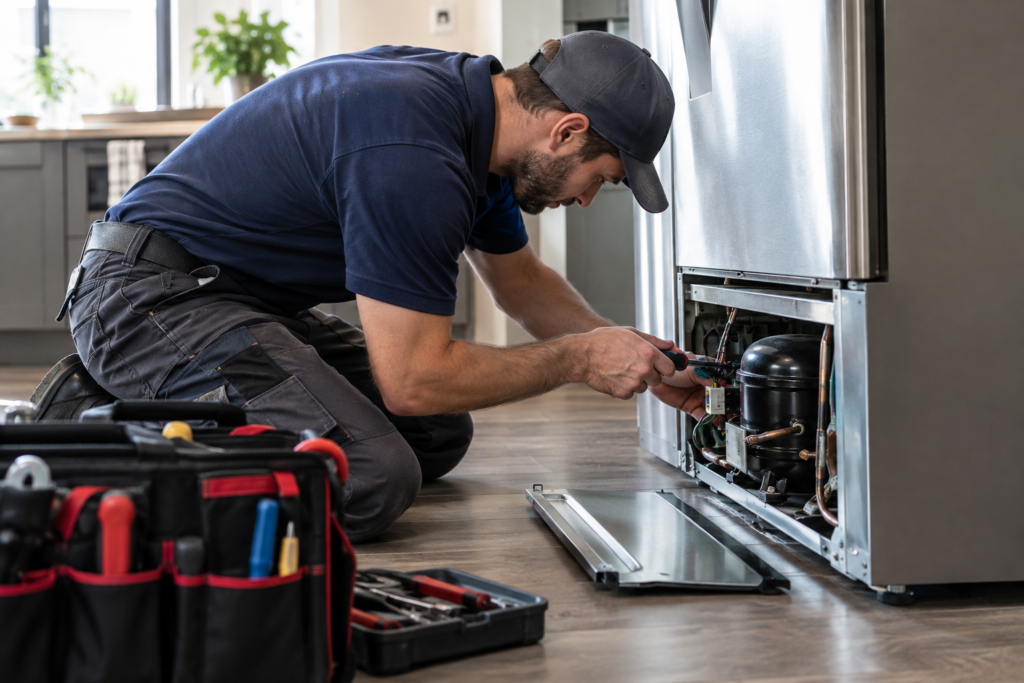
The median completed appliance repair in 2026 runs about $277, parts, labor, and the diagnostic visit combined, and three separate, unrelated trends are pushing that number up at the same time, which is part of why it doesn’t feel like it’s just “inflation.”
This post contains affiliate links. If you click and buy, I may earn a small commission, at no extra cost to you.
Three Things Are Happening at the Same Time
When one cost goes up, there’s usually one explanation. When appliance repair costs go up the way they have recently, it’s worth separating out what’s actually driving it, because three genuinely independent trends are compounding at once: parts got more expensive, the workforce that installs them got smaller and older, and the appliances themselves got more electronically complex to work on. None of these three would be a big deal on its own. Together, they’re why a repair bill that used to feel routine now sometimes prompts a real “is it worth fixing” conversation.
Parts: The Tariff Pass-Through Nobody Explains
Replacement parts, control boards, compressors, electronic modules in particular, have risen roughly 12% to 25% in price since the start of 2025. This traces back to Section 301 and related tariffs on imported components, the same broad tariff pressure that pushed up new-appliance prices this year. The mechanism is the same one that drives new-appliance pricing: a cost increase at the border for imported parts and sub-assemblies gets passed through the supply chain to the distributor, then to the repair shop, then to your invoice. It doesn’t get announced with the same visibility as a new refrigerator’s sticker price, because nobody’s watching parts pricing the way they watch new-appliance pricing, but the technician ordering your dryer’s control board is paying more for it than they were 18 months ago, and that shows up in what you’re charged.
Labor: A Shrinking, Aging Workforce
This is the less obvious driver, and arguably the more structural one. The Bureau of Labor Statistics counts only around 37,300 home appliance repairers nationwide, a small occupation to begin with, and one that’s aging out faster than it’s being replaced. The average technician is in their early-to-mid forties, retirements are accelerating, and the field is losing talent specifically to HVAC work, where the Bureau projects roughly 9% employment growth through 2033, faster than average, and often better-paying for comparable skill and licensing requirements.
Fewer available technicians relative to demand pushes labor rates up on its own, independent of parts costs entirely. Current hourly labor rates run roughly $50 to $150, with a national average closer to $100 to $125, a real increase from where those rates sat even a few years ago, driven straight by the basic supply-and-demand math of a shrinking skilled workforce.
Complexity: Why “It’s Just a Sensor” Isn’t Cheap Anymore
Older appliances relied heavily on separately serviceable mechanical parts, a belt, a valve, a simple switch, that a technician could diagnose and replace in isolation. Newer appliances integrate far more electronics: control boards that manage multiple functions at once, moisture and temperature sensors tied into smart connectivity, modules that bundle several components into one assembly rather than several individually replaceable ones. When one part of that bundle fails, you’re sometimes paying to replace the whole assembly, not just the specific piece that broke, a structural shift in how appliances are built, not a pricing decision by any one repair company.
This complexity also shows up in a statistic that’s easy to miss: industry data puts the average technician’s first-call fix rate at only around 50%. Half the time, the needed part isn’t already in the truck and has to be special-ordered, which means a second service call, a second labor charge, and, depending on the brand’s parts-sourcing setup, a real wait before the second visit can even happen.
The Real Numbers Right Now
Putting it together: the median completed repair nationally runs around $277, with a broader range of $100 to $400 depending on appliance type and failure severity, refrigerators tend to run highest, since compressor and sealed-system repairs are both parts-expensive and labor-intensive. That’s meaningfully higher than what most people remember paying for a comparable repair several years ago, and it’s not one single cause, it’s tariff-driven parts costs, a shrinking labor pool, and increasingly integrated electronics, all moving the same direction at the same time.
A Repair or Replace Rule You Can Use Today
Use the 50 percent rule. Get a written estimate for the repair. Divide it by the price of a comparable new model. If the estimate is more than half of that price, replace. If it is less than a third, repair, as long as the appliance is not already near the end of its life. Between a third and a half, look at the age. The median $277 repair against a $900 replacement is about 31 percent, so on a younger machine it is usually worth fixing.
Age matters because the next failure is coming. Refrigerators and ranges tend to last 10 to 15 years, washers 10 to 14. A $277 repair on a three-year-old washer buys you many more years. The same repair on a twelve-year-old one may buy you a year or two before the next bill. Ask the technician what else is wearing out. A good one will give you an honest answer. A vague one is a sign to get a second estimate.
Before you book anyone, ask three questions. Is the diagnostic fee credited if I go ahead with the repair? Do you stock common parts for my brand or order them each time? What is the warranty on the repair itself? Short, clear answers to all three are a good sign. If you get hedging on any of them, thank them and call the next shop. A repair is a purchase like any other, and it deserves the same comparison shopping.
What I Wouldn’t Do
I wouldn’t assume a repair quote that feels high is padding or overcharging without checking it against current parts and labor reality, the increases described here are industry-wide, not specific to one company trying to take advantage of you.
I also wouldn’t automatically choose the cheapest quote you get without asking about first-call fix likelihood and parts availability for your specific model. A technician who has to special-order a part and come back a second time often ends up costing more in total than a slightly higher initial quote from someone who stocks the part already, the sticker number on the first call isn’t always the real total cost.
THE BOTTOM LINE
Appliance repairs cost more right now because of three separate trends landing at the same time: parts prices up 12% to 25% since early 2025 from tariff pass-through, a shrinking and aging technician workforce pushing labor rates up independently, and increasingly complex, electronics-heavy appliance design making individual repairs pricier and more likely to need a second visit. None of these is temporary noise, they’re structural, and they’re the reason the median repair bill sits where it does today.
Some of this traces back to the same pressure covered in why new appliance prices went up this year, and if you’re deciding whether to repair or just replace, whether an extended warranty is worth it is worth reading alongside this.
Cheers, Kazaan.