
KitchenAid lists its Professional 600 at 575 watts and a newer, more expensive mixer at 500 watts — and the 500-watt model is not weaker. That single fact tells you more about how to actually shop this brand than any spec sheet will.
This post contains affiliate links. If you click and buy, I may earn a small commission — at no extra cost to you.
The Wattage Number That Doesn’t Mean What You Think
Every KitchenAid comparison chart puts wattage front and center, and it’s the number most people use to decide which model is “more powerful.” Here’s the problem: wattage is a measurement of electrical input, not mechanical mixing output, and KitchenAid uses different internal motor and gearing designs across its model families. Comparing wattage across two different product lines is like comparing two cars by how much gas flows into the engine instead of how much torque reaches the wheels.
Within a single line, the number is meaningful — an Artisan’s 325-watt motor genuinely has more headroom than a Classic’s 275-watt motor, because they share the same core construction and only the motor differs. But across lines — comparing a 575-watt Professional 600 to a 500-watt Artisan Plus, for example — the number stops being a reliable shorthand for real-world power. This is exactly the kind of detail that shows up when you’ve actually had to explain a spec sheet to a customer instead of just reading one: KitchenAid isn’t being dishonest, it’s segmenting the wattage number by audience, because different buyers respond to different framing on the same underlying hardware.
Tilt-Head vs Bowl-Lift: The Real Engineering Line
The dividing line that actually matters is tilt-head versus bowl-lift, and it’s a mechanical decision, not a marketing tier.
Classic, Artisan, Artisan Plus — The Tilt-Head Tier
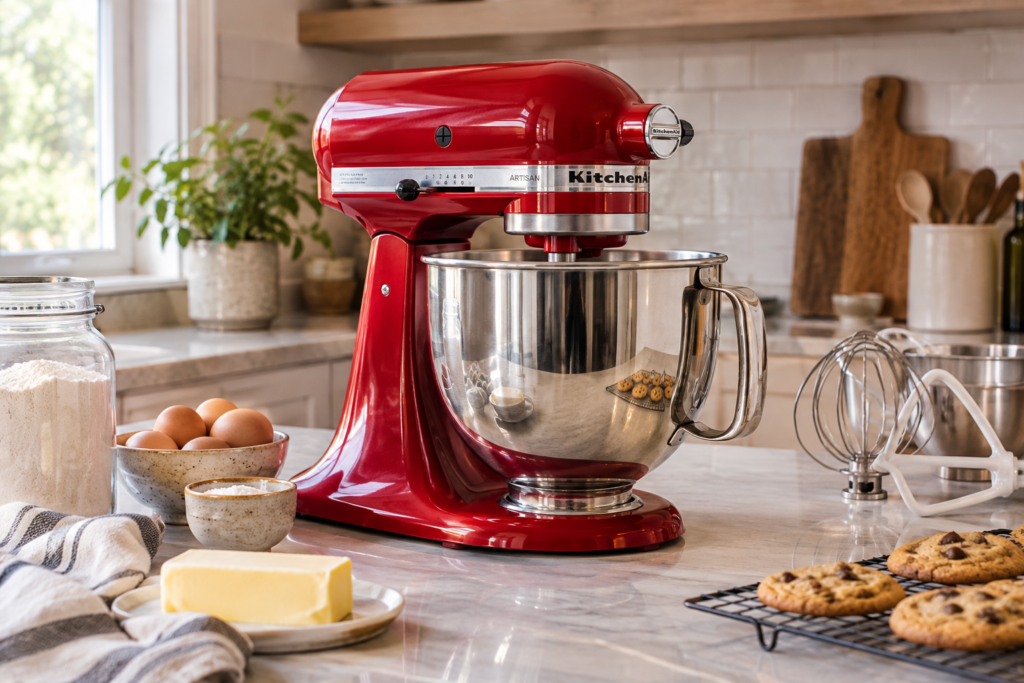
Tilt-head mixers pivot the motor head up and away from the bowl, which makes it easy to add ingredients or swap attachments mid-mix, and takes up less vertical counter clearance. The Classic (4.5 qt, 275W, ~$259–$349) is the base version — plain bowl, no handle, fewer accessory bundles. The Artisan (5 qt, 325W, list around $449.99, frequently discounted to $349) adds a bowl handle, a pouring shield, and by far the widest color selection in the lineup — this is the model most people picture when they picture a KitchenAid. The new Artisan Plus (launched 2026, $599.99) is the first tilt-head redesign in decades, adding built-in LED lighting and more precise speed control — a genuine engineering update, not a repaint.
Professional 600 and Commercial — The Bowl-Lift Tier
Bowl-lift mixers raise the bowl up into a fixed motor head using a lever, which creates a more stable, rigid connection — the bowl doesn’t have any give the way a tilt-head’s hinge does. That stability is what actually matters for dense, heavy mixtures: bread dough, pizza dough, stiff cookie batter in large quantities. The Professional 600 (6 qt, 575W, list around $549.99, frequently seen near $499.99) is the standard bowl-lift home model. The Commercial (8 qt, 1.3 HP DC motor, roughly $999.95) is genuinely a different class of machine — a DC motor instead of AC, built for volume that most home kitchens never approach.
👉 KitchenAid Classic Series Stand Mixer, 4.5 Qt — ~$349
the same core tilt-head mechanism as the Artisan at a lower cost — you’re giving up a bowl handle and some color options, not mixing performance for normal home baking.
Where the KitchenAid Premium Actually Comes From
KitchenAid is a Whirlpool brand, and it moved through the same 2026 pricing pressure as the rest of Whirlpool’s portfolio — but the KitchenAid premium over generic stand mixers predates any of that. It comes from three things that are genuinely hard to replicate cheaply: the all-metal gear-driven transmission (not plastic gears, which strip under load over years of use), the planetary mixing action that hits multiple points around the bowl per rotation instead of just spinning in place, and a parts and service network that’s been supporting the same core mixer design for decades. A KitchenAid bought in 2015 can still get a replacement gear or motor brush today. That’s not true of most appliance brands at any price point, and it’s the actual reason the upfront cost gets justified over a 10+ year ownership period instead of a 3-year one.
That transmission detail matters more than it sounds like it should. A cheaper stand mixer built around plastic gearing is engineered so that under real overload — a stiff bagel dough, a double batch of bread, cold butter that hasn’t fully softened — the gears are designed to strip rather than let the motor burn out. It’s a legitimate safety mechanism, but it also means the mixer’s practical ceiling is lower than its marketed capacity. KitchenAid’s metal gear-driven transmission doesn’t have that same built-in failure point, which is why you’ll see KitchenAid mixers marketed as capable of handling dense, heavy mixtures that a similarly priced plastic-gear competitor explicitly warns against. That’s not a subjective quality feeling — it’s a different mechanical design choice with a directly testable consequence.
👉 KitchenAid Artisan Series Stand Mixer, 5 Qt — $449.99 (frequently $349)
the most balanced model in the lineup — enough motor headroom for regular home baking, the widest color range, and the price point where KitchenAid’s resale value and parts availability hold up best over a decade of ownership.
Decision Framework: Which Tier Is Actually Right For You
Buy Classic or Artisan if you bake in normal home quantities — cookies, cakes, weekly bread, occasional pizza dough. The tilt-head design and mid-range motor genuinely cover that range without leaving performance on the table.
Buy Professional 600 if you regularly make large or dense batches — sourdough in volume, bagel dough, thick pasta dough — where bowl-lift stability stops being a nice-to-have and starts being the thing that keeps the machine from walking across the counter under load.
Skip Commercial unless you’re running an actual small bakery or catering operation out of your kitchen. The 1.3 HP motor and 8-quart bowl are built for a workload almost no home cook consistently generates, and the price reflects that.
What I Wouldn’t Buy
I wouldn’t buy based on the wattage number alone across different model lines — as covered above, it’s not a reliable power comparison once you cross from tilt-head to bowl-lift construction, or between generations. Compare bowl capacity, motor type (AC vs DC), and mechanism (tilt-head vs bowl-lift) instead.
I also wouldn’t buy the Artisan Plus specifically for the LED light feature if budget is tight. It’s a genuinely nice quality-of-life update, but it’s a $150–$250 premium over the standard Artisan for a feature that doesn’t change what the mixer can actually do to your dough.
👉 KitchenAid Professional 600 Series Stand Mixer, 6 Qt — ~$499.99–$549.99
the bowl-lift design and larger capacity are a real mechanical upgrade for anyone regularly working with dense, heavy batches — this is the point in the lineup where the extra cost buys a different mixing mechanism, not just a different color option.
THE BOTTOM LINE
The wattage number on a KitchenAid spec sheet is only comparable within the same model line, not across the whole lineup — don’t let it be the deciding factor. The real dividing line is tilt-head (Classic, Artisan, Artisan Plus) for normal home baking versus bowl-lift (Professional 600, Commercial) for dense, high-volume mixing. Buy for the mechanism you actually need, and remember you’re paying for a machine most owners keep running for a decade or more — that’s where the KitchenAid premium over a generic mixer actually gets earned back.
If you’re not sold on a stand mixer at all yet, our full stand mixer buying guide is worth reading first, and how Whirlpool’s brand portfolio strategy works explains how KitchenAid’s parent company thinks about pricing across its whole lineup.
Cheers, Kazaan.