
Most people read a stand mixer buying guide and still end up buying the wrong one. Not because they picked a bad machine — but because they bought more than they needed. Or not enough. And they only find out six months later, when the thing is gathering dust or burning out on a double batch of bread dough.
This post contains affiliate links. If you click and buy, I may earn a small commission — at no extra cost to you.
I’ve spent years working with kitchen appliances at the category management level. I know what the spec sheet doesn’t tell you. I know which brands cut corners on gearboxes and which ones are priced on brand equity alone. This isn’t about reviews. It’s about helping you make the right call before you spend $200–$450 on something you’ll live with for the next decade.
First: Do You Actually Need a Stand Mixer?
Before we go any further, let’s settle one thing. A stand mixer is not a universal kitchen upgrade. For some people, a $40 hand mixer does 90% of the same work.
You probably don’t need a stand mixer if you bake occasionally — a few batches of cookies around the holidays, a cake here and there. A hand mixer handles those jobs fine. It’s lighter, easier to store, and costs a fraction of the price.
You do need a stand mixer if any of these apply to you:
- You bake bread, pizza dough, or bagels regularly. Kneading stiff doughs by hand (or with a hand mixer) is miserable. A stand mixer’s dough hook handles it hands-free.
- You bake in large batches — multiple loaves, dozens of cookies at a time.
- You want to multitask while baking. The stand mixer runs while you prep other things. That’s the real time-saver.
- You make meringues, whipped cream, or marshmallow frosting often. These require long whipping times that exhaust hand mixers.
- You’re considering add-on attachments — pasta rollers, meat grinders, ice cream makers.
If you’re on the fence: do you knead dough or make large batches at least once a month? If yes, a stand mixer will pay for itself in convenience within weeks.
Tilt-Head vs Bowl-Lift: The First Real Decision
This is the most misunderstood spec in any stand mixer buying guide, and most guides bury it in paragraph 12.
Tilt-head mixers have a motor head that tilts backward to give you access to the bowl. You lower the head, lock it in, and mix. Generally lighter, easier to fit under cabinets, and the standard design for most home models.
Bowl-lift mixers use a lever to raise the bowl up into the mixing position. The motor head stays fixed. More stable with heavy doughs, better for large-capacity bowls (6+ quarts), and the preferred choice for serious bread bakers.
Honest take: if you’re a home baker making bread occasionally or baking standard recipes, a tilt-head in the 5–5.5 quart range is everything you need. If you’re making 4-pound doughs every week or baking at near-commercial volumes, go bowl-lift.
5 Things That Actually Matter
1. Motor Wattage — Not in the Way You Think
Higher watts don’t automatically mean better mixing. What matters is how the motor delivers power at low speeds — that’s where dough kneading happens. A 500-watt motor with a well-designed transmission can outperform a 700-watt motor with a cheap gearbox.
The KitchenAid Artisan has a 325-watt motor and handles heavy doughs without complaint. Why? Because the gear-driven transmission converts that power efficiently. Cheaper brands with 660-watt motors often struggle with the same task because the internals can’t handle the torque.
Rule of thumb: 300–500 watts from a reputable brand handles casual to heavy home baking. Don’t let inflated wattage from no-name brands fool you.
2. Bowl Capacity — Bigger Isn’t Always Better
Standard home recipes fit comfortably in a 5-quart bowl. That covers two loaves of bread, a double batch of cookie dough, or a full batch of buttercream.
The 5.5-quart sweet spot (Cuisinart’s SM-50) adds just enough extra room without making the mixer bulky. Go bigger than 6 quarts and you’ll notice small batches mix worse — the beater can’t reach the ingredients properly when the bowl is mostly empty.
Recommendation: 5 to 5.5 quarts covers 95% of home bakers. Only go 6+ quarts if you’re consistently running double-batch or near-commercial recipes.
3. The Attachment Ecosystem
This is where KitchenAid has a near-monopoly advantage. The front power hub accepts over 80 optional attachments — pasta rollers, meat grinders, spiralizers, grain mills, ice cream bowls. The ecosystem is mature and widely available.
If there’s even a 30% chance you’ll want a pasta attachment in the next three years, buy a KitchenAid. The attachment library alone is worth the price premium for many buyers.
Cuisinart also has a front hub with a growing accessories range — significantly smaller than KitchenAid’s but functional. Hamilton Beach has minimal attachment support.
If attachments don’t interest you at all, this factor disappears and the Cuisinart becomes much more competitive on value.
4. Build Quality and Weight
Here’s something counterintuitive: heavier usually means better. Weight in a stand mixer comes from cast metal construction — which translates to less vibration, less “walking” across the counter during heavy cycles, and longer lifespan.
The KitchenAid Artisan weighs around 23 pounds. The Cuisinart SM-50 weighs 16.5 pounds. The difference is real — the Cuisinart bounces slightly during heavy dough at higher speeds.
That said, if you store your mixer in a cabinet and carry it to the counter each time, lighter has practical value. Know your kitchen habits before you decide.
5. Warranty and Service Network
KitchenAid’s Artisan comes with a 1-year warranty — modest on paper, but these machines regularly run 15–20 years with normal home use. KitchenAid’s US service network is well-established.
Cuisinart’s SM-50 offers a 3-year warranty, which is more reassuring especially given reported tilt-head adjustment issues on some units.
Hamilton Beach budget models typically ship with 1-year warranties and limited service support. Functional, but don’t plan on 20-year service life.
My 3 Picks — By Use Case
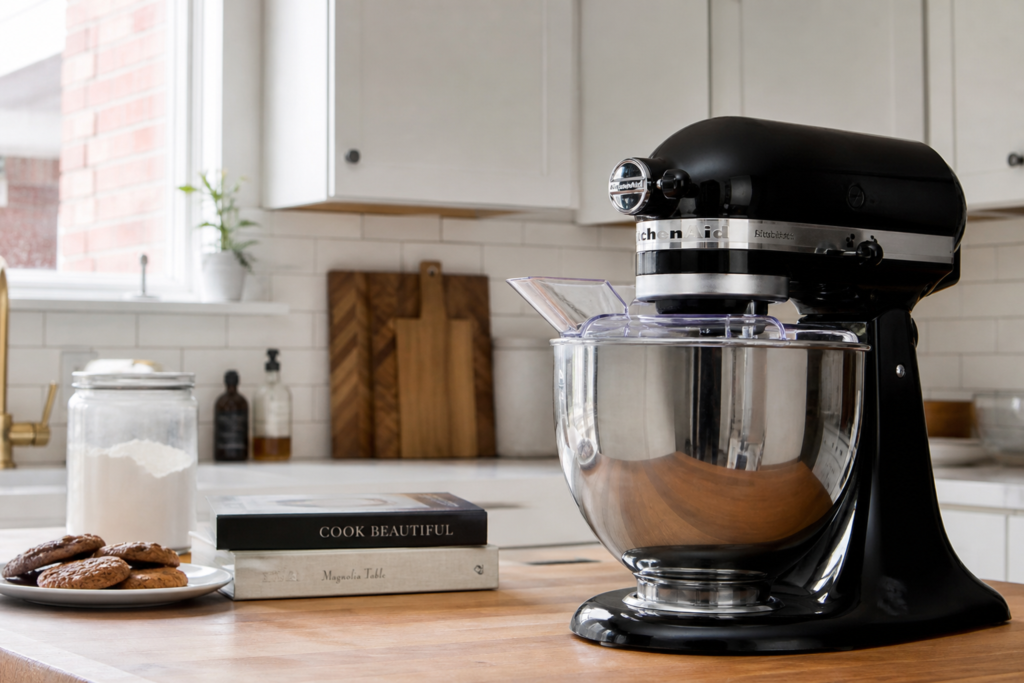
Best Overall: KitchenAid Artisan 5-Quart KSM150PS ($449)
👉 The benchmark for a reason — planetary mixing action touches the bowl at 59 points per rotation, all-metal gear-driven transmission, and an attachment ecosystem nothing else matches. Best if you bake regularly or want pasta or meat grinder attachments down the line. Heads up: not great for tiny batches, and it’s 23 lbs.
Check Price on Amazon →
Best Value: Cuisinart Precision Master SM-50 (~$229)
👉 Handles about 80% of what the Artisan does at roughly half the price. 5.5-quart bowl, 12-speed dial, die-cast metal build that feels solid in hand. Best for regular bakers doing cakes, cookies, and lighter doughs — skip it if you want pasta attachments.
Check Price on Amazon →
Best Budget: Hamilton Beach Electric Stand Mixer (~$99)
👉 Around $99 and it just works — 7 speeds, dough hook, flat beater, and whisk included. Right pick if you’re new to stand mixing, unsure how often you’ll use one, or need a reliable backup. Trade-off: 1-year warranty and you’ll outgrow it within a year if you bake heavily.
Check Price on Amazon →
The Decision Shortcut
It boils down to three questions:
Do you make bread or stiff doughs regularly? Yes → KitchenAid Artisan. No → Cuisinart SM-50 is more than enough.
Do you want pasta, meat grinder, or specialty attachments? Yes → KitchenAid. No interest at all → Cuisinart saves you $200 with minimal compromise.
Are you testing the habit? Not sure how often you’ll really use a stand mixer? Start with Hamilton Beach at $99. A low-cost experiment beats a $450 machine you use twice.
Where People Go Wrong
Buying based on color. KitchenAid colors are genuinely beautiful. But make sure the model is right before you choose the finish. The Artisan Mini looks great but its 3.5-quart bowl is too small for most bread recipes.
Ignoring cabinet clearance. Tilt-head mixers need clearance above the machine to tilt properly. The Artisan is about 14 inches tall at rest. If your upper cabinets hang low, measure before you buy.
Overbuying for future you. If you bake twice a year today, a $450 mixer will not change that. Buy for who you are right now.
Skipping refurbished. KitchenAid sells certified refurbished Artisans at significant discounts. These machines are mechanically serviced — most refurbs are just cosmetically imperfect. If you want a KitchenAid at a Cuisinart price, search KitchenAid’s official refurb store first.
Quick FAQs
Stand Mixer Buying Guide Question: Can a stand mixer replace a food processor? No. They do fundamentally different jobs. A stand mixer mixes, whips, and kneads. A food processor chops, slices, shreds, and purees. With KitchenAid attachments you can approximate some food processor tasks, but it’s not a replacement. I compare them in detail in my food processor vs stand mixer guide.
Stand Mixer Buying Guide: How Long Do They Last? A KitchenAid Artisan with normal home use should run 15–20 years. I’ve seen machines from the early 2000s still going strong with zero mechanical repairs. The Cuisinart SM-50 is newer to market but builds suggest similar longevity. Hamilton Beach budget models are more realistically 5–8 years under regular use.
Is the KitchenAid Artisan worth $449? (Stand Mixer Buying Guide Perspective) If you bake at least weekly: yes. Amortized over 15 years, that’s about $2.50 per month. If you bake occasionally, the Cuisinart SM-50 at half the price is the smarter buy.
What KitchenAid attachments are worth buying? The pasta roller attachment is what most owners are happiest with — it turns the mixer into a full pasta-making setup. The meat grinder is genuinely useful if you make burgers or sausage at home. Everything else is situational.
THE BOTTOM LINE
Bake seriously and want the best attachment ecosystem? Get the KitchenAid Artisan. Want real mixing performance at half the price? Go Cuisinart SM-50. Just testing the habit and don’t want to commit $300+? Hamilton Beach does the job. Buy it because it matches how you actually cook — not because it looks good in photos.
Cheers,
Kazaan
Pingback: KitchenAid: What You're Actually Paying For