
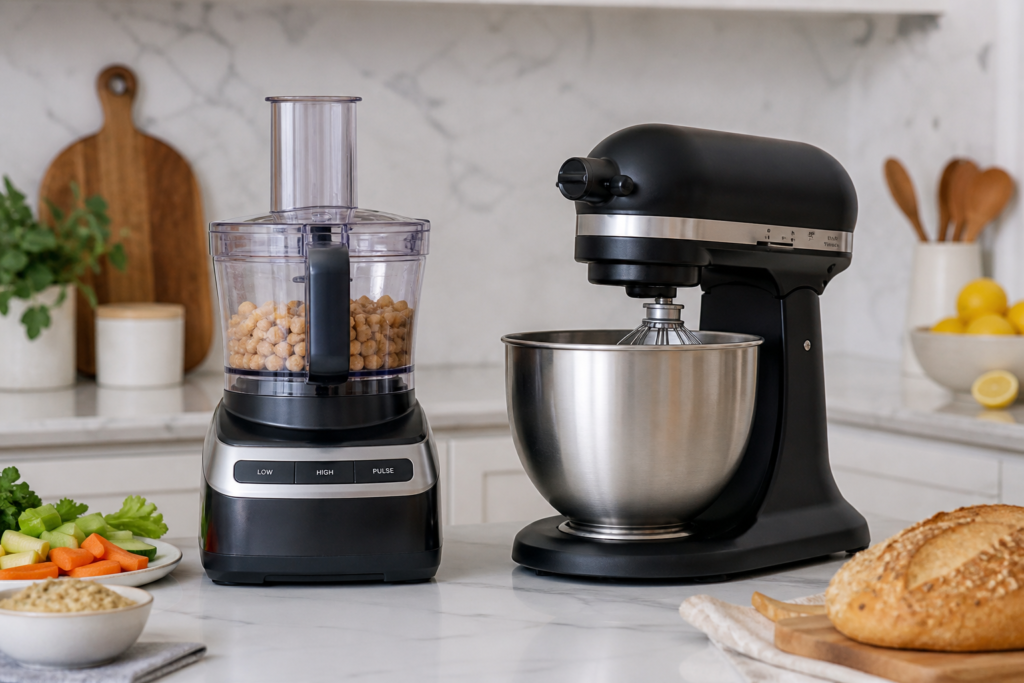
The food processor vs stand mixer debate has confused home cooks for years. People treat them like they’re interchangeable. They’re not. Using one to do the other’s job is like using a screwdriver to hammer a nail — you can do it, but you’ll regret it.
Disclosure: This post contains affiliate links. If you buy through them, I earn a small commission at no extra cost to you. I only recommend products I’d use myself.
I’ve seen this play out hundreds of times. Someone buys a food processor thinking it covers baking. Or they get a stand mixer assuming they can make salsa in it. Then they’re annoyed the machine doesn’t perform, when the real problem was the wrong tool for the job.
By the end, you’ll know exactly which one you need — or whether you actually need both.
What Each Machine Actually Does
Stand Mixer: Built for Bakers
A stand mixer’s core job is to combine ingredients smoothly, consistently, and hands-free. The motor drives an attachment — a flat beater, dough hook, or wire whip — that moves through the bowl in a planetary orbit, touching every part of the mixture on each rotation.
What it does well:
- Knead dough. Bread, pizza, pasta, bagels. This is the stand mixer’s highest-value use case. 8–10 minutes of hands-free kneading versus 15+ minutes by hand.
- Whip air into things. Meringues, whipped cream, buttercream, marshmallow fluff. The wire whip incorporates air far more efficiently than any other method.
- Mix batters. Cake batter, pancake mix, brownie batter — consistently combined, no lumps, no hand fatigue.
- Cream butter and sugar. The foundation of most baking. A stand mixer does this perfectly at low speed in about 4 minutes.
What it can’t do well:
- Chop, dice, or slice vegetables
- Shred cheese
- Make smooth purees (hummus, salsa, pesto)
- Process raw meat
- Crush ice
Food Processor: Built for Cooks
A food processor’s core job is to transform raw ingredients through cutting. S-blades chop and puree. Discs slice and shred. The result is fast, consistent prep work that would take 3–4 times longer by hand.
What it does well:
- Chop vegetables at scale. Onions, carrots, celery, peppers — the food processor does in 5 seconds what takes 5 minutes with a knife.
- Shred cheese. Block cheddar to shredded in 20 seconds. Pre-shredded bags have nothing on fresh.
- Make purees and dips. Hummus, pesto, salsa, guacamole, tapenade — smooth results in under a minute.
- Slice and grate. Thinly sliced cucumbers for a salad, grated parmesan for pasta — quick and uniform.
- Make pie dough and pastry. Cold butter cut into flour perfectly in 8–10 pulses. No warm hands touching the fat.
What it can’t do well:
- Knead yeast doughs (most models over-process and heat the dough)
- Whip cream or egg whites (no aeration)
- Cream butter and sugar for cakes
- Mix batters to a smooth, airy consistency
Food Processor vs Stand Mixer: The Core Difference
A stand mixer blends things together. A food processor breaks things apart and reduces them. Different physics, different results, different use cases.
The Real Food Processor vs Stand Mixer Question: Cook or Baker?
This is the fastest way to make the decision. Most people lean clearly one way.
In the food processor vs stand mixer decision: you’re a cook if: You spend most of your kitchen time making savory meals — stir fries, soups, salads, dips, grain bowls. You prep vegetables more than you bake. You make hummus, pesto, or salsa more than you make cake. → Get the food processor.
You’re primarily a baker if: You make bread, cakes, cookies, pastries, or desserts regularly. You knead dough. You whip cream from scratch. You build batters. → Get the stand mixer.
You do both equally: Then you probably need both. I’ll talk about that below. But don’t try to use one to replace the other — you’ll get mediocre results in both areas.
Food Processor vs Stand Mixer: Where They Overlap (And Where It Gets Complicated)
Both machines can technically do certain tasks. That doesn’t mean they do them equally well.
Pie crust and pastry dough: A food processor actually does this better than a stand mixer. The pulsing action cuts cold butter into flour without overworking it — warmer hands and longer mixing times in a stand mixer can melt the fat and toughen the pastry. If pie is your thing, food processor wins this round.
Shredding cooked chicken: A stand mixer with a flat beater can shred cooked chicken in about 30 seconds. A food processor can do it too, but the stand mixer does it better. Unexpected, but true.
Whipped butter: A stand mixer is the right tool. Technically a food processor can aerate butter with a blade, but the results are inconsistent and the process is messy.
Kneading dough: Some food processors have a dough blade, and they can handle soft, quick-bread doughs. But for yeast-risen bread, the blade generates too much friction and heat — it can kill the yeast and give you a dense result. Stand mixer wins decisively.
What About a Blender?
A question I get often: “Can’t my blender do what a food processor does?”
Partially. A high-powered blender (Vitamix, Blendtec) handles smooth purees, soups, and liquid-heavy sauces brilliantly. But it can’t slice vegetables, shred cheese, or make chunky salsa — blenders liquefy rather than chop. If you already own a blender, you still might benefit from a food processor for dry prep work. They’re complementary, not replacements.
My Picks for Each Category
For the Stand Mixer Side
For more detail, see my complete stand mixer buying guide.
👉 KitchenAid Artisan KSM150PS — $449
The gold standard — planetary mixing, gear-driven transmission, 20+ year lifespan, and the widest attachment ecosystem around. Pays off if you bake bread or knead regularly.
Check Price on Amazon →
👉 Cuisinart Precision Master SM-50 — $249
About 80% of the KitchenAid’s capability at half the price — right for regular bakers doing cakes, cookies, and lighter doughs.
Check Price on Amazon →
- What Each Machine Actually Does
- Food Processor vs Stand Mixer: The Core Difference
- The Real Food Processor vs Stand Mixer Question: Cook or Baker?
- Food Processor vs Stand Mixer: Where They Overlap (And Where It Gets Complicated)
- What About a Blender?
- My Picks for Each Category
- If You Can Only Buy One
- Food Processor vs Stand Mixer: If You Want Both
- Practical Food Processor vs Stand Mixer Scenarios
- FAQs
For the Food Processor Side
👉 Cuisinart Custom 14 DFP-14BCNY — $179
The most widely recommended food processor in the US — 14-cup capacity, 720W motor, handles chopping, slicing, shredding, and pureeing without complaint.
Check Price on Amazon →
👉 Ninja Professional Plus BN601 — $99
1000W motor, 9-cup bowl, punches above its price for chopping and pureeing — the budget pick for moderate volumes.
Check Price on Amazon →
If You Can Only Buy One
There’s no universal right answer here — it depends on your cooking style. But I can give you a clear framework.
In the food processor vs stand mixer choice, buy a food processor if: You cook savory meals more than you bake. You prep large amounts of vegetables, make dips or sauces regularly, or do batch cooking. The food processor saves you more time per week in the average home kitchen than a stand mixer does — unless you bake.
Buy a stand mixer if: You bake bread, cakes, or cookies at least once a week. You knead dough. You make anything that requires whipping or creaming. The stand mixer does things a food processor simply cannot replicate.
A useful data point: studies on kitchen appliance usage consistently show food processors get used more frequently in the average household than stand mixers. Most people cook more often than they bake. But if baking is your thing, the stand mixer matters more.
Food Processor vs Stand Mixer: If You Want Both
This is the ideal setup for people who both cook and bake seriously. But you don’t have to buy them at the same time or at the same price point.
My suggested sequence: if you’re building from scratch, start with the food processor. It covers more daily use cases for most people. Once your baking frequency justifies it, add the stand mixer. Don’t start with a $450 KitchenAid if you’re not sure whether you’ll bake regularly.
Counter space matters too. A full-size food processor and a stand mixer together take up real estate. If your kitchen is small, think carefully about what earns a permanent spot on the counter. Everything that goes in a cabinet gets used less.
Practical Food Processor vs Stand Mixer Scenarios
“I make homemade bread every weekend.” → Stand mixer. No question. A food processor will overheat your dough.
“I do meal prep on Sundays — lots of chopping and batch cooking.” → Food processor. You’ll cut prep time in half.
“I make cakes and cookies a few times a month.” → Stand mixer, or honestly — a good hand mixer at $40 covers this fine unless you’re doing large batches.
“I want to make homemade hummus and pesto.” → Food processor. A blender can approximate, but the food processor gives you better texture control.
“I want to make homemade pasta.” → Tricky. A food processor can mix pasta dough. But a stand mixer with a KitchenAid pasta roller attachment produces better, more consistent results and is more enjoyable to use. If pasta is a priority, stand mixer.
“I bake and I cook seriously.” → Both. Start with the one you need more, then add the second when budget allows.
FAQs
Can a food processor knead bread dough? Technically yes, but not well. The blade generates too much heat and friction for yeast doughs — you risk killing the yeast and getting a dense loaf. Quick breads (no yeast) are fine. For anything yeasted, use a stand mixer.
Can a stand mixer replace a food processor? Only partially, with expensive attachments. KitchenAid makes shredding, slicing, and food processor attachments — but they’re an additional $100–$150 and the results aren’t as clean as a dedicated food processor. If you process a lot of vegetables, a real food processor does the job better.
Which is harder to clean? Food processors have more parts — bowl, lid, multiple blades and discs. All dishwasher safe on good models, but there’s more to reassemble. Stand mixers are simpler — the bowl and attachments go in the dishwasher, and the machine base just needs a wipe down. Slight edge to stand mixer for cleanup speed.
What’s the cheapest way to get both capabilities? A stand mixer (KitchenAid) with food processor attachment covers both, but it’s expensive and the food processing results are mediocre. A more practical budget approach: get a budget food processor ($60–$100) and a budget stand mixer ($99) and have both. The Cuisinart DFP-14BCNY at $179 and Hamilton Beach stand mixer at ~$99 is a $278 setup that covers both bases very competently.
THE BOTTOM LINE
A stand mixer is for baking. A food processor handles everything else — chopping, shredding, savory prep. Cook more than you bake? Start with the processor. Baking is central to your kitchen? The mixer comes first. Doing both seriously — build toward owning both, but don’t drop $500+ on two machines at once when one $200 tool gets you 80% of the way there.
Cheers,
Kazaan
Pingback: Stand Mixer Buying Guide: What To Know Before Spending $200–$450