
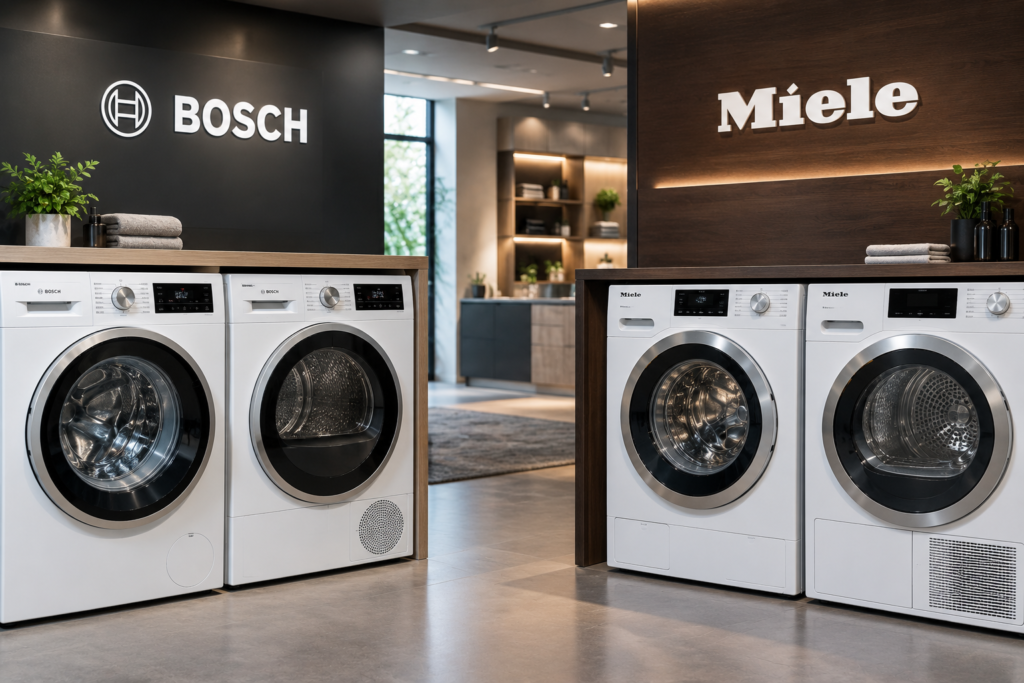
Miele advertises its dishwashers as tested for a 20-year service life. That’s a real lab claim, not marketing fluff, but it’s also not a warranty, and the gap between those two things is exactly where a lot of buyers overpay for a promise they misunderstood.
This post contains affiliate links. If you click and buy, I may earn a small commission, at no extra cost to you.
Same Country, Two Very Different Ownership Structures
Both brands are German, both carry real engineering credibility, and they get lumped together constantly, but the companies behind them are structured very differently. Bosch dishwashers are built by BSH Hausgeräte, which also produces Thermador and Gaggenau. BSH started as a joint venture between Bosch and Siemens, but Bosch bought out Siemens’ remaining stake back in 2014, making it fully Bosch-owned. Current Bosch dishwashers for the U.S. market are manufactured in New Bern, North Carolina, a plant BSH has run since 1997, not imported from Germany, despite the German engineering pedigree the brand trades on.
Miele, by contrast, remains a privately held, family-owned German company that manufactures the large majority of its own parts in-house at its factory in Gütersloh, Germany, genuine vertical integration, not a licensing or joint-venture structure. That difference in ownership and manufacturing philosophy is a big part of what separates the two brands’ actual products, not just their price tags.
The Reliability Numbers, Side by Side
Independent service-call tracking puts Miele’s first-year service rate at roughly 5.6%, the lowest of any dishwasher brand currently tracked in that data, with Bosch close behind at roughly 7.8%. Both sit comfortably below the roughly 8.8% industry average, meaning both brands are genuinely reliable relative to the category as a whole. The gap between them is real but modest, Miele holds a measurable edge, not a dramatic one, in year-one reliability specifically.
👉 Bosch 800 Series Dishwasher, ~$1,499
sits right at the point where Bosch’s reliability data (roughly 7.8% first-year service rate) and its CrystalDry zeolite drying system are both at their strongest, genuinely close to Miele-level performance at a meaningfully lower price.
The 20-Year Claim: What It Actually Means
Here’s the distinction worth being precise about: Miele’s “tested for 20 years” language describes laboratory testing, select models run through roughly 7,000 cycles, the lab equivalent of about 20 years of average household use. That’s Miele’s own testing claim, and it’s a legitimate one, but it is not a warranty and it is not a guarantee for your specific unit in your specific kitchen. Real-world results depend heavily on water hardness, detergent choice, maintenance, and usage patterns, the same as any appliance.
That said, independent real-world data does back up a meaningfully longer typical lifespan for Miele, commonly 14 to 20 years in practice, against roughly 10 to 14 years for Bosch. The claim isn’t just marketing copy; it’s supported by both the lab testing methodology and observed field data. It’s simply important to know you’re buying a well-supported testing claim, not a contractual guarantee, when that “20 years” figure is part of your decision.
Where the Price Gap Actually Goes
Bosch’s mainstream lineup runs roughly $550 to $2,300, with most buyers landing in the $800 to $1,500 range. Miele starts higher and climbs further, roughly $1,500 to $3,700+, commonly landing 2 to 3 times Bosch’s price for a comparably featured unit. That premium buys three things specifically: Miele’s in-house parts manufacturing and the longevity that supports, the AutoDos automatic detergent dispensing system (unique to Miele in this category, though it creates an ongoing proprietary PowerDisk supply cost), and marginally better fine-glassware and mixed-load wash performance.
Bosch’s CrystalDry system, a zeolite mineral that absorbs moisture and releases heat at the end of the cycle, is a genuine technical advantage of its own, and multiple independent sources rate it as the better performer specifically for drying plastic items, an area where Miele’s cooler condensation-based drying is comparatively weaker.
👉 Miele G7000 Series Dishwasher, starting ~$1,749
the entry point into Miele’s in-house-manufactured build quality and AutoDos detergent system, the clearest place to evaluate whether the longevity and reliability premium is worth 2–3x Bosch’s price for your specific kitchen.
Parts and Repairability: The Trade-off Underneath
Bosch’s parts ecosystem is built for current-production speed, its distribution network is broad, and most independent appliance technicians are already familiar with the platform, since Bosch, Thermador, and Gaggenau share core engineering. If something needs fixing on a relatively new Bosch unit, sourcing the part and finding a technician who already knows the platform is usually straightforward.
Miele’s parts network runs differently: current parts typically ship in 3 to 5 days through Miele USA’s distribution, but what’s genuinely unusual is that Miele explicitly stocks parts for units 15-plus years old, a long-tail parts commitment that directly supports the brand’s longevity claims. It’s a real trade-off: Bosch optimizes for fast, familiar service on a shorter expected lifespan; Miele optimizes for supporting a much longer ownership window, even if a specific part for an older unit takes longer to arrive.
👉 Bosch Benchmark Series Dishwasher
Bosch’s top tier, built on the same New Bern platform as the 800 Series with additional features and finish options, for buyers who want to stay in the Bosch ecosystem’s faster parts and service network while still getting near-flagship performance.
Decision Framework
Choose Miele if you’re planning to stay in your current kitchen for 15-plus years, you want the lowest realistic chance of a service call in year one, and the AutoDos and mixed-load wash performance genuinely matter to how you use a dishwasher daily.
Choose Bosch if your ownership horizon is closer to 5 to 10 years, if drying plastic items well is a real priority (CrystalDry’s specific strength), or if you want reliability that’s close to Miele’s without committing to 2 to 3 times the price.
What I Wouldn’t Buy
I wouldn’t buy Miele purely for the “20-year” figure without understanding it’s a tested lab claim, not a warranty, it’s well-supported by real-world data, but it’s not a guarantee on your specific unit, and it shouldn’t be the only reason you pay a multiple of Bosch’s price.
I also wouldn’t let a Bosch control-panel cosmetic issue, a documented class-action matter over button label fading on some 100–800 Series models, change your reliability assessment of the brand. It affects how easy the labels are to read over time, not mechanical performance, cleaning ability, or safety, and it’s worth knowing about without overweighting it in your decision.
THE BOTTOM LINE
Bosch and Miele are both genuinely reliable, German-engineered brands, but they’re built by very differently structured companies solving for different ownership timelines. Miele holds a real, if modest, reliability edge and a well-supported longer lifespan, in exchange for 2 to 3 times Bosch’s price and Bosch’s faster current-parts turnaround. Bosch delivers close-to-Miele reliability, better plastic drying, and a much more accessible price for anyone not planning to own the same dishwasher for two decades. Neither is the objectively “better” German premium brand, they’re solving for different ownership horizons.
If dishwashers broadly are still an open question, our full dishwasher buying guide is the place to start, and why repairs cost more across the board right now explains part of why the labor side of any repair costs what it does right now.
Cheers, Kazaan.