
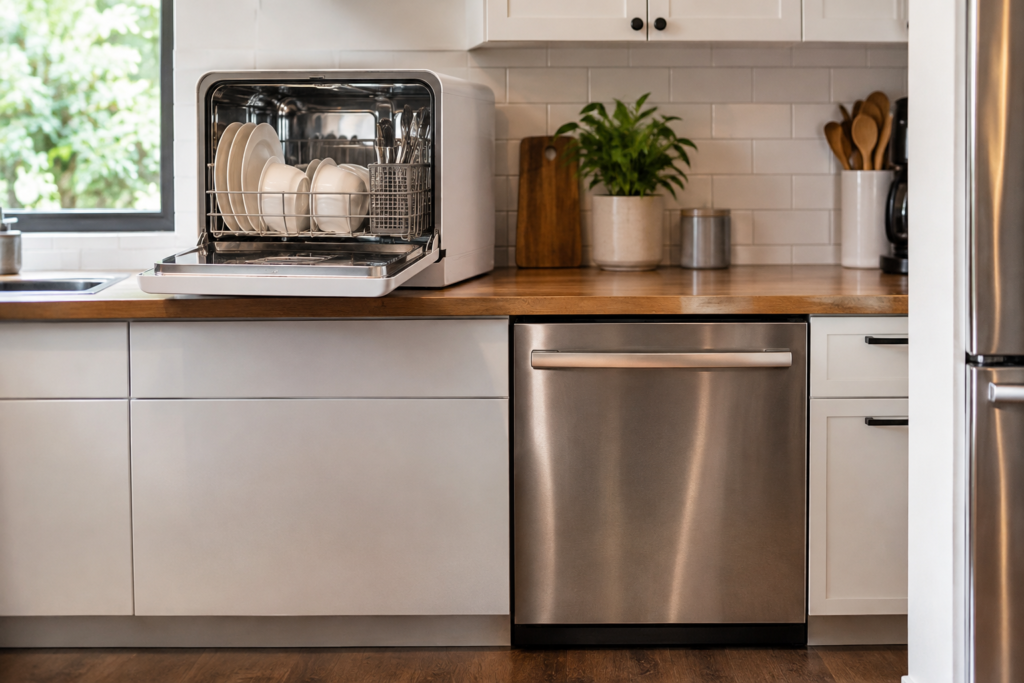
A countertop dishwasher uses roughly half the water of a full-size model per cycle, not because it’s smaller, but because it’s built around a completely different assumption about how often you’ll actually run it.
This post contains affiliate links. If you click and buy, I may earn a small commission, at no extra cost to you.
The Real Question Isn’t Size: It’s Load Pattern
The instinct is to treat this as a straightforward “bigger is better if you can fit it” decision, the same way you’d think about a refrigerator. It isn’t. A full-size dishwasher is engineered around the assumption that you’ll fill it before running it, that’s how it earns its efficiency numbers. A countertop dishwasher is engineered around the opposite assumption: that you’re washing a small, frequent load and don’t want to either hand-wash it or let it sit for two days waiting for a full rack. Which one actually wins depends entirely on which of those two patterns matches your household, not on which unit has more raw capacity.
Why Smaller Genuinely Uses Less, Not Just Proportionally Less
A full-size Energy Star dishwasher run at full capacity is genuinely efficient, often more water-efficient per dish washed than a countertop unit, because the fixed water and energy cost of a cycle gets spread across more dishes. The problem most single people and couples run into isn’t the full-size machine’s efficiency, it’s that they’re not filling it. A half-full cycle in a full-size dishwasher uses close to the same water and energy as a full one, because the machine doesn’t scale down its wash volume based on how many dishes are actually inside. Rebates can change that math, so check my Energy Star rebate breakdown for 2026 before you decide.
A countertop dishwasher sidesteps that problem entirely by having a genuinely smaller wash chamber to begin with, there’s no “half load” version of a 6-place-setting machine, because 6 place settings is close to what a solo cook or a couple actually generates in a day. The efficiency advantage isn’t really about the technology being smarter; it’s about the fixed cost of a cycle being spread across a load size that actually matches how much you’re washing.
The Per-Place-Setting Math
Here is the arithmetic the efficiency claims skip. Take the water numbers below and divide them by how many place settings each machine actually washes.
A countertop unit that uses 2.77 gallons for 6 place settings works out to about 0.46 gallons per place setting. The wider range I quote below, 2 to 5 gallons, gives roughly 0.33 to 0.83. A 14-place-setting full-size machine at 6 to 10 gallons, loaded completely, lands at about 0.43 to 0.71. So a full rack in a full-size machine is as efficient as the countertop unit. It is not worse. It is just rarely full.
Now run the same full-size machine half empty. The cycle still draws 6 to 10 gallons, but only 7 place settings are in it. That is about 0.86 to 1.43 gallons per place setting, roughly double to triple the countertop figure above. That gap is the entire case for small, and it only exists if your load is small. Fill the big one every time and the gap closes. These are my numbers from the ranges in this post, not lab results for one model, so check the Energy Star listing for the unit you are actually considering.
The Numbers That Matter
Capacity
Most countertop dishwashers hold 5 to 6 place settings, with some compact units holding as few as 2. That covers a solo person or couple’s daily dishes comfortably, but it’s genuinely not enough for a family’s daily load or for bulky items like roasting pans and large mixing bowls, plan on hand-washing those regardless of which machine you own.
Water and Operating Cost
Countertop models typically use 2 to 5 gallons per cycle depending on the specific unit and whether it’s tank-fed or faucet-connected. A full-size dishwasher running a normal cycle uses roughly 6 to 10 gallons. Annual operating cost on a countertop unit run daily commonly lands around $15 to $20 for the year, genuinely negligible, which is part of why the purchase price gap matters more than the running cost gap in this comparison.
Installation
This is where countertop models have a real structural advantage for renters specifically: a faucet-hookup model connects with an included adapter and needs no permanent plumbing modification, and a tank-fed model needs no water connection at all, fill it from a jug and it runs anywhere there’s an outlet, which is why these units show up in RVs, boats, and dorms as much as apartments. A full-size dishwasher requires an actual plumbing and drain connection, which is a non-starter in a rental where you can’t modify the kitchen.
One thing the installation section does not cover is counter space. Most countertop units are roughly 20 to 22 inches wide and 17 to 19 inches tall and deep. That is a microwave-sized block you give up permanently, and it needs clearance under any wall cabinet above it. Measure that spot, height included, before you look at a single listing.
👉 COMFEE' Portable Countertop Dishwasher, 6 Place Settings
a faucet-hookup model with genuine Energy Star-rated water use around 2.77 gallons per cycle, a straightforward, no-permanent-installation option for apartments where a full-size unit isn’t an option at all.
Who Countertop Actually Wins For
This isn’t a compromise pick for people who can’t afford full-size, it’s a genuinely better fit for specific households. Renters who can’t modify plumbing, solo dwellers and couples who don’t generate a full-size load daily, RV and tiny-home owners with real space constraints, and anyone with a galley kitchen that never had a dishwasher bay built in all come out ahead with a countertop unit, both on cost and on actually using it daily instead of letting hand-washed dishes pile up while waiting for a full-size load.
👉 Danby 6-Place-Setting Countertop Dishwasher
an Energy Star-rated countertop model with stainless steel interior, representative of the segment’s realistic capacity ceiling, useful for confirming whether 6 place settings actually covers your household’s daily load before you commit.
Decision Framework
Choose countertop if you’re a solo cook, a couple, or a renter without plumbing flexibility, and your daily dish volume genuinely fits in 5 to 6 place settings most days.
Choose full-size if your household consistently generates more than 6 place settings per meal, you regularly wash bulky cookware, or you already have the plumbing and cabinet space and don’t want to manage a second small appliance on your counter.
Run the One-Week Test
Before you pick, count. For five days, tally the place settings you would put in a dishwasher at the end of the day: one for each plate, bowl, mug and set of cutlery. If you land at 5 or 6 or fewer on most days, a countertop unit matches your life. If you reach 8 or more on three days out of five, you are a full-size household, and the small unit will run twice a day.
One more reality check. A spec sheet counts place settings with standardized test dishes. Your real pots, mugs and mixing bowls load less neatly, so treat the listed number as a ceiling, not a promise. A week of counting beats an hour of comparing specs.
👉 Full-Size Budget Built-In Dishwasher, 14 Place Settings
for households whose daily load genuinely exceeds what any countertop model can handle, a straightforward, plumbed-in option once the load pattern, not just the counter space, points toward full-size.
What I Wouldn’t Buy
I wouldn’t buy a countertop dishwasher for a household of four or more expecting it to replace a full-size unit, the 5-6 place setting ceiling means you’d be running it multiple times a day, which erases most of the water and time savings that make the category worth it in the first place.
I also wouldn’t buy a tank-fed-only model without checking whether you’re comfortable manually filling and emptying it every cycle, it’s the right call for zero-plumbing situations like a boat or dorm, but it adds a manual step that a faucet-hookup or full-size model doesn’t require.
THE BOTTOM LINE
The countertop-versus-full-size decision isn’t really about counter space, it’s about whether your household’s actual daily dish volume matches a 5-6 place setting machine or consistently exceeds it. For solo cooks, couples, and renters without plumbing flexibility, a countertop dishwasher genuinely uses less water, costs less upfront, and gets used more consistently than a half-empty full-size unit. For larger households with real daily volume, full-size remains the better math. Match the machine to your load pattern, not to whichever one looks more like a “real” dishwasher.
our full-size dishwasher buying guide is worth reading if full-size is still the front-runner, and our Bosch vs Miele dishwasher breakdown if a premium German brand is part of that full-size decision.
Cheers, Kazaan.