
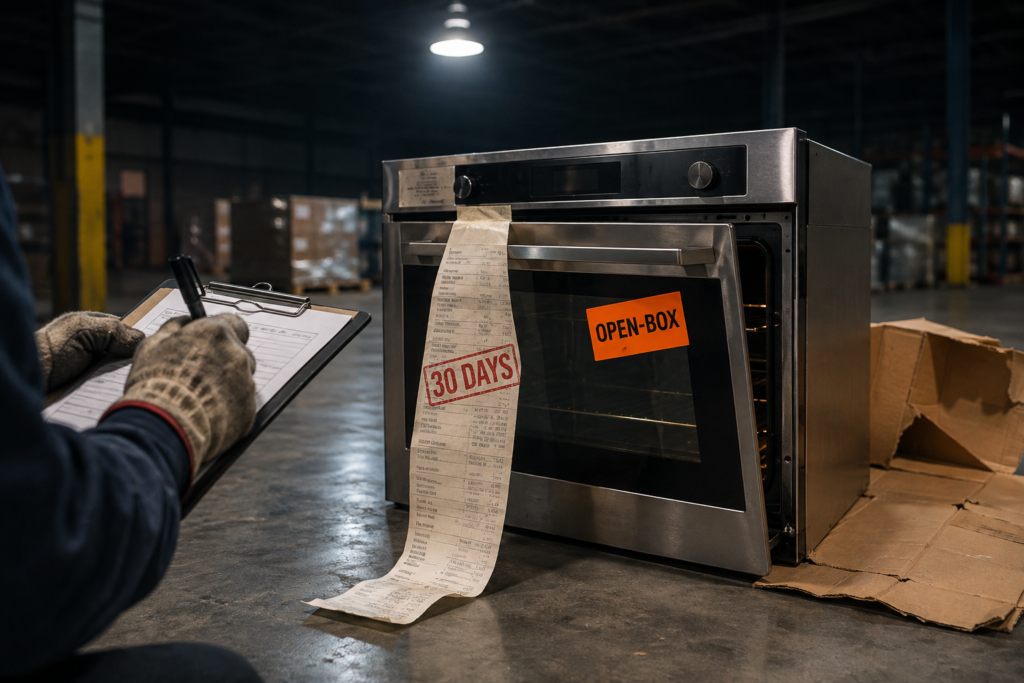
The discount on an open-box refrigerator is printed in bold. The return window is buried three clicks deeper, and it decides whether you saved money or bought a problem.
This post contains affiliate links. If you click and buy, I may earn a small commission, at no extra cost to you.
Why the Same Appliance Costs Less Open-Box
Open-box is a catch-all label. According to Chowhound’s reporting on Best Buy, the pool includes customer returns, display items and products with damaged packaging, and many came back simply because the buyer changed their mind. The same piece says outlet stores also sell returned, discontinued, repaired and exchanged appliances.
A unit that can’t be sold as new gets a lower price. That’s the mechanism behind the discount. It isn’t charity, and it isn’t always a defect either.
What the label tells you is mostly cosmetic. Best Buy’s open-box page grades units Excellent, Good or Fair. All three are described as working like new and restored to factory settings. What changes between them is scratches, dents, packaging and missing accessories, and a Fair unit may be missing parts. Chowhound adds that returned appliances are often inspected to make sure they’re in working order.
Read that carefully. The grade describes the paint and the box. The inspection checks working order on the day it’s inspected. Neither one tells you how the machine behaves in month eight, which is why the return window matters more than the discount.
The Clock Is the Real Product
Most people compare price. They should compare something else: how many days they have to find out the unit is bad, and when that clock starts.
Best Buy’s return policy, as I read it on November 8, 2026, gives open-box products the standard 15 days, counted from the day you receive the product. For major appliances there’s a process on top of that. You can refuse delivery before you accept it. After that, you call a phone line instead of going to the store, and major appliances can’t be returned by shipping. Purchases made between October 30 and December 31 get a holiday extension to January 15, 2027. The page lists a few exclusions and open-box isn’t one of them, but confirm that at checkout before you lean on it.
Lowe’s is much tighter. A July 2026 ConsumerAffairs report puts the window for major appliances at 48 hours. After that, it says, Lowe’s will typically direct you to the manufacturer’s warranty instead of processing a return. The same report says Home Depot’s windows are similar. It’s a secondary source, so read the current policy before you pay.
| Retailer | Window for major appliances | Where this comes from |
|---|---|---|
| Best Buy | 15 days for open-box, from the day you receive it | Best Buy return policy, read Nov 8, 2026 |
| Lowe’s | 48 hours | ConsumerAffairs, July 2026 |
| Home Depot | 48 hours (described as similar to Lowe’s) | ConsumerAffairs, July 2026 |
Now the part that catches people. The clock starts at delivery, not at installation. If your gas line isn’t capped yet, or the 240-volt outlet is still on someone’s to-do list, the window runs while the appliance sits in your garage. A 48-hour window isn’t a test period. It’s a countdown. Schedule delivery for the day after your prep is finished, not the day before.
What the Discount Has to Cover
Example: a refrigerator listed at $1,400 and an open-box unit at $1,120. Those prices are an illustration, not a quote. You save $280, and that $280 has to cover every risk you now carry that a sealed-box buyer doesn’t.
The biggest one is the warranty. Best Buy’s open-box page says these items often keep the manufacturer warranty of a new product. Chowhound’s reporting says coverage for refurbished and pre-owned products varies, and that some returned items come with the manufacturer’s warranty while others don’t. A company that sells coverage for scratch-and-dent units, CPS, goes further and says manufacturer coverage applies only to new, unopened appliances. It profits from saying that, so weigh it accordingly. The takeaway isn’t a rule. It’s a question you have to ask before you pay.
Then ask when the warranty starts. If it runs from the original sale date, a floor model that sat in a showroom reaches you with some of its coverage already spent. Get the start date in writing, on the invoice.
If the unit has no manufacturer coverage, one repair call can erase the savings. Repair costs have been climbing, which I walked through in why appliance repairs cost more than they used to. A discount smaller than one realistic repair bill isn’t a discount. It’s a bet.
An extended plan doesn’t fix this either. The math behind those plans is the same whether the box was opened or not, and I broke it down in the extended warranty margin math.
The Four Questions I Ask Before I Sign
Does the manufacturer warranty apply, and from which date? On the invoice, not in a salesperson’s mouth.
How long do I have, and when does it start? Compare the hours or days against the date you can actually test the thing.
What’s missing? Shelves, bins, hoses, filters, brackets, the manual. Best Buy says a Fair grade may be missing parts, and chasing a replacement after the window closes is your problem.
Can I refuse it at the door? Inspect before you accept. After you accept, the process gets slower.
Then match the machine to the risk. Open-box makes the most sense on ranges, cooktops and dishwashers, where a dented side panel ends up between two cabinets and you never see it again. A flaw you’ll never look at is the best kind of discount.
My rule on the rest: the more moving parts and electronics inside, the longer the window I want. That means refrigerators, freezers, front-load washers and anything with a screen and a Wi-Fi board. If a refrigerator was laid on its side, LG’s guidance is to wait at least 2 hours upright before plugging it in, because that lets the compressor oil settle. Other brands may differ, so read your manual.
And if you’re comparing open-box against the seasonal sale calendar, the best time of year to buy appliances shows when a sealed-box price can beat an open-box one.
The Day-One Test
Treat the first 24 hours as an inspection, not a honeymoon.
For a refrigerator, put a thermometer in each compartment and leave it overnight. The USDA’s food safety basics (archived copy) recommend 40°F or below in the refrigerator and 0°F or below in the freezer, and advise checking both with an appliance thermometer. If the unit isn’t there by morning, make the call while the window is open.
👉 AcuRite Digital Wireless Fridge and Freezer Thermometer with Alarm, Max/Min (00515M)
One refrigerator sensor and one freezer sensor feeding a single display, with customizable temperature alarms. The catch: it costs more than a basic dial thermometer, and the listing describes alarms at the display, not phone alerts.
Then check what it draws. Divide the EnergyGuide label’s annual kWh by 365 and you have the daily figure the unit should land near. A 350 kWh label, which is the figure Direct Energy uses for a modern ENERGY STAR refrigerator, works out to about 0.96 kWh a day. A plug-in meter will log the real number over 24 hours. A unit that uses far more than its label is telling you something, and the return window is when you want to hear it.
👉 P3 P4400 Kill A Watt Electricity Usage Monitor
Plugs between the wall and the appliance and counts consumption in kilowatt-hours. The catch: the listing says it’s designed for 115-volt appliances, so it can’t test a dryer or an electric range.
For washers and dishwashers, run a full cycle with a towel under each hose connection and a sensor on the floor. A slow weep at a hose fitting or a door seal is exactly what a short window is for.
👉 YoLink Water Leak Sensor 4, 105 dB Alarm Kit (4 sensors + hub)
Each sensor has a built-in 105 dB alarm, runs on 2 AAA batteries (listed at up to 5 years) and sends app, email and text alerts through the included hub. The catch: it needs the hub set up first, which is more work than a stick-on Wi-Fi sensor.
What I Would Not Buy
I wouldn’t buy any open-box unit that’s final sale or as-is with no written warranty, unless I’m prepared to treat the money as gone. Some people are. Most people aren’t, and they find out after the first repair call.
I wouldn’t accept delivery before I can test the machine. If the plumber isn’t coming until next week, neither should the washer.
I wouldn’t take a Fair-grade unit with missing parts if the missing part is something I’ll use every day, like a refrigerator bin or a dishwasher rack.
And I wouldn’t add a protection plan at checkout to make an open-box purchase feel safe. If the warranty position is unclear, a plan is paying to patch a question you should have answered first.
THE BOTTOM LINE
Open-box isn’t a discount on the same product. It’s a different product with a shorter safety net. Price the safety net first: confirm the manufacturer warranty and its start date, count the hours or days you have to test, and schedule delivery for when you can actually run the machine. If the discount is bigger than one realistic repair and the return window outlasts your install, buy it. If either of those is unclear, the sealed box is cheaper than it looks.
Sources: Best Buy return policy · Best Buy open-box deals · Chowhound, returned appliances at Best Buy · ConsumerAffairs, Lowe’s return policy (July 2026) · CPS, scratch-and-dent warranties · LG, moving a refrigerator · USDA FSIS, food safety basics (archived) · Direct Energy, refrigerator electricity use
Cheers, Kazaan.