
- Wattage Determines Speed More Than Anything Else
- Temperature Control Is the Feature Worth Paying For
- Why the Heating Element Placement Actually Matters
- Electric Kettle Buying Guide: My Take
- Descaling: The Maintenance Step Everyone Skips
- The Wattage Number That Actually Means Nothing Past a Point
- Glass or Stainless — a Real Tradeoff, Not Just Looks
An electric kettle looks like the simplest appliance in your kitchen. It’s also one of the easiest to buy wrong, because the differences that matter are invisible on the box.
This post contains affiliate links. If you click and buy, I may earn a small commission — at no extra cost to you.
Wattage Determines Speed More Than Anything Else
US kettles are capped around 1500W by standard household outlets (unlike UK kettles, which run 2500-3000W on their different voltage system — this is why “imported” kettle reviews often overstate real US boil times). At 1500W, expect roughly 4-5 minutes for a full kettle. Anything advertising dramatically faster boil times on a standard US outlet is misleading you on the math.
👉 Amazon Basics Electric Stainless Steel Kettle, 1500W — $23.60
No frills, boils fast, does exactly one job — the pick if you just want hot water without paying for features you won’t use.
Check Price on Amazon →
Temperature Control Is the Feature Worth Paying For
If you drink anything beyond black coffee or basic tea, variable temperature control matters. Green tea wants around 175°F, French press coffee closer to 200°F, and boiling water at 212°F actually scalds delicate tea leaves rather than brewing them properly. A basic on/off kettle can’t do this. A variable-temp kettle pays for itself the first time you stop guessing.
👉 Cosori Stainless Steel Electric Kettle with Temperature Control — $89.98
Temperature control matters the moment you care about tea — green tea scalds at boiling, and this is what fixes that.
Check Price on Amazon →
Why the Heating Element Placement Actually Matters
Concealed (hidden) heating elements last longer and are easier to clean than exposed coil elements, because minerals from hard water don’t build up directly on a visible coil you have to scrub. If you’re in a hard water area, a concealed element isn’t a luxury feature — it’s the difference between a kettle that lasts 5 years and one that tastes metallic after 8 months.
👉 Gourmia Electric Glass Kettle, Programmable, Concealed Element — $65.41
A concealed heating element means no mineral scale building up on exposed coils — less descaling, longer life.
Check Price on Amazon →
Electric Kettle Buying Guide: My Take
Just want hot water fast, drink basic coffee or black tea → simple 1500W kettle with auto shutoff, concealed element, done. Drink varied tea, care about proper brew temps → variable-temp model, worth the extra $15-25. Either way, check for a concealed heating element before checkout — it’s the spec that determines whether this thing is still working in three years.
Descaling: The Maintenance Step Everyone Skips
Mineral scale buildup is the single biggest killer of kettle performance over time — especially in hard water areas. A monthly descale with equal parts water and white vinegar, left to sit for 20 minutes then rinsed, keeps the heating element working at full efficiency. Skip this and you’ll notice slower boils and a metallic taste well before the kettle actually fails. It takes five minutes a month and adds years to the unit’s life — cheap insurance for something you’ll use daily.
Auto shut-off is worth checking too — not every budget kettle includes it, and it’s the feature that actually prevents a dry-boil situation if you get distracted mid-brew. Gooseneck spouts are another detail worth knowing about: they’re built for pour-over coffee precision, not speed, so skip them if you just want water boiled fast for tea or instant meals. Lid design matters more than people expect too — a wide opening makes filling and cleaning genuinely easier day to day, while a narrow spout-only design tends to trap mineral buildup in harder-to-reach corners.
The Wattage Number That Actually Means Nothing Past a Point
Higher wattage genuinely means faster boiling, but only up to your outlet’s limit — in the US that’s roughly 1500W on a standard circuit, so a kettle advertised at 1875W or higher won’t boil any faster in your kitchen than a 1500W model, because the outlet itself is the bottleneck, not the kettle. This is one of the most common places people overpay for a spec that doesn’t apply to their actual home.
Where higher-wattage claims do matter is imported UK-style kettles rated for 220-240V systems — those numbers simply don’t translate to US wiring, so ignore any comparison that pulls specs from a UK review site.
Glass or Stainless — a Real Tradeoff, Not Just Looks
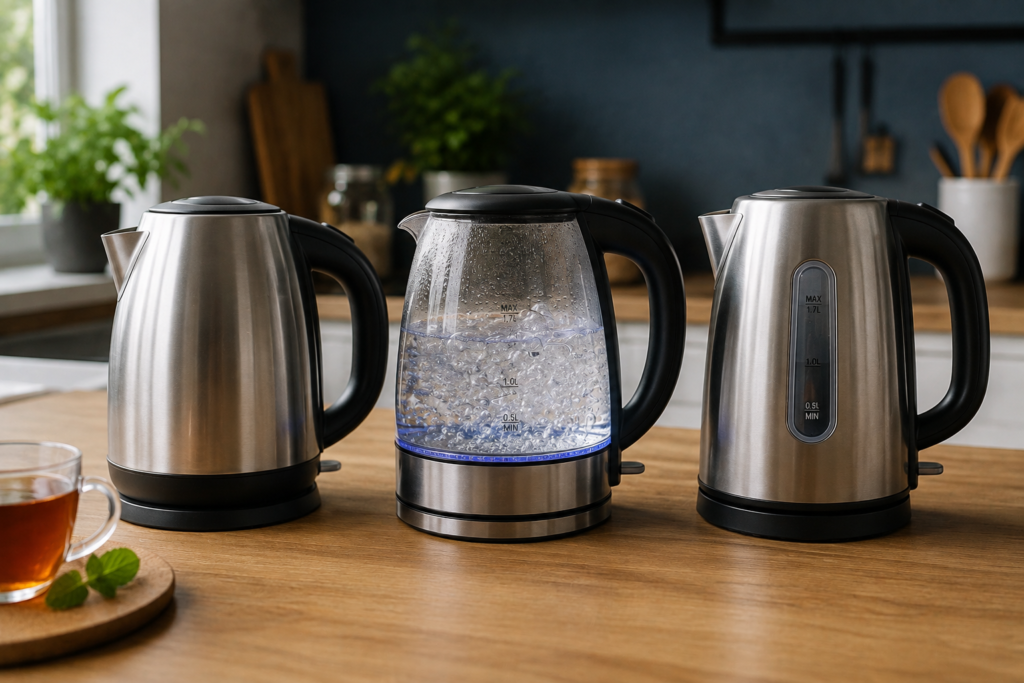
Stainless steel holds up better long-term and resists chips and cracks that glass kettles are prone to after a drop or a hard knock against the faucet. Glass lets you watch the boil, which some people genuinely prefer for the ritual of it, and it shows mineral buildup more obviously — which is either a helpful reminder to descale or a minor annoyance, depending on how you look at it. I lean stainless for durability, especially in hard water regions where scale buildup happens faster and glass shows every bit of it.
If your morning routine includes coffee too, our coffee maker comparison pairs naturally with this. For the physics behind resistive heating, Wikipedia’s electric kettle overview covers the basics.
THE BOTTOM LINE
Just want hot water fast for coffee or black tea → a simple 1500W kettle with auto shut-off is all you need. Drink varied teas that need precise temps → the variable-temp model earns its extra $15-25. Either way, a concealed heating element is the spec that determines whether it’s still working in three years.
Cheers, Kazaan.
Pingback: Drip Vs Espresso Vs Pod Coffee Maker: Which Fits You?