
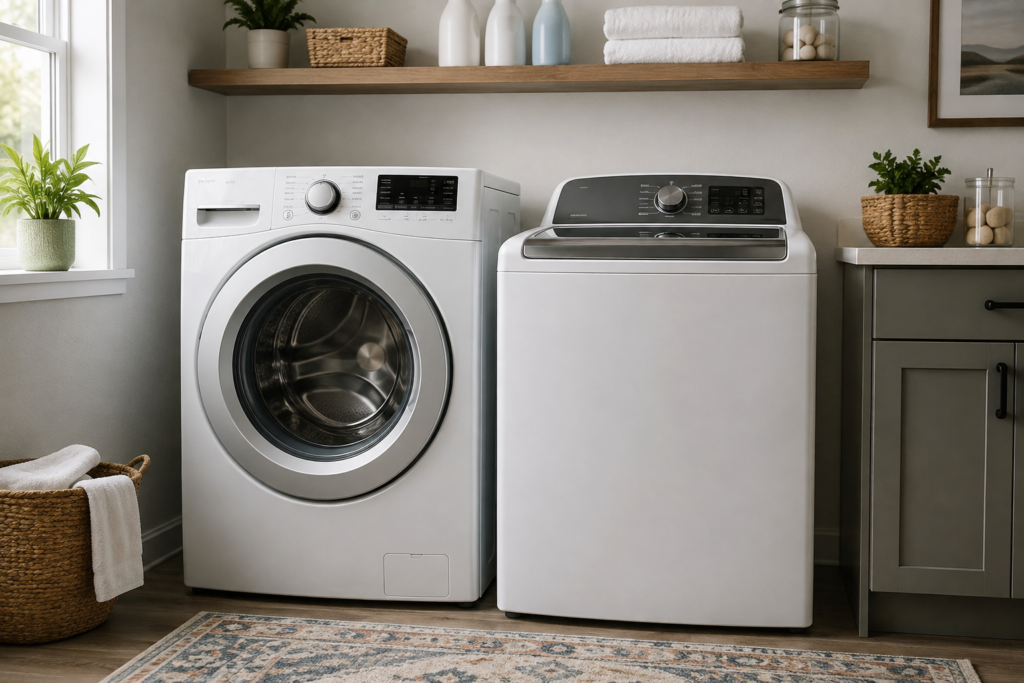
The upfront price gap between front-load and top-load washers is real. What most people never calculate is the five-year gap — and that number tells a completely different story. This front-load vs top-load washer comparison is about five-year cost, not just the price tag on day one.
This post contains affiliate links. If you click and buy, I may earn a small commission — at no extra cost to you.
Water and Energy Use Isn’t Close
Front-load washers use gravity and tumbling instead of a deep water-filled tub, which cuts water use by roughly 30-40% compared to a traditional top-load agitator model, and energy use drops with it since less water needs heating. Over five years of weekly laundry, that difference shows up on your utility bill in a way the sticker price never mentions.
👉 Samsung 4.5 Cu. Ft. HE Front Load Washer with Vibration Reduction — $729.00
Front-load wins on water and energy use, and the vibration reduction here is what keeps it from walking across the laundry room on spin cycle.
Check Price on Amazon →
The Maintenance Cost Nobody Mentions at the Store
Front-load machines need the door left open between cycles and a monthly drum-clean cycle, or you’ll deal with mold and odor around the rubber gasket — this is the single most common complaint I’ve seen with this category. Top-load machines don’t have this issue at all, since there’s no sealed rubber gasket trapping moisture. If you know you won’t stay on top of that maintenance, factor it in honestly.
👉 Kenmore 4.4 Cu. Ft. Top Load Washer, Triple Action Agitator — $849.99
The agitator is the old-school choice for a reason — it’s rougher on delicate fabric but nothing beats it for heavily soiled loads.
Check Price on Amazon →
Wash Time and Fabric Care
Front-load cycles run longer — often 60-90 minutes versus 30-45 for top-load — but they’re gentler on fabric since there’s no center agitator twisting clothes. High-efficiency top-load machines split the difference: no agitator, faster cycles than front-load, but slightly less water efficiency. If cycle time matters more to your routine than efficiency, HE top-load is worth a look.
👉 Kenmore 4.5 Cu. Ft. Top Load Washer, Triple Action Impeller — $849.99
Same top-load convenience, no agitator post — gentler on clothes, closer to front-load performance without giving up the top-load habit.
Check Price on Amazon →
Front-Load vs Top-Load Washer: My Actual Recommendation
High laundry volume, care about long-term utility costs, willing to do monthly gasket maintenance → front-load. Want simplicity, faster cycles, zero maintenance routine, or you’re not precious about it → top-load, ideally HE without an agitator. Don’t just compare sticker prices — compare what you’ll actually pay and do over five years.
Detergent Matters More Than People Think
Whichever side of the front-load vs top-load washer decision you land on, using the wrong detergent undermines both. Front-load machines need HE (high-efficiency) detergent — regular detergent creates too many suds in a low-water system, which can actually leave residue on clothes and strain the machine’s drain pump over time. Top-load machines are more forgiving, but HE detergent still performs better even there, since it’s formulated to rinse cleaner with less water overall.
Load size discipline matters too. Overloading a front-load washer is one of the most common causes of premature bearing wear, since clothes need room to tumble freely for the drum design to work as intended.
Fabric Wear Is Real, Not Marketing
Front-load washers are genuinely gentler on clothes — no center agitator means less mechanical stress on fabric across hundreds of cycles, which matters more than people assume until they notice how much longer their good t-shirts and towels last. Top-load agitator models are harder on fabric by design; that same aggressive motion is what makes them faster and more effective on heavily soiled loads, so there’s a real tradeoff, not just a downside.
If you do a mix of delicates and heavily soiled work clothes, an HE top-load with an impeller instead of an agitator is often the best middle ground — gentler than a traditional agitator, faster cycles than most front-load machines.
The Mold Smell Problem, Honestly
It’s common enough that this front-load vs top-load washer comparison has to address it directly. Leaving the door cracked open between loads and running a monthly drum-clean cycle with hot water prevents most of it — the smell comes from trapped moisture in the rubber door gasket, not a design flaw exactly, just a maintenance requirement nobody mentions at the store. Top-load machines don’t have this issue at all since there’s no sealed gasket trapping moisture, which is genuinely the strongest argument in their favor if you know you won’t stay on top of maintenance.
Pairing this with a dryer purchase? Our dishwasher buying guide uses the same cost-over-time logic worth applying here. For the mechanics behind each washer design, Wikipedia’s washing machine overview is a solid reference.
THE BOTTOM LINE
Front-load costs more upfront but saves real money on water, energy, and detergent over 5+ years. Top-load wins on speed, simplicity, and repair cost if you’d rather not do that math.
Cheers, Kazaan.