
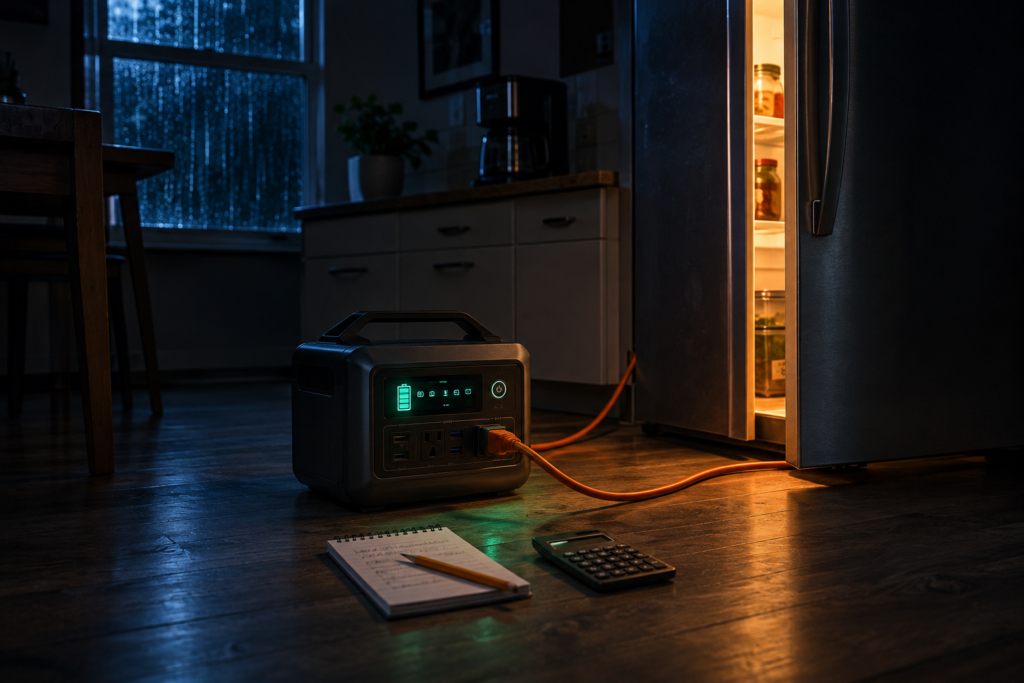
A 1,000 Wh power station sounds like days of backup for a refrigerator. Run the numbers and it’s closer to 16 hours.
This post contains affiliate links. If you click and buy, I may earn a small commission, at no extra cost to you.
Watts and Watt-Hours Answer Two Different Questions
Think of a water tank and a pipe. Watt-hours (Wh) are the tank: how much energy is stored. Watts (W) are the pipe: how much the unit can push out at once. A refrigerator asks both questions, and the box usually only advertises the flattering one.
The pipe question first. According to Anker’s sizing guide, a refrigerator draws roughly 100 to 200 W while its compressor runs. The trouble is the start. The compressor can briefly need several times its running wattage, from a few hundred watts to more than 1,000 W. For many full-size refrigerators, Anker suggests an inverter rated at least 1,500 W continuous, with a surge rating well above that.
The stations people are buying right now clear that bar. Adorama’s listing gives the EcoFlow DELTA 3 Classic 1,800 W continuous, 3,600 W surge and 2,600 W with X-Boost. Jackery lists the Explorer 1000 v2 at 1,500 W, and Amazon’s listing puts its peak at 3,000 W. So the pipe is rarely your problem. The tank is.
The Runtime Math
Here’s the three-step calculation. It follows the one in Anker’s guide, with my assumptions flagged.
Step 1: Find the real average load. Take the annual kWh on the EnergyGuide label, divide by 365, then by 24. Direct Energy uses about 350 kWh a year for a modern ENERGY STAR refrigerator. That’s about 0.96 kWh a day, an average of roughly 40 W, because the compressor cycles on and off. The 100 to 200 W figure only applies while it’s running.
Step 2: Subtract the station’s own losses. An inverter wastes some energy turning battery power into household power, and the station draws a little just by being switched on. Neither number is printed prominently. I assume 85% efficiency and a 15 W idle draw. Both are my assumptions, not measurements of any product. The 15 W idle figure is the one Anker uses in its worked example.
Step 3: Divide. Runtime = battery Wh × 0.85 ÷ (40 W + 15 W).
| Example calculation, using my assumptions | Estimated fridge runtime |
|---|---|
| 292 Wh (the size of the Jackery Explorer 300) | about 4.5 hours |
| 1,024 Wh (EcoFlow DELTA 3 Classic and Jackery Explorer 1000 v2) | about 15.8 hours |
| 2,048 Wh (the size of the DJI Power 2000) | about 31.7 hours |
The table is an example calculation, not a test result. The capacities come from the Amazon listings for those models.
Run the same formula for longer outages and you get roughly 1,550 Wh of battery for one day, 3,100 Wh for two days and 4,650 Wh for three days, before any margin. Anker recommends adding 20 to 30% on top. So a 1 kWh station isn’t a weekend. It’s a night and most of a day.
Your real number will differ. A hot kitchen, frequent door openings and an older refrigerator all push the average load up. So measure before you buy. A plug-in meter logs your refrigerator’s actual draw over a full day.
👉 P3 P4400 Kill A Watt Electricity Usage Monitor
Plug the fridge into it for 24 hours and read the kWh, which replaces my 40 W assumption with your number. The catch: the listing says it’s designed for 115-volt appliances, which is fine for a refrigerator and useless for a dryer or range.
What Food Safety Says About How Much You Need
Here’s the part that changes the purchase. The USDA’s emergency food safety fact sheet (archived copy) says a refrigerator holds its temperature for about 4 hours in an outage, a full freezer for about 48 hours and a half-full freezer for about 24 hours, as long as the doors stay closed. The source describes those as estimates.
Read that as a floor. A power station doesn’t buy you the first four hours. You get those free. It buys you the time between four hours and the end of the outage.
That gives you a clean way to decide whether you need one at all. If outages in your area usually last under four hours, you don’t need a station for the fridge. Keep the doors shut. If they run four to twenty-four hours, you’re in the 1 to 1.6 kWh range from the math above. For two days, you’re near 3.1 kWh before margin, and for three days near 4.7 kWh. Past that, you’re looking at recharging the station, not just buying one.
A full freezer holds temperature longer than a half-full one, according to the same USDA numbers. That’s free backup, and it costs nothing to keep the freezer full.
What the Two Common Picks Actually Give You
Both stations below have a 1,024 Wh LiFePO4 battery, so both give you roughly the same 16 hours on a refrigerator by my math. The difference is in everything else.
The EcoFlow DELTA 3 Classic is the stronger of the two on paper: 1,800 W continuous, 3,600 W surge and a 10 ms UPS switchover, per Adorama’s listing. It weighs 26.68 lb.
👉 EcoFlow DELTA 3 Classic Portable Power Station, 1,024 Wh, 1,800 W AC
1,800 W continuous with a 3,600 W surge and X-Boost up to 2,600 W for heavier loads. The catch: 1,024 Wh is still only about 16 hours of refrigerator by my math, and at 26.68 lb it’s the heavier of the two.
The Jackery Explorer 1000 v2 has the same capacity but a lower output. Jackery’s page lists 4,000 charge cycles, and Amazon’s listing gives 1,500 W with a 3,000 W peak, a weight of 23.3 lb and two AC ports. That last number sounds like a footnote until the night you want the fridge, a lamp and a charger running at once.
👉 Jackery Explorer 1000 v2 Portable Power Station, 1,024 Wh, 1,500 W
4,000 rated charge cycles, 1,500 W (3,000 W peak) and 23.3 lb. The catch: only two AC ports, and a lower continuous rating leaves less headroom if you add anything that heats.
One more thing. Every extra load comes off the same tank. A 55 W fridge plus another 100 W of lights, a router and phone chargers cuts your runtime by roughly two thirds. The tank doesn’t know which device matters more to you.
What I Would Not Buy
I wouldn’t buy a station in the 300 Wh class for a refrigerator. At about 4.5 hours in the table above, it barely beats the free closed-door window. Stations that size are popular and good for a weekend trip. They’re a poor fit for this job.
I wouldn’t shop by the surge number on the box. A surge rating tells you whether the unit can start the compressor. It tells you nothing about how long it keeps running afterward.
I wouldn’t trust any listing that gives a runtime without saying what load it assumed. “Powers a fridge for 24 hours” depends entirely on which fridge and how the math was done.
And I wouldn’t buy a station for an older refrigerator without measuring it first. If the fridge is aging, the year-seven problem covers why appliances fail around then, and if you’re shopping for a new one, the French door refrigerator buying guide is where I’d start.
THE BOTTOM LINE
Size a power station by watt-hours, not by the number on the front of the box. Measure your fridge’s real load, apply 85% efficiency and an idle draw, add a 20 to 30% margin, and compare that to how long your outages actually run. About 1 kWh covers a night and part of a day. Anything longer needs more capacity, and food safety guidance means the first four hours are free.
Sources: Anker, how long a power station runs a refrigerator · Direct Energy, refrigerator electricity use · Adorama, EcoFlow DELTA 3 Classic specs · Jackery, Explorer 1000 v2 · USDA FSIS, food safety in emergencies (archived)
Cheers, Kazaan.