
- Pint Rating Is a Lab Number, Not a Real-World Promise
- Two Different Technologies, Two Different Jobs
- The Drainage Question That Determines Daily Effort
- Dehumidifier Buying Guide: My Actual Recommendation
- Where You Place It Changes Everything
- How a Dehumidifier Actually Affects Your AC Bill
- The Signs You Actually Need One
Pint capacity is the number on every dehumidifier box, and it’s also the number most people completely misread. Here’s what it actually means, and what to check instead.
This post contains affiliate links. If you click and buy, I may earn a small commission — at no extra cost to you.
Pint Rating Is a Lab Number, Not a Real-World Promise
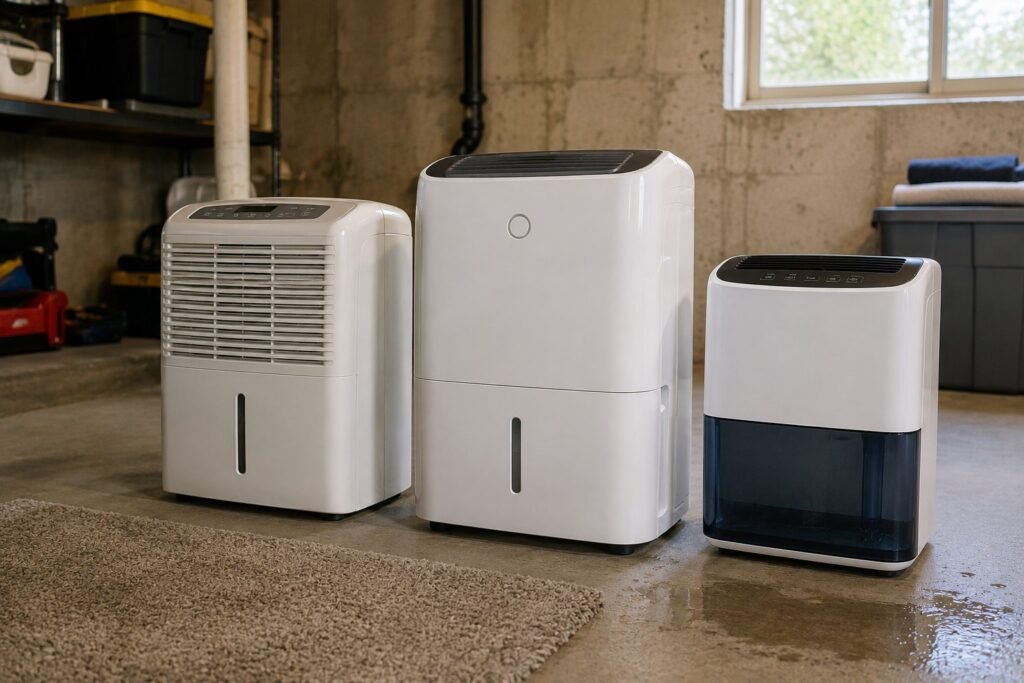
A “50-pint” dehumidifier is tested at 80°F and 60% humidity — ideal conditions. In a real basement at 65°F, the same unit removes noticeably less moisture, sometimes 30-40% less. This is why people buy a 50-pint unit for a damp basement and still feel like it’s not working. Size up from what the box suggests if your space runs cool, which most basements do.
👉 Waykar 6000 Sq.Ft Dehumidifier for Basement, 120 Pint/Day — $245.98
This is the size-up move I’m talking about — rated well above what a typical basement needs on paper, so it still performs once real-world humidity and cooler temps eat into its output.
Check Price on Amazon →
Two Different Technologies, Two Different Jobs
Compressor-based dehumidifiers are the standard choice and work well in normal room temperatures. Desiccant dehumidifiers use a moisture-absorbing material instead of refrigeration, and they actually perform better in cold spaces (below 65°F) where compressor units struggle. If you’re dehumidifying an unheated basement or garage in cooler months, desiccant outperforms compressor units despite lower pint ratings on paper.
👉 Ivation 19 Pint Small-Area Desiccant Dehumidifier — $299.99
The desiccant pick for unheated spaces — keeps pulling moisture even when the temperature drops below what a compressor unit can handle.
Check Price on Amazon →
The Drainage Question That Determines Daily Effort
A manual bucket needs emptying every 1-2 days in a genuinely damp space — and if you forget, the unit shuts off automatically, so you lose dehumidifying time. A continuous drain hose (gravity or built-in pump) removes that chore entirely. If the space is a basement near a floor drain, spend the extra $30-40 for pump drainage — it’s the single upgrade that makes the appliance actually low-maintenance.
👉 Amazon Basics 50-Pint Dehumidifier with Built-In Pump — $260.99
Skip the bucket entirely — the built-in pump pushes water uphill through a hose, which matters if your drain isn’t below the unit.
Check Price on Amazon →
Dehumidifier Buying Guide: My Actual Recommendation
Cool basement, ongoing moisture problem → desiccant or compressor unit sized one tier above the “rated” square footage, with continuous drainage. Warm room, occasional humidity, closet or bathroom → smaller compressor unit, manual bucket is fine. Match the technology to the temperature of the room, not just the square footage on the label.
Where You Place It Changes Everything
Even the right unit underperforms in the wrong spot. Keep it at least 6 inches from walls for proper airflow, and place it centrally in the room rather than in a corner, where air circulation is weakest. Closing doors to isolate the space you’re actually trying to dry also speeds things up significantly — running one unit for an entire open basement takes far longer than isolating the damp section.
Noise level is worth checking too if the unit will run in a finished basement you actually spend time in — compressor units tend to run louder than desiccant models, especially on higher fan settings. Filter maintenance is another detail people skip — a clogged intake filter forces the compressor to work harder for the same result, quietly driving up your electric bill while the unit still runs. A monthly rinse under the sink takes two minutes and keeps it operating at rated capacity, and it’s the kind of small habit that pays for itself many times over across a full damp season.
How a Dehumidifier Actually Affects Your AC Bill
Running a dehumidifier alongside your AC can indirectly lower your cooling costs — drier air feels cooler at the same thermostat setting, so a lot of people end up nudging their AC up a degree or two once the dehumidifier is running, without sacrificing comfort. The dehumidifier itself does use electricity, roughly 300-700 watts depending on size and compressor type, so the net savings depend on how much you actually adjust your AC afterward. In genuinely humid climates, most people come out ahead; in already-dry climates, a dehumidifier is solving a problem you may not have.
A cheap hygrometer, usually under $15, takes the guesswork out of this entirely — track the room for a week before buying anything, and you’ll know exactly whether you have a real humidity problem or just a stuffy-feeling room.
The Signs You Actually Need One
Musty smell, visible condensation on windows or pipes, or a hygrometer reading consistently above 55% are the clearest signs. I’m assuming you’ve already noticed at least one of those rather than buying preemptively. Persistent humidity above 60% is also where mold and dust mites thrive, so if you’re dealing with allergy symptoms that seem to spike indoors, a dehumidifier is worth trying before assuming it’s something else entirely.
Running both a dehumidifier and an AC in the same space? Our portable AC buying guide explains how the two interact. For how the underlying refrigeration cycle works, Wikipedia’s dehumidifier overview is a good starting point.
THE BOTTOM LINE
The pint-per-day number on the box is measured at a lab standard your basement will rarely match. Size the unit to your square footage and real humidity level, not the rating alone.
Cheers, Kazaan.